
Did 3I/ATLAS Explode?
A sudden wave of online reports has claimed that 3I/ATLAS, the interstellar object tracked through late 2025, catastrophically exploded—scattering debris on a direct path toward Earth. Within speculative analysis, the scenario is dramatic. Within verified science, it demands careful qualification.
What follows is not a declaration of confirmed impact risk, but a structured examination of what such an event would imply if fragmentation were observed, and why interstellar objects challenge planetary-defense assumptions.
The Reported Event: Fragmentation at Close Solar Approach
In this scenario, observers reported a rapid brightening event on December 3, followed by an apparent dispersal of material around 3I/ATLAS. Such behavior—sudden luminosity increase and fragment separation—has precedent among comets and comet-like bodies experiencing thermal stress near the Sun.
Data attribution in online narratives often points to instruments associated with the James Webb Space Telescope. In reality, Webb is optimized for infrared spectroscopy and distant targets; while it can detect changes in brightness and composition, confirming explosive fragmentation requires corroboration from multiple platforms.
At present, no public statement from NASA confirms an explosion or Earth-bound debris.
What “Explosion” Means in Astronomical Terms
In astronomy, an “explosion” rarely implies detonation. More often, it refers to fragmentation—the structural failure of a body due to thermal gradients, internal volatile pressure, or rotational stress.
If 3I/ATLAS fragmented, the most likely causes—within known physics—would include:
Rapid heating of volatile-rich regions
Structural weakness in an object formed outside Solar System norms
Differential stress as solar radiation penetrated unfamiliar material layers
None of these mechanisms imply intent, propulsion, or artificial design.
Debris Trajectories and Earth Risk
A critical distinction is often lost in viral framing: fragmentation does not equal collision course.
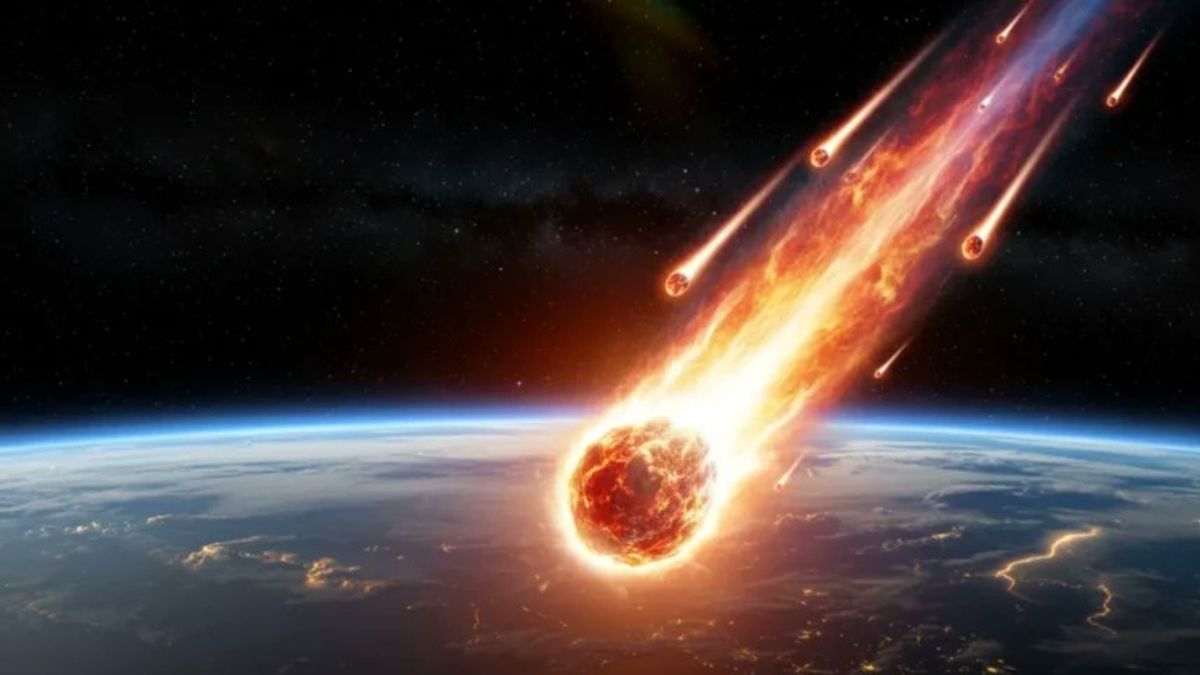
Even if 3I/ATLAS broke apart, the overwhelming majority of fragments would continue along trajectories close to the parent body’s original hyperbolic path—away from Earth. For debris to threaten Earth, fragments would need precise velocity changes aligned with Earth’s orbital position.
Planetary-defense models show that such alignment is statistically unlikely, especially for small fragments subject to radiation pressure and rapid dispersion.
Claims of debris “on a direct path toward Earth” remain unsupported by public orbital solutions.
Mars and the Inner Solar System
Some speculative narratives suggest fragments may have intersected the orbital region of Mars. Even if true, the Martian atmosphere and vast orbital distances involved make significant impact effects improbable.
Small interstellar fragments would likely ablate harmlessly, contributing little more than transient meteoric events—valuable scientifically, but not climatically disruptive.
Why Interstellar Objects Feel More Dangerous
The anxiety surrounding 3I/ATLAS is not about size—it is about origin.
Interstellar objects are:
Chemically unfamiliar
Structurally unconstrained by Solar System formation models
Poorly sampled (only a handful detected so far)
This uncertainty amplifies fear, even when physical risk remains low.
The Scientific Opportunity—If Fragmentation Occurred
Within speculative but plausible science, fragmentation would be a windfall, not a disaster.
Debris from an interstellar object could:
Reveal pristine chemistry from another stellar system
Offer insight into exoplanetary formation environments
Expand models of volatile behavior beyond Solar System norms
Such material would not “alter the Solar System,” but it could significantly alter our understanding of cosmic chemistry.
Planetary Defense: A Real Conversation, Not a Panic
Interstellar objects do raise legitimate questions for planetary defense—not because they are more dangerous, but because they are less predictable.
Current systems are designed around Solar System populations. Interstellar bodies move faster, appear with less warning, and behave differently. That gap is scientific, not existential.
Conclusion: Fragmentation Is Not Confirmation of Threat
There is no verified evidence that 3I/ATLAS exploded in a way that endangers Earth. What exists is a convergence of:
Limited data
High public interest
Narrative amplification
Within disciplined science-fiction analysis, the scenario serves as a reminder: the universe is not obligated to behave according to our expectations.
Interstellar objects will continue to surprise us—not as harbingers of disaster, but as messengers from environments we are only beginning to understand.
And the real challenge is not debris—it is interpretation.
