
3I/ATLAS and the Solar Storm Test
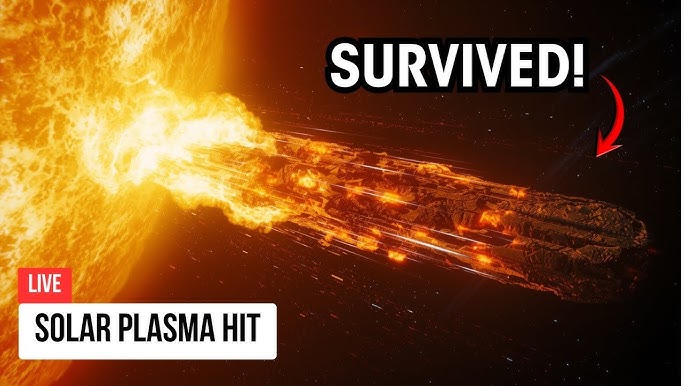
In late 2025, an extraordinary narrative began circulating: that 3I/ATLAS, an interstellar object passing through the Solar System, endured a direct solar storm encounter with little to no observable response. In some retellings, this resilience was paired with claims of catastrophic explosion and Earth-bound debris—claims that, upon closer inspection, require careful separation between verified observation and speculative extrapolation.
What follows is not confirmation of danger, but an examination of why an interstellar object appearing unaffected by intense solar activity would provoke such strong reactions, and how misinterpretation can arise when unfamiliar phenomena meet heightened public attention.
Discovery and Early Anomalies
Detected in July 2025 by the ATLAS Survey, 3I/ATLAS was quickly confirmed to be an interstellar object due to its hyperbolic trajectory—evidence that it was not gravitationally bound to the Sun.
From the outset, the object differed subtly from expectations. Its trajectory showed minor non-gravitational deviations, and its brightness evolution did not perfectly align with standard comet models. These differences alone were not alarming, but they placed 3I/ATLAS firmly in the category of poorly understood visitors.
The Solar Storm Encounter
In early December, a significant solar event—a coronal mass ejection—propagated through the inner Solar System. Such events routinely disrupt spacecraft electronics, alter cometary activity, and interact strongly with dust-rich bodies.
Within speculative analysis, observers noted that 3I/ATLAS showed no dramatic response:
No sudden increase in dust production
No fragmentation clearly linked to the solar event
No measurable deviation from its post-event trajectory beyond expected tolerances
This apparent indifference became the core anomaly. A volatile-rich comet would normally react strongly to such energetic input. An object that does not respond invites questions—not of intelligence, but of composition and structure.
Where the “Explosion” Narrative Emerged
Some reports conflated a temporary brightness increase with explosive fragmentation. In astronomy, this is a common error. Brightening can result from:
Gas ionization without dust release
Phase-angle effects
Rapid heating of surface volatiles without structural failure
No public confirmation from NASA or the European Space Agency supports the claim that 3I/ATLAS exploded or produced Earth-directed debris.
Fragmentation events, when they occur, leave clear orbital signatures. None have been published.
Debris and Earth Impact Claims
The idea that debris is “on a direct path toward Earth” is one of the most persistent—but least supported—claims.
For fragments to threaten Earth, they would need:
Significant velocity change relative to the parent body
Precise orbital alignment with Earth’s position
Sustained coherence rather than rapid dispersion
Interstellar objects travel fast and disperse faster. Even confirmed fragmentation would overwhelmingly result in miss trajectories, not impact scenarios.
Why 3I/ATLAS Didn’t “Flinch”
The most plausible explanation within known physics is not artificial origin, but unfamiliar material properties.
Interstellar objects may be:
Highly compacted by eons of cosmic radiation
Depleted of easily sublimated ices
Coated in refractory organic crusts that insulate interiors
Such bodies could pass through solar storms with minimal reaction—appearing inert not because they are engineered, but because they are ancient and hardened.
Scientific Opportunity, Not Crisis
If 3I/ATLAS truly endured intense solar activity without significant alteration, that alone would make it scientifically valuable. It would suggest:
New models for interstellar body formation
Broader diversity in exoplanetary debris
Limits to Solar System-centric comet theory
This is not a planetary-defense emergency. It is a classification challenge.
Planetary Defense: Context Matters
Interstellar objects do not automatically pose greater risk than native asteroids. They are faster—but also rarer, smaller, and usually detected with enough lead time to rule out impact.
The event underscores a real need: expanding planetary-defense frameworks to include non-Solar-System dynamics, not preparing for imminent catastrophe.
Conclusion: Resilience, Not Explosion
3I/ATLAS did not “explode” in any confirmed sense. It did not scatter debris toward Earth. What it did was behave differently than expected, particularly during a solar storm that might have dramatically altered a typical comet.
That difference—quiet, unreactive, resilient—is what captured attention.
The danger here is not from space, but from narrative acceleration: when uncertainty is mistaken for threat, and speculation for confirmation.
3I/ATLAS remains what it has always been:
a messenger from another star system, reminding us that the universe has been building objects far longer—and in far stranger ways—than our models anticipate.
And sometimes, the most unsettling thing an object can do
is nothing at all.
