
Scientists Scramble as James Webb Detects Something So Strange It Could Rewrite Our Understanding of the Universe
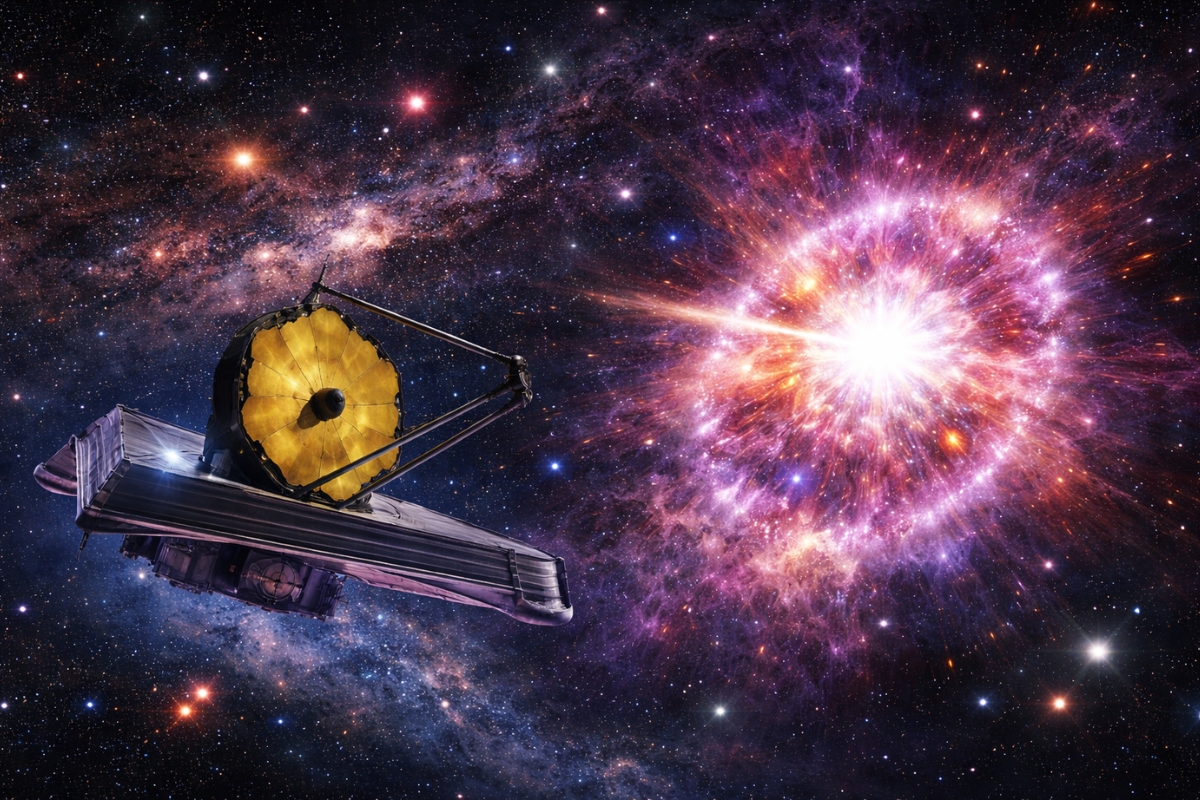
The internet may love dramatic headlines, but every so often a telescope genuinely delivers discoveries that feel almost unimaginable, and that is precisely what has happened since the launch of the James Webb Space Telescope. When it began returning its first deep-space images, scientists expected remarkable results, but they did not anticipate how quickly the data would challenge long-standing ideas about the early universe, revealing galaxies that appeared far older, brighter, and more massive than existing theories predicted. For decades, astronomers believed the earliest galaxies formed slowly after the Big Bang, beginning as small gas clouds that gradually merged over hundreds of millions of years, yet Webb has detected massive, surprisingly organized galaxies already shining just a few hundred million years after the universe began—cosmically speaking, almost yesterday.
Using its powerful infrared instruments, Webb can peer through cosmic dust and observe extreme distances, effectively acting as a time machine that allows scientists to study the universe’s infancy, where they expected faint, chaotic structures but instead found mature systems resembling fully formed cities rather than primitive villages. These findings do not break the laws of physics, but they suggest that stars may have formed more rapidly, galaxies may have merged faster, or dark matter may have played a more influential role in early cosmic structure than previously assumed. Webb has also begun uncovering chemical clues pointing to early generations of stars enriching galaxies with heavy elements sooner than expected, implying that the ingredients for planets and life may have emerged earlier in cosmic history. Alongside these revelations, the telescope has delivered some of the most detailed images ever captured, including deep-field views packed with thousands of ancient galaxies—far surpassing what earlier observatories like the Hubble Space Telescope could resolve—thanks to Webb’s ability to detect infrared light stretched by the expansion of the universe. As discoveries continue, from probing the atmospheres of distant exoplanets to reshaping timelines of galaxy formation, scientists emphasize that Webb is not rewriting cosmology overnight but exposing gaps in our understanding, reminding us that every new window into the universe brings surprises, and that the deeper we look into space, the more clearly we see how much remains to be learned about the origins of everything.
