
NASA Shutdown Coincides with 3I/ATLAS’s Close Encounter with Mars — Is This the Cosmic Event We’ve Been Waiting For?
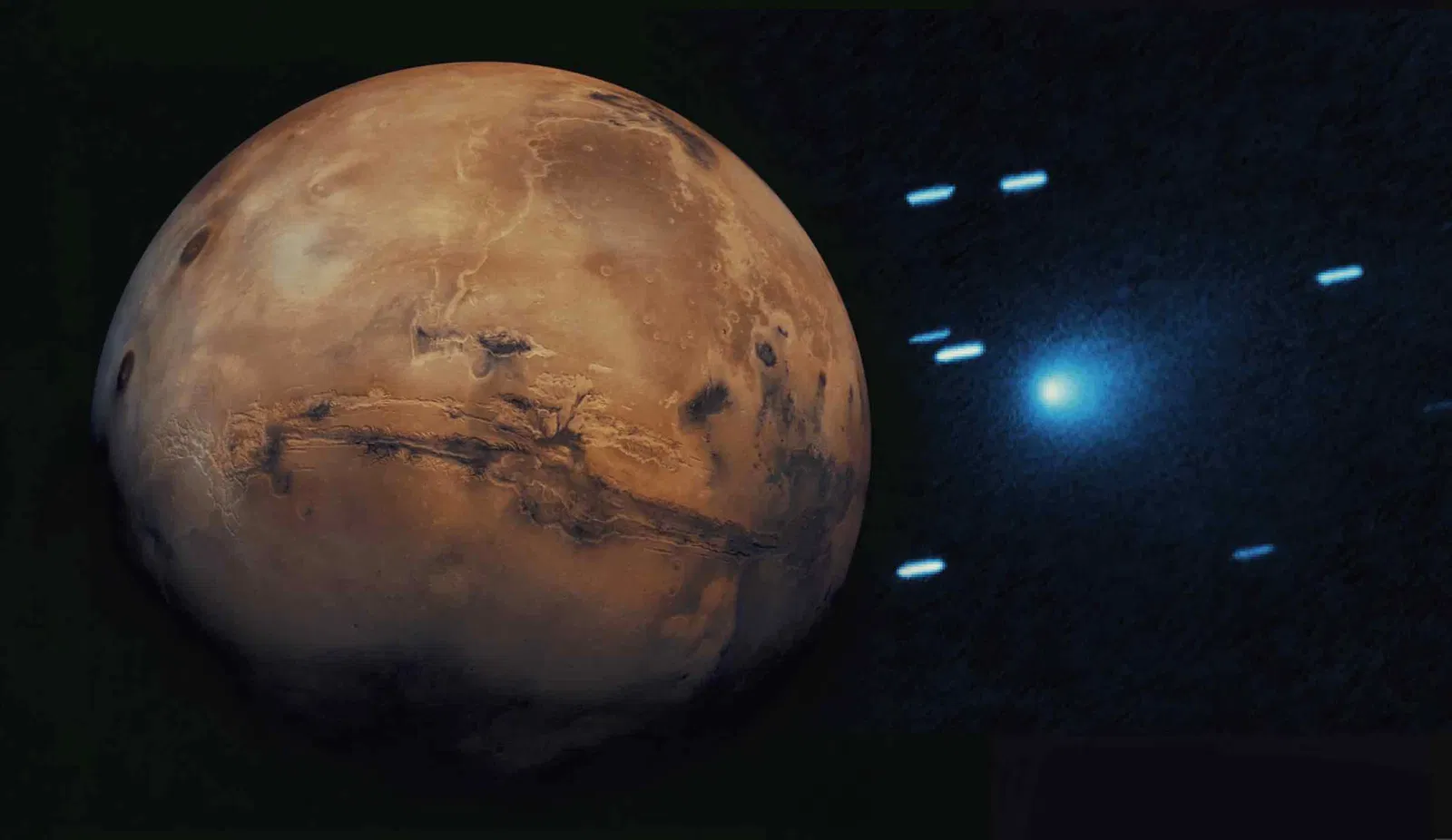
Recent online reports and social media discussions have claimed that the interstellar object 3I/ATLAS made a close approach to Mars around October 3rd, 2025, with some estimates suggesting it passed at a distance of roughly 0.2 astronomical units. While this would be an interesting observational geometry for astronomers, such a distance is still extremely large in planetary terms, posing no physical risk or interaction with the planet. The situation has attracted attention partly because of broader claims about a temporary disruption in U.S. government communications affecting NASA operations; however, there is no verified evidence that such disruptions impacted ongoing deep-space tracking or planetary observation programs.
Independent monitoring from international partners, including the European Space Agency, continues to be the primary source of confirmed observational data. Orbiters around Mars—such as Mars Express and the ExoMars Trace Gas Orbiter—are routinely used to study objects passing through or near the Martian environment, while NASA’s Perseverance Rover provides surface-level imaging of the planet itself, though it is not designed for tracking distant interstellar objects directly.
At present, there is no confirmed scientific evidence supporting extraordinary claims such as anomalous structure, artificial origin, or unusual energy emissions associated with 3I/ATLAS. Most astronomers continue to classify it as an interstellar object being studied for its trajectory, composition, and behavior under solar radiation. While public speculation has linked it to broader theories involving alien technology or unusual alignments, these interpretations remain unverified and are not part of the established scientific consensus.

As with previous interstellar visitors, the primary scientific value of 3I/ATLAS lies in its ability to help researchers better understand material originating beyond our solar system, offering a rare opportunity to study how such objects behave as they pass through planetary environments like that of Mars.
