
Truman Bethurum and the Alien Encounters That Defined the 1950s UFO Era

Truman Bethurum and the Alien Encounters That Defined the 1950s UFO Era
🌌 A Desert Encounter That Changed UFO History
In the early 1950s, during America’s growing fascination with flying saucers and life beyond Earth, a little-known construction worker named Truman Bethurum emerged as one of the most unusual figures of the UFO contactee movement.
Unlike military sightings or radar mysteries, Bethurum’s story was deeply personal: he claimed repeated face-to-face meetings with extraterrestrials — including conversations aboard a flying saucer commanded by a mysterious alien woman.
His accounts became one of the most famous and controversial alien contact stories of the Cold War era.
👤 Who Was Truman Bethurum?


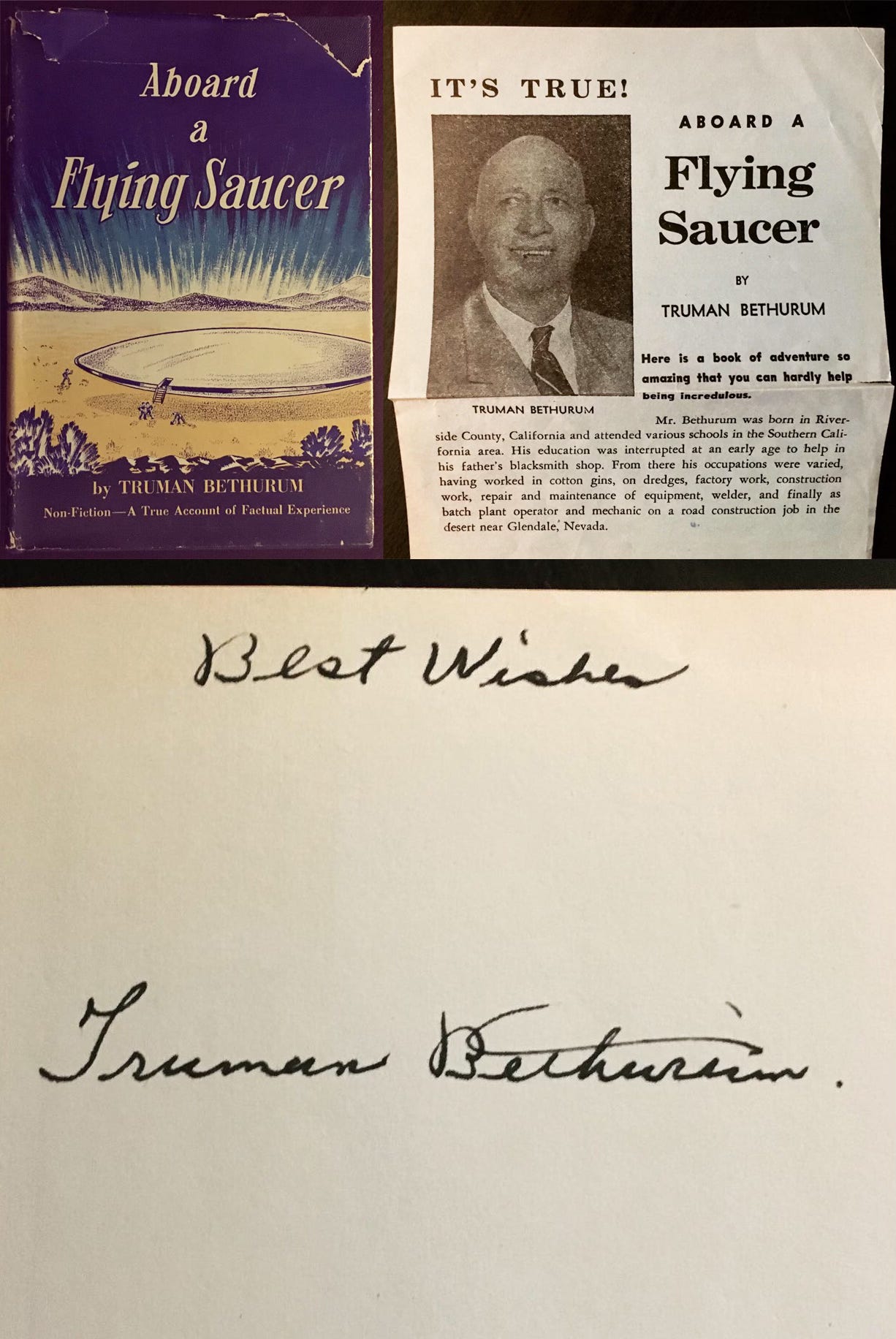
Born in California in 1898, Bethurum lived an ordinary life working various blue-collar jobs. Everything changed, he said, on July 28, 1952, while he was supervising road construction near the Mojave Desert in Nevada.
According to his later testimony:
-
He fell asleep beside heavy equipment.
-
A bright craft descended silently nearby.
-
Humanoid beings awakened him and invited him aboard their spacecraft.
The encounter would launch him into UFO celebrity status almost overnight.
🛸 The Flying Saucer “Admiral’s Scow”
Bethurum claimed the craft was called “The Admiral’s Scow,” a large flying saucer operated by visitors from a hidden planet named Clarion, allegedly located on the far side of the Moon.
Inside the ship, he described:
-
Advanced technology without visible controls
-
Friendly human-like occupants
-
A peaceful society far more advanced than Earth
Most strikingly, he said the ship’s captain was a woman named Aura Rhanes, whom he described as beautiful, calm, and highly intelligent.


Bethurum claimed he met her multiple times during later visits, discussing humanity’s future and the dangers of nuclear weapons — a common theme among 1950s “Space Brother” contact stories.
📖 Aboard a Flying Saucer — The Book That Made Him Famous
In 1954, Bethurum published his autobiography:
Aboard a Flying Saucer


The book presented his encounters as factual experiences rather than fiction. It quickly became popular among UFO enthusiasts and helped define the contactee movement, alongside figures like George Adamski.
Bethurum later founded a spiritual organization called the Sanctuary of Thought, promoting messages he said were inspired by the Clarion visitors.
👽 The Message of the Clarionites
According to Bethurum, the extraterrestrials shared several key ideas:
-
Humanity was being watched by advanced civilizations
-
Nuclear weapons threatened planetary survival
-
Spiritual development was essential for technological progress
-
Peaceful cooperation among nations was necessary
He described the people of Clarion as living in a utopian society without war, disease, or poverty — a reflection of post-World War II hopes and anxieties.
🤔 Skepticism and Controversy
Despite public fascination, scientists and many UFO researchers strongly doubted Bethurum’s claims.
Critics pointed out:
-
No physical evidence was ever verified
-
The proposed planet Clarion contradicts astronomy
-
Witnesses and documentation were limited
Even some UFO investigators of the era dismissed his story as fantasy or exaggeration. Still, Bethurum attracted devoted followers and became a regular speaker at famous UFO gatherings such as the Giant Rock conventions in California.
🌠 Legacy in UFO Culture
Today, Truman Bethurum is remembered as one of the most colorful figures of the 1950s contactee era, a time when UFO stories blended science fiction, spirituality, and Cold War fears.
Whether viewed as:
-
a sincere experiencer,
-
a storyteller shaped by his time, or
-
a pioneer of UFO mythology,
his narrative helped shape modern alien lore — especially the idea of friendly humanoid extraterrestrials guiding humanity.
🧭 Why His Story Still Matters
Bethurum’s story reveals more than a UFO claim; it captures a historical moment when humanity first imagined itself as part of a larger cosmic community.
In an age of nuclear anxiety and rapid technological change, stories like his offered both warning and hope — suggesting that somewhere beyond Earth, wiser civilizations might already exist.
And decades later, the question remains open:
Was Truman Bethurum describing reality, belief, or the dreams of an era reaching toward the stars?
