
Mystery Beneath the Ice: The Truth Behind the 1971 USS Trepang “UFO” Photos
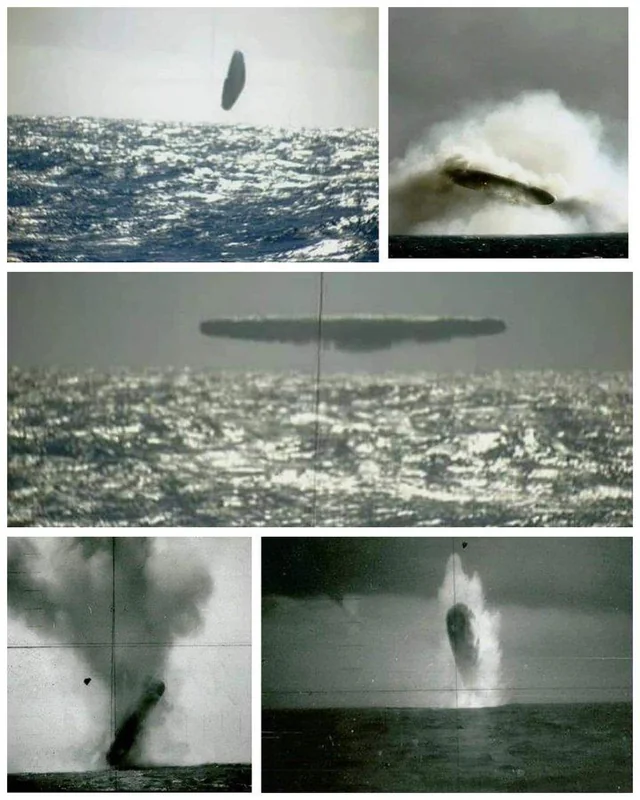
For decades, a series of grainy, black-and-white photographs have circulated in the darker corners of the internet, allegedly showing an extraterrestrial encounter in the Arctic. The story goes that in March 1971, the crew of the USS Trepang (SSN-674), a Sturgeon-class nuclear attack submarine, photographed massive, unidentified craft rising from the frozen depths of the ocean.

But as with most stories that seem “too good to be true,” the reality of the USS Trepang incident is a fascinating blend of Cold War history, naval testing, and digital legend.
The “Leaked” Photographs
The images first gained widespread attention in 2015 when they were published by the French paranormal magazine Top Secret. They appear to show various objects: a cigar-shaped cylinder “tumbling” through the air, a triangular craft, and what looks like a massive saucer-shaped object emerging from the water.
Adding to the mystery, some versions of the photos featured official-looking stamps reading: “Official Photograph. Not to be Released. CT.” and “Unauthorized Disclosure Subject to Criminal Sanction.”

The Forensic Reality: Targets, Not Travelers
UFO researchers, including John Greenewald of The Black Vault, have spent years investigating these frames. Their findings lean toward a much more terrestrial, albeit military, explanation:
-
Naval Target Balloons: In 1971, the USS Trepang was indeed in the Arctic for “extensive weapons testing.” Experts suggest the “cylinders” are actually naval target balloons used by submarines to test sonar and periscope tracking. These balloons were designed to be launched from underwater, where they would bob on the surface or hover just above the water to act as a target for non-explosive practice rounds.
-
The “Tumbling” Effect: The different shapes seen in the photos—from cigars to triangles—are consistent with a single balloon rotating or collapsing as it drifts or is hit.
-
Fata Morgana: The Arctic is famous for a complex optical illusion known as a Superior Mirage or Fata Morgana. This phenomenon can make flat objects on the horizon (like icebergs or low-flying balloons) appear stretched, stacked, or “floating” in impossible shapes.

The Captain Speaks
The most definitive blow to the alien theory came from the men who were actually there. Rear Admiral Dean Sackett Jr., who was the commanding officer of the USS Trepang in 1971, was contacted about the photos. His response was clear: “There were no sightings.” Sackett confirmed the submarine was conducting weapons tests but stated he never saw any unidentified craft. Another officer on board, John Klika, similarly stated that neither he nor any other crew member witnessed anything unusual during the 1971 patrol.

Why the Legend Persists
Despite the denials from the crew and the logical explanation of target balloons, the USS Trepang photos remain iconic. They tap into a deep-seated human fascination with the “Unidentified Submerged Object” (USO)—the idea that the world’s oceans, especially the inaccessible Arctic, could hide bases for non-human intelligence.
Today, while the photos are largely viewed by historians as documented proof of Cold War naval exercises, they continue to serve as a reminder of how easily the “unknown” can be found in the reflection of a periscope.
