
Project Sign: The U.S. Air Force’s First Official UFO Investigation

Project Sign: The U.S. Air Force’s First Official UFO Investigation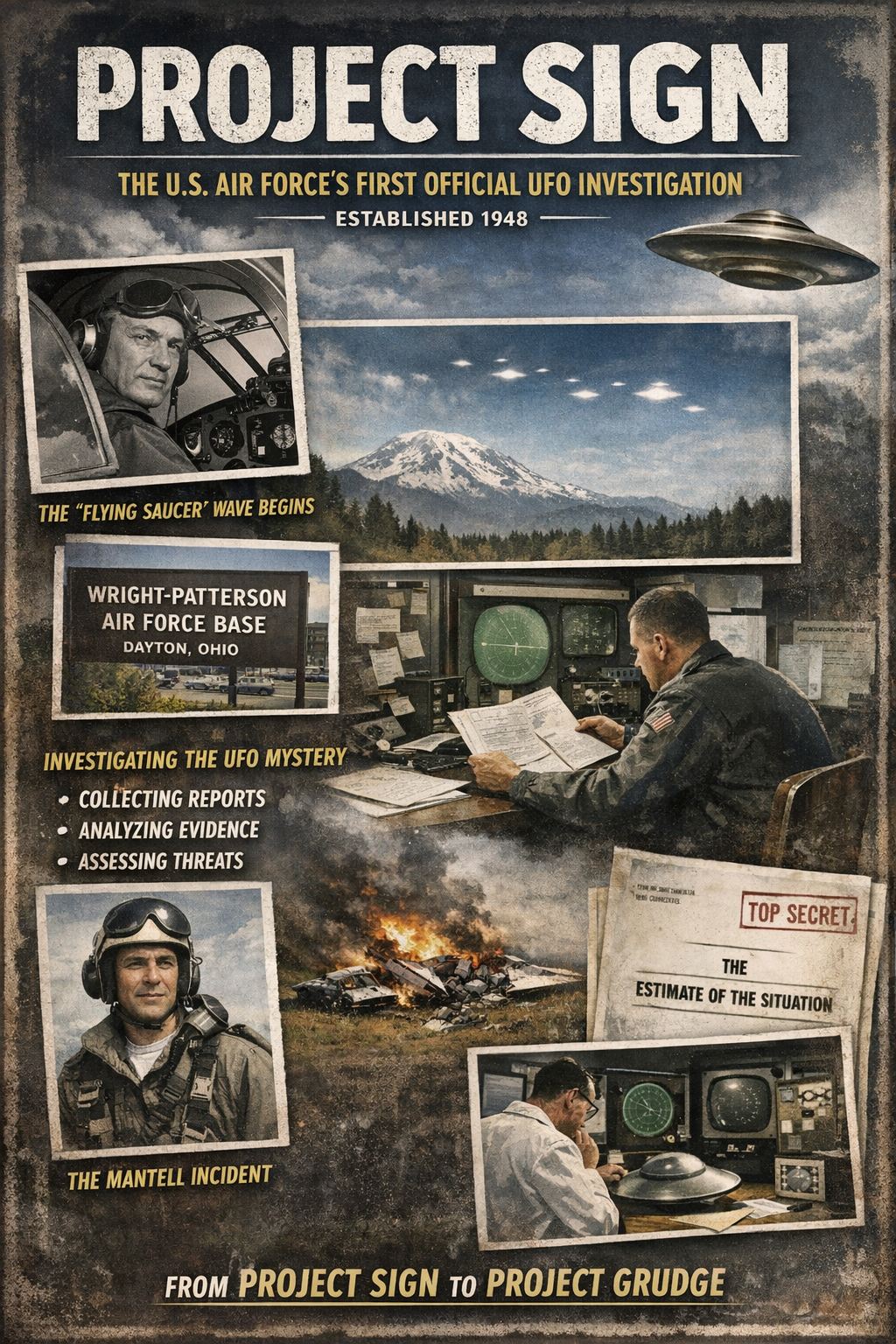
Introduction
In the late 1940s, reports of mysterious flying objects began appearing across the United States. These strange sightings—often described as “flying saucers”—captured public attention and raised concerns within the military. In response, the United States Air Force launched Project Sign, the first official American program dedicated to investigating unidentified flying objects (UFOs).
Created in 1948, Project Sign represented the earliest attempt by the U.S. military to determine whether these unexplained aerial phenomena posed a threat to national security.
Background: The Flying Saucer Wave
The creation of Project Sign followed the surge of UFO sightings that began after the famous Kenneth Arnold UFO sighting. In June 1947, pilot Kenneth Arnold reported seeing nine bright objects flying at extremely high speeds near Mount Rainier in the state of Washington, United States.
The media quickly coined the term “flying saucers,” and within months, hundreds of similar sightings were reported across the country. The growing number of reports led the U.S. Air Force to begin a systematic investigation.
Establishment of Project Sign
Project Sign was officially established in January 1948 and headquartered at Wright-Patterson Air Force Base in Dayton, Ohio.
The mission of the project was to:
-
Collect and analyze UFO sighting reports
-
Determine whether the objects represented advanced foreign technology
-
Evaluate potential threats to U.S. national security
-
Study scientific explanations for unexplained aerial phenomena
Military intelligence officers, engineers, and scientists were assigned to analyze radar data, pilot reports, and eyewitness testimonies.
Early Investigations
Project Sign investigated several notable UFO incidents reported by military pilots and civilians. One of the most famous cases was the Mantell UFO incident.
In January 1948, Thomas Mantell, a pilot with the Kentucky Air National Guard, pursued a mysterious object spotted over Frankfort, Kentucky. During the chase, Mantell’s aircraft crashed after climbing to high altitude without oxygen equipment.
The incident intensified military interest in UFO sightings and reinforced the importance of Project Sign’s investigation.
The “Estimate of the Situation”
One of the most controversial aspects of Project Sign was a classified document reportedly produced by its analysts called the “Estimate of the Situation.”
According to some accounts, the document concluded that certain UFO sightings could not be explained by known aircraft or natural phenomena and suggested the possibility that the objects might be extraterrestrial spacecraft.
However, the report was allegedly rejected by senior Air Force leadership and never officially accepted. The original document has never been publicly found, leading to decades of speculation among UFO researchers.
Transition to Project Grudge
By late 1948, Project Sign was replaced by another investigation called Project Grudge.
Project Grudge adopted a more skeptical approach toward UFO sightings, often attributing reports to misidentified aircraft, weather balloons, or astronomical objects. This later evolved into the well-known Project Blue Book, which ran from 1952 to 1969.
Legacy
Although it lasted only about a year, Project Sign marked the beginning of official U.S. government research into unidentified aerial phenomena. The project established many of the investigative methods later used in UFO research programs.
Today, historians and UFO researchers view Project Sign as the starting point of modern governmental UFO investigation, paving the way for later programs that continued studying mysterious objects in Earth’s skies.
