
The Setka Program: The Soviet Union’s Secret UFO Investigation

The Setka Program: The Soviet Union’s Secret UFO Investigation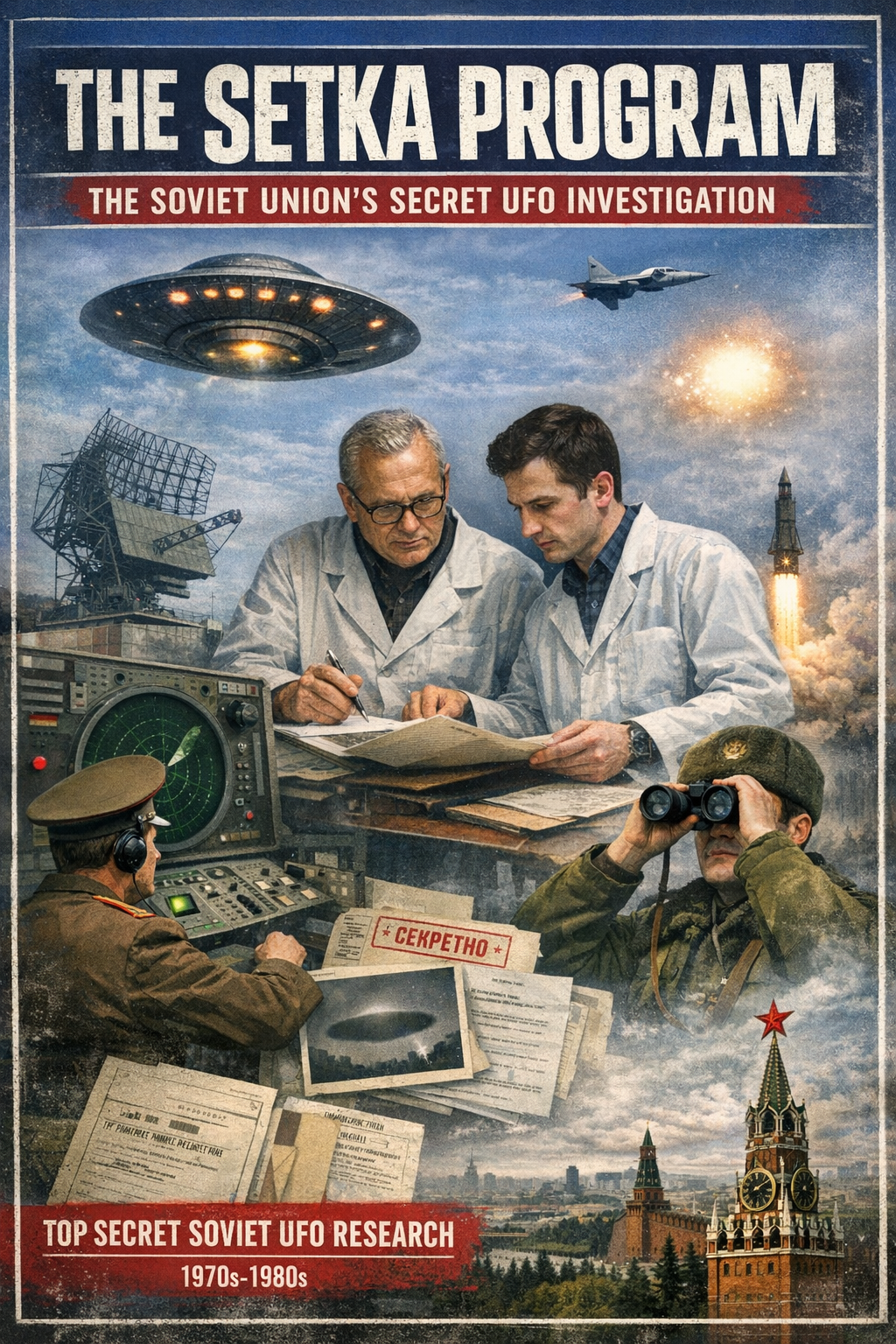
Introduction
During the Cold War, reports of unidentified flying objects were not limited to the Western world. The Setka Program was a secret Soviet initiative established to study mysterious aerial phenomena observed across the Soviet Union.
Launched in the 1970s, the program represented one of the largest government investigations of UFO sightings conducted outside the United States. It involved cooperation between the Soviet military, scientific institutions, and intelligence organizations.
Origins of the Program
The Setka Program emerged after numerous UFO sightings were reported by both civilians and military personnel throughout the Soviet Union. Some sightings were recorded near military bases, radar installations, and missile testing ranges, which raised concerns among Soviet defense officials.
In response, Soviet authorities initiated a coordinated effort to systematically collect and analyze UFO reports. The project was conducted by the Soviet Ministry of Defense in cooperation with the Soviet Academy of Sciences.
Unlike many Western UFO investigations, the Soviet approach emphasized gathering large quantities of observational data from military observers and scientific instruments.
Structure of the Setka Program
The program was divided into two major branches:
Setka MO
Setka MO was managed by the Soviet Ministry of Defense and focused primarily on sightings reported by the military. Its purpose was to determine whether unidentified objects represented foreign surveillance technology or experimental aircraft.
Military radar operators, pilots, and air defense units were required to document unusual aerial phenomena and send reports to central research centers.
Setka AN
Setka AN was managed by the Soviet Academy of Sciences. This branch focused on the scientific study of unexplained aerial phenomena, including atmospheric events, plasma formations, and astronomical objects.
Scientists analyzed patterns in sightings and attempted to determine whether the phenomena had natural explanations.
Data Collection and Investigations
The Setka Program gathered thousands of reports from across the vast territory of the Soviet Union. Investigators examined incidents involving:
-
Bright glowing spheres or discs
-
Objects moving silently at extreme speeds
-
Strange lights hovering over military installations
-
Radar contacts without visible aircraft
Because the Soviet Union maintained an extensive air defense radar network, many sightings were recorded simultaneously by visual observers and radar systems.
Some cases were later explained as ball lightning, rocket launches, satellites, or atmospheric effects. However, a number of reports remained unexplained.
Secrecy and Declassification
For many years, the existence of the Setka Program remained largely unknown outside Soviet scientific circles. Most information about the project was classified during the Cold War.
After the collapse of the Soviet Union in 1991, some documents and testimonies from former researchers became publicly available. These revelations confirmed that the Soviet government had conducted extensive investigations into unidentified aerial phenomena.
Comparison with Western UFO Programs
The Setka Program is often compared with American UFO research initiatives such as Project Blue Book and the Advanced Aerospace Threat Identification Program.
While the United States tended to focus on evaluating whether UFO sightings posed national security threats, the Soviet program emphasized collecting statistical data and scientific observations from across the country.
Both programs reflected the intense technological and military competition of the Cold War era.
Legacy
Although the Setka Program did not produce definitive answers about UFO phenomena, it demonstrated that the Soviet Union took unexplained aerial sightings seriously. The program also contributed to scientific research into atmospheric and plasma phenomena.
Today, the Setka Program remains one of the most fascinating examples of Cold War–era UFO investigations. It highlights how governments on both sides of the geopolitical divide attempted to understand mysterious objects appearing in Earth’s skies.
The project continues to attract interest from historians, scientists, and UFO researchers seeking to uncover the truth behind some of the most puzzling aerial sightings reported during the 20th century. 🛸
