
The Antikythera Mechanism
The Antikythera Mechanism: The Ancient Computer That Defied History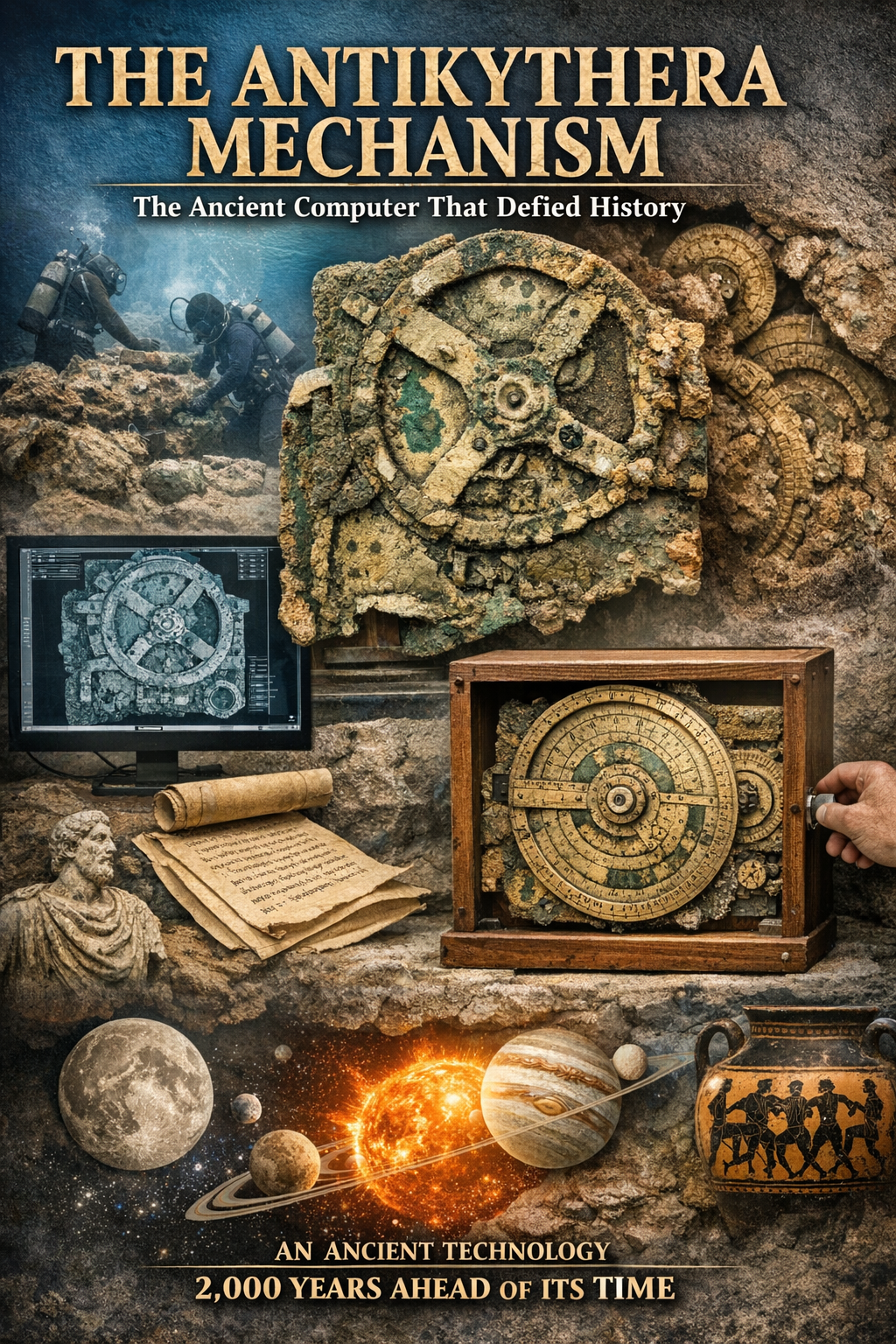
Introduction
In the early 20th century, a remarkable artifact was discovered in a shipwreck off the coast of Greece. At first, it appeared to be nothing more than a lump of corroded bronze. But after careful examination, scientists realized they had uncovered one of the most extraordinary technological objects from the ancient world.
Known today as the Antikythera Mechanism, the device is often described as the world’s first analog computer. Its complex system of gears and dials suggests that ancient engineers possessed technological knowledge far more advanced than previously believed.
Discovery Beneath the Sea
The mechanism was discovered in 1901 by sponge divers exploring an ancient shipwreck near the Greek island of Antikythera, located between Crete and mainland Greece.
The wreck contained numerous ancient artifacts, including statues, pottery, and jewelry. Among the objects was a heavily corroded bronze device that had broken into several fragments.
For decades, researchers struggled to understand what the mysterious object actually was.
A Complex System of Ancient Gears
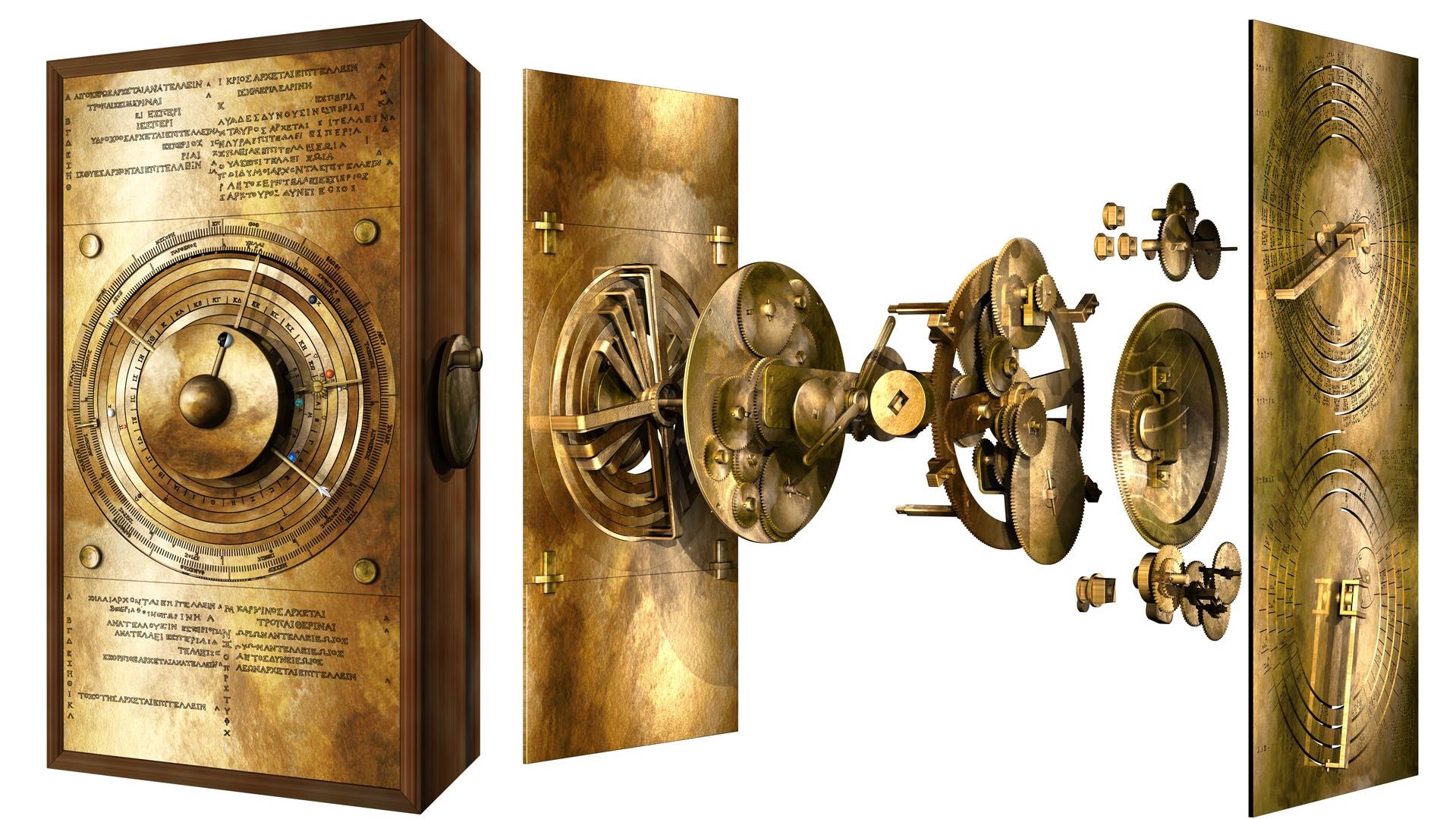
In the 1950s and later decades, advanced imaging techniques such as X-ray scanning revealed that the artifact contained an astonishing network of over 30 bronze gears.
These gears were arranged in a highly sophisticated system capable of performing complex astronomical calculations.
Researchers eventually determined that the device could predict:
-
The phases of the Moon
-
Solar and lunar eclipses
-
The movement of planets
-
Important cycles in the ancient Greek calendar
-
Dates of Olympic Games
Such precision required an understanding of astronomy and mechanical engineering that seemed centuries ahead of its time.
How the Mechanism Worked
The device was likely housed in a wooden case roughly the size of a shoebox. On its exterior were rotating dials and inscriptions explaining how to use it.
When a user turned a crank on the side, the gears inside would move, displaying astronomical information on the front and back dials.
Some historians believe the mechanism may have been designed by scholars connected to the traditions of famous Greek scientists such as Archimedes or Hipparchus, though the exact inventor remains unknown.
Most researchers date the device to around 100 BC.
A Technology Far Ahead of Its Time
What makes the Antikythera Mechanism so astonishing is its mechanical complexity.
Nothing comparable appeared again until medieval astronomical clocks, more than 1,000 years later.
This discovery forced historians to rethink assumptions about ancient technology. It suggests that Greek engineers may have developed highly advanced mechanical systems that were later lost to history.
The Mystery of Lost Knowledge
One of the biggest mysteries surrounding the Antikythera Mechanism is why similar devices were not widely preserved.
Possible explanations include:
-
The knowledge was limited to a small group of scholars
-
The technology was too complex or expensive for widespread use
-
The knowledge was lost during wars and the collapse of ancient civilizations
Some historians believe that ancient texts describing such machines may have been destroyed over time.
Modern Scientific Studies
In the 21st century, researchers used advanced technologies such as 3D X-ray tomography to study the fragments in greater detail.
These studies revealed thousands of Greek characters engraved on the device, providing instructions and astronomical explanations.
Scientists have since created working reconstructions that demonstrate how the mechanism likely functioned as an ancient astronomical calculator.
Conclusion
The Antikythera Mechanism remains one of the most astonishing discoveries in the history of science and archaeology.
Created more than 2,000 years ago, it demonstrates that ancient civilizations possessed a level of mechanical sophistication that was once thought impossible.
Even today, the mysterious device continues to fascinate researchers and inspire new questions about the lost technologies of the ancient world.
