
The Interstellar Visitor Mystery

In the vast, silent expanse of our solar system, a new visitor has arrived, moving at a velocity that has sent ripples through the international astronomical community. Detected in early March 2026, the object—currently designated by its interstellar trajectory—is the latest “extra-solar” traveler to pass through our cosmic neighborhood, following in the mysterious footsteps of predecessors like ‘Oumuamua and Comet Borisov.

What makes this discovery particularly compelling for researchers at the Vera C. Rubin Observatory is its flight path. Unlike the millions of asteroids and comets that orbit our Sun in predictable ellipses, this object is traveling on a hyperbolic trajectory. This means it has enough speed to escape the Sun’s gravity entirely, proving it originated from a distant star system millions of light-years away.

Anomalous Features: Natural or Engineered?
While most interstellar objects are assumed to be fragments of rock or ice ejected during the chaotic formation of other solar systems, this new visitor displays several characteristics that have sparked intense debate among astrophysicists:
-
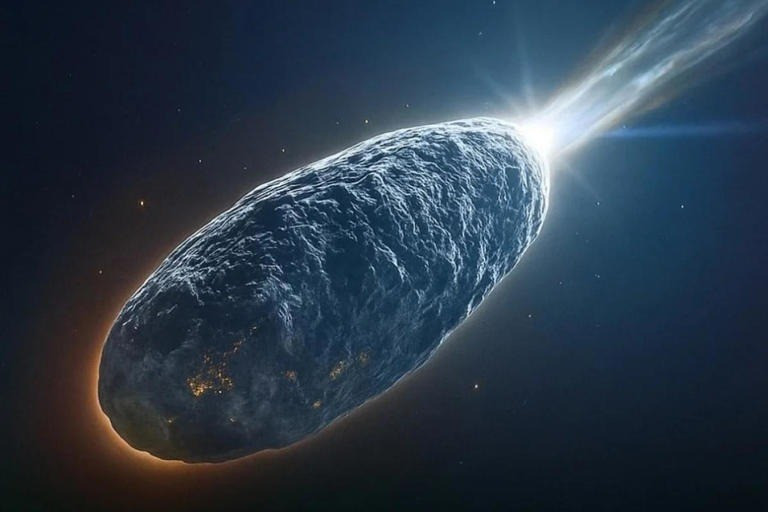
Extreme Aspect Ratio: Preliminary light-curve data suggests the object is highly elongated—either a long, thin “cigar” shape or a flat, “pancake-like” disc. Such geometry is rare in nature, as most large asteroids tend to be more spherical or “potato-shaped.”
-
Unusual Rotation: The object is tumbling in a complex, non-periodic manner. Scientists are currently analyzing whether this rotation is caused by the outgassing of frozen volatiles (like a comet) or if it is the result of a collision eons ago.
-
Non-Gravitational Acceleration: Most intriguingly, sensors have detected a slight “push”—an acceleration that cannot be fully explained by the Sun’s gravity alone. While skeptics suggest this is simply solar radiation pressure hitting a very light object, others point to more exotic theories.
The “Technosignature” Search
The arrival of such a rare visitor has prompted a coordinated effort from the SETI Institute and the Breakthrough Listen project. As of March 16, 2026, radio telescopes in Australia and West Virginia are being pointed at the object to listen for any electromagnetic signals.
“The probability that this is a natural piece of space debris is high,” noted one lead researcher. “However, given its unusual velocity and shape, we have a scientific obligation to check for ‘technosignatures’—any sign that this could be a derelict probe or a piece of advanced technology from another civilization.”

A Window into the Deep Past
Even if the object is purely a natural rock, it serves as a “time capsule” from a far-off world. By analyzing the light reflecting off its surface, astronomers can determine the chemical composition of its home star system. This data helps scientists understand if the building blocks of life—carbon, nitrogen, and water—are common throughout the Milky Way.
As the object reaches its perihelion (its closest point to the Sun) later this month, the world’s most powerful telescopes, including the James Webb Space Telescope (JWST), will be tracking its every move. It is a fleeting opportunity; within a few years, the traveler will vanish back into the dark void of interstellar space, leaving us with more questions than answers.
