
The Void’s Silhouette: How the First Black Hole Image Redefined Physics
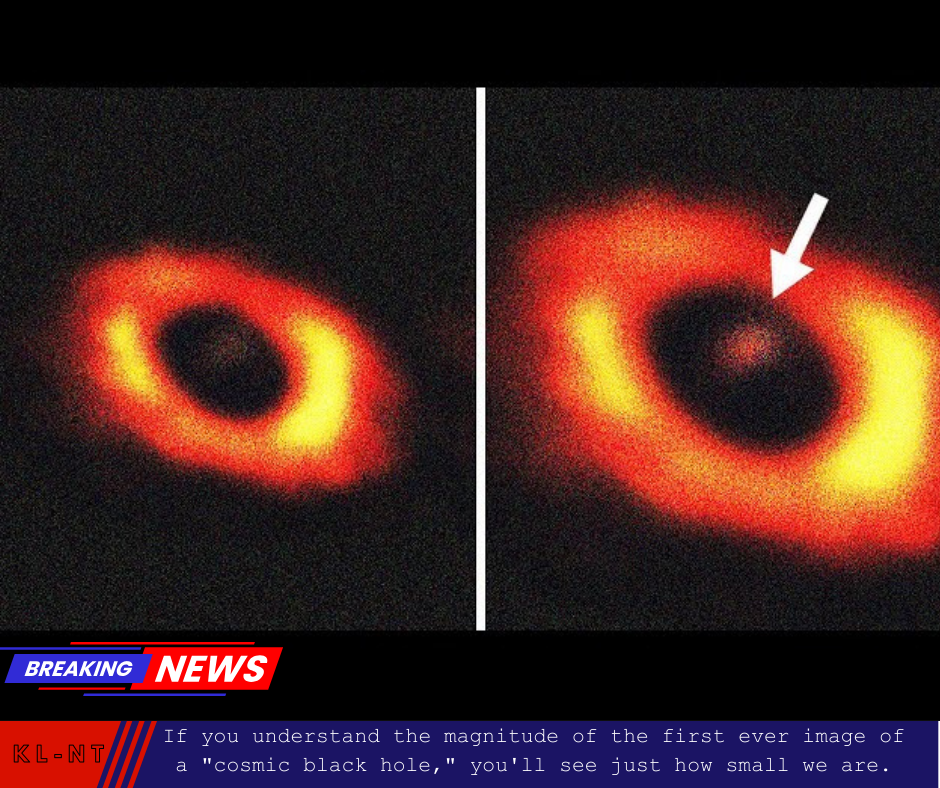
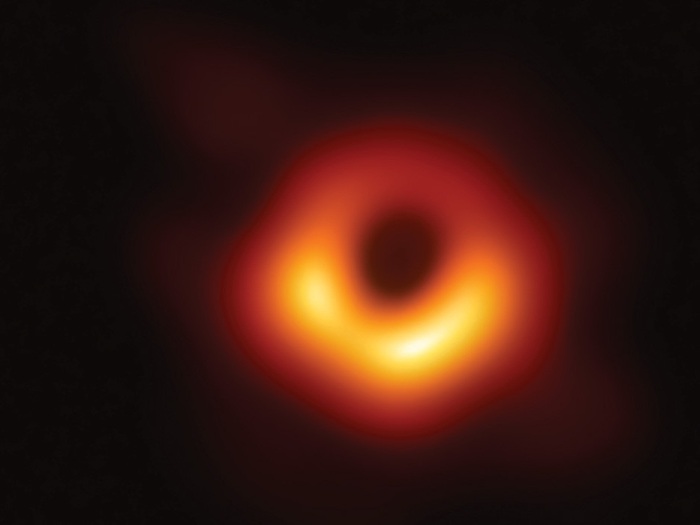
The historic first photograph of a black hole, unveiled in 2019, transformed one of humanity’s most abstract theories into a haunting visual reality. Captured by the Event Horizon Telescope (EHT)—a global network of eight radio observatories acting as a single Earth-sized lens—the image shows the supermassive black hole at the heart of the Messier 87 (M87) galaxy, located 55 million light-years away.
What appears as a “glowing donut” is actually a window into the most extreme environment in the known universe.
The Anatomy of the Image
While the black hole itself remains unseeable, the photograph documents the interaction between gravity and light at the “point of no return.”
-
The Glowing Ring: This is the accretion disk, composed of superheated gas and plasma swirling around the black hole at nearly the speed of light. The “lopsided” brightness of the ring is a result of relativistic beaming; the side of the disk rotating toward Earth appears brighter than the side moving away.
-
The Shadow: The dark center is the shadow of the black hole, a region twice as large as the event horizon itself. It marks the boundary where gravity is so intense that even photons of light are sucked into the abyss.
-
The Confirmation of Einstein: The image provided the most stringent test to date of Albert Einstein’s Theory of General Relativity. The circular shape of the shadow perfectly matched predictions made over a century ago, confirming that gravity warps spacetime exactly as he described.
New Breakthroughs in 2026
As of March 2026, the EHT collaboration has moved beyond static images to reveal the dynamic “beating heart” of M87. Recent findings have achieved a major scientific milestone: tracing the source of a 3,000-light-year-long cosmic jet.
Using expanded data from 2021 and 2022, researchers have finally connected the glowing ring of light to the very base of the relativistic jets—powerful streams of particles blasted out from the black hole’s poles. This discovery helps solve a decades-old mystery of how black holes act as “cosmic engines,” recycling matter and energy back into their host galaxies.
The Future: Black Hole “Movies”
The next frontier for the EHT is the creation of real-time videos. By adding more telescopes—including the upcoming Africa Millimetre Telescope in Namibia, set for construction in 2026—scientists aim to film the turbulent motion of gas around Sagittarius A*, the black hole at the center of our own Milky Way. Because our black hole is smaller, the matter around it orbits in minutes rather than days, making “movies” the only way to truly understand its restless behavior.
