
James Webb Space Telescope Just Broke Science
Since its launch in late 2021, the James Webb Space Telescope has steadily rewritten astronomy textbooks—but its latest discoveries are pushing scientists toward something far more unsettling: the possibility that our fundamental understanding of the universe is incomplete. What began as a series of faint, easily dismissed anomalies has now escalated into what some researchers quietly describe as a crisis in modern physics. From galaxies that appear far too old to exist, to chemical signatures linked to life emerging shockingly early in cosmic history, Webb is revealing a universe that refuses to follow the rules we thought were settled.
The first tremors arrived in mid-2023, when astrophysicists analyzing Webb’s deep-field data identified several galaxies whose light simply did not behave as expected. These systems appeared fully formed far earlier than standard cosmological models allow, suggesting the presence of exotic objects known as “dark stars”—hypothetical stellar giants powered not by nuclear fusion, but by dark matter itself. If confirmed, these objects could explain the rapid emergence of supermassive black holes and force a complete rewrite of stellar evolution, especially considering that dark matter makes up roughly 85% of the universe yet remains almost entirely mysterious.
Webb then turned its infrared gaze toward exoplanets, including GJ 1214 b, a super-Earth orbiting a red dwarf star. Long thought too clouded and hostile to study, the planet revealed thick layers of water vapor and traces of methane—chemicals often associated with biological processes. Some researchers now suspect GJ 1214 b may be a “water world,” covered in global oceans, raising the chilling possibility that habitable environments may be far more common than previously believed.
Even more unsettling was Webb’s detection of complex organic molecules—polycyclic aromatic hydrocarbons—inside a galaxy whose light has traveled more than 12 billion years to reach us. These molecules, often associated with smoke and life on Earth, were observed thanks to gravitational lensing, a phenomenon predicted by Einstein. Their presence suggests that the chemical building blocks of life existed long before Earth formed, implying that life in the universe may be not rare, but inevitable.
Perhaps the most destabilizing discovery came from Webb’s ultra-deep field images, which revealed massive, mature galaxies and supermassive black holes forming less than 600 million years after the Big Bang. According to existing models, such structures should not exist so early. Some black holes appear hundreds to thousands of times more massive than the one at the center of the Milky Way, forcing cosmologists to question whether the universe somehow “fast-forwarded” its own evolution. An astronomer from Penn State University described the findings as “deeply puzzling,” admitting that current theories may have misunderstood the universe’s earliest moments.
Then came the image that unsettled even veteran scientists: a near-perfect spiral galaxy whose spectral signature appeared duplicated, as if Webb were observing the same galaxy twice, slightly offset in space and time. While gravitational lensing can distort images, this phenomenon showed synchronized energy fluctuations and identical redshifts—prompting speculative discussions about overlapping realities or even multiverse effects stitched into spacetime itself.
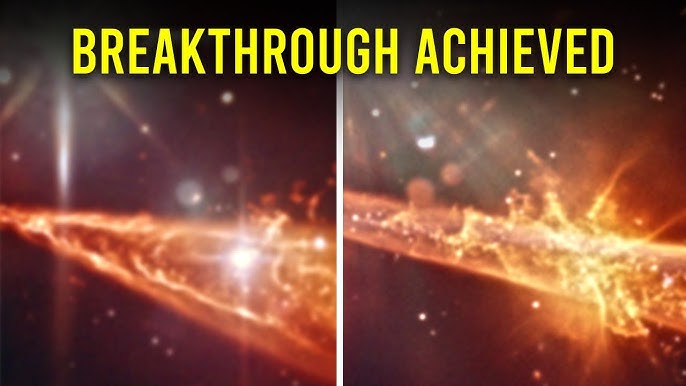
In early 2024, Webb observed a dying star within the Carina Nebula, detecting an eerily rhythmic low-frequency pattern during its collapse. When converted into sound, the data resembled a deliberate pulse—far more ordered than the chaotic noise astronomers expect from stellar death. Some compared it to a heartbeat, others to a signal, raising uncomfortable questions about whether cosmic processes might carry patterns we do not yet understand.
Finally, NASA introduced machine-learning analysis to process Webb’s overwhelming data volume. The AI flagged a vast cosmic void containing no matter—yet showing a rotating gravitational distortion unlike anything cataloged before. Similar patterns had appeared faintly in old Hubble Space Telescope data and were dismissed as noise. Webb confirmed them. The AI refused classification, labeling the phenomenon simply as an “unknown entity.”
As if that were not enough, astronomers mapping distant galaxies detected a temporal anomaly: redshift measurements in one region appeared to move backward in time, an effect that should be impossible under the standard model of cosmology. If confirmed, it suggests that something may be interfering with the fabric of time itself.
Together, these revelations point toward a universe far stranger, more complex, and less obedient than we ever imagined. The James Webb Space Telescope is no longer just observing distant stars—it is exposing cracks in reality itself. And as its mission continues, one truth becomes unavoidable: we are not merely learning more about the universe—we are discovering how much we never truly understood.
