
Researchers Reexamine the Mysterious Baltic Sea Anomaly, Claiming New Evidence May Finally Explain the Bizarre Object That Left Divers Stunned
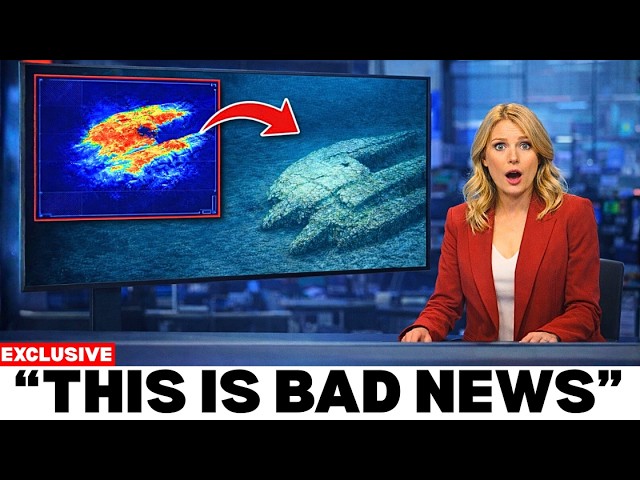
“Hidden beneath the ocean for years, the mystery of the Baltic Sea Anomaly has once again captured global attention—this time with scientists taking a closer, more grounded look at what may be one of the strangest underwater discoveries of the modern era.
First discovered in 2011 by the Ocean X Team while scanning the seafloor for shipwrecks, the object immediately sparked intense speculation. Lying about 90 meters beneath the surface of the Baltic Sea, sonar images revealed a circular formation roughly 60 meters wide, with features that appeared unusually symmetrical—almost mechanical. Its strange shape quickly ignited the imagination of the internet, with theories ranging from crashed UFOs to ancient alien technology and even secret wartime experiments.
Fueled by viral headlines and late-night documentaries, comparisons to the Millennium Falcon became widespread. Some claimed the object had ramp-like structures, grooves, and even interference effects on nearby equipment. Within days, it had transformed from a curious sonar reading into one of the most talked-about “mysteries” beneath the ocean.
However, as the excitement grew, scientists began to step in with a more measured perspective. While even members of the discovery team, including diver Dennis Åsberg, admitted the formation looked unusual, researchers emphasized a critical point: the ocean floor is full of strange, deceptive shapes.
Geologists studying the anomaly increasingly pointed toward a far less sensational explanation. Evidence suggests the formation is likely a natural geological structure formed during the last Ice Age. As massive glaciers once covered northern Europe, they carried rocks and debris across vast distances. When the ice eventually melted—around 10,000 to 15,000 years ago—these materials were deposited across the seabed, often in unusual and irregular formations.
In this context, the Baltic Sea Anomaly may simply be a glacial deposit—a chunk of rock shaped and positioned by ancient ice movement. Sonar imaging, which simplifies complex surfaces into clean outlines, can easily exaggerate symmetry and make natural formations appear artificial.
Subsequent investigations and sample analyses have reinforced this interpretation. Materials collected near the site, including granite and other common geological substances, align closely with known glacial deposits in the region. In other words, what once looked like a mysterious craft increasingly resembles ordinary rock shaped by natural forces.
Despite this, the legend has proven remarkably resilient. The combination of limited visibility, difficult diving conditions, and incomplete early data allowed speculation to flourish. The Baltic Sea itself—with its cold, murky waters—adds another layer of difficulty to direct observation, making definitive conclusions slower to reach.
Even today, alternative theories continue to circulate. Some claim the anomaly is a submerged structure from a lost civilization, others suggest it could be linked to secret experiments from World War II, while more imaginative interpretations still insist on extraterrestrial origins. Yet, from a scientific standpoint, none of these claims are supported by concrete evidence.
What this case ultimately reveals is not the existence of alien technology, but something equally fascinating: how quickly human imagination fills the gaps when confronted with the unknown. A blurry sonar image, an inaccessible location, and a mysterious shape were enough to turn a geological formation into a global phenomenon.
In the end, the most likely explanation remains the simplest one. The Baltic Sea Anomaly is not a spacecraft, a secret base, or an ancient machine—it is a product of Earth’s own geological history. But its story continues to resonate because it highlights a deeper truth: our oceans still hold countless mysteries, and sometimes, the line between discovery and speculation is thinner than we think.
And perhaps that’s why the fascination endures. Because even when science points to a rock, part of us still wonders—what if it wasn’t?”
