
Dark Matter: The Invisible Mystery Shaping the Universe
📰 Dark Matter: The Invisible Mystery Shaping the Universe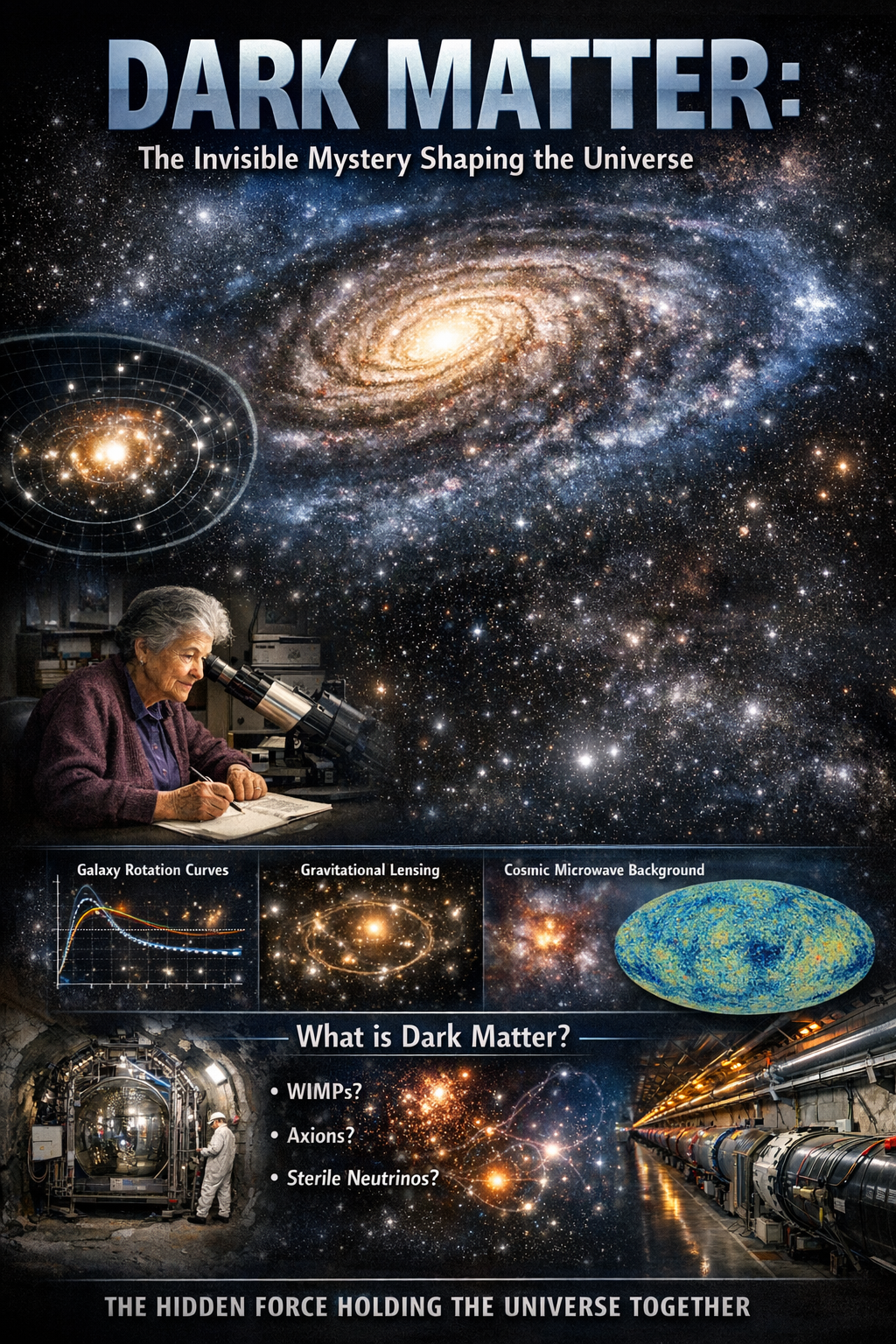
Introduction
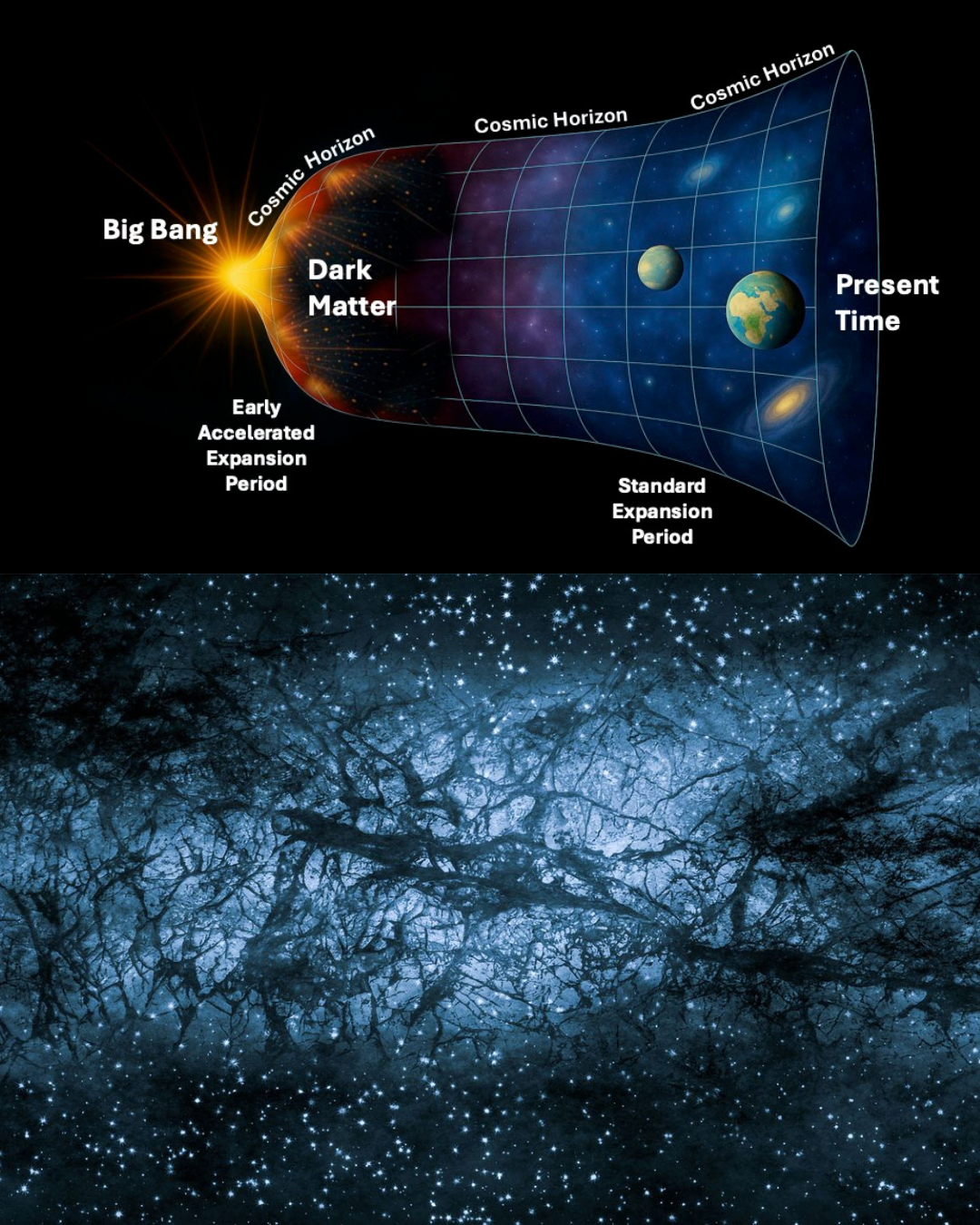
Across the vastness of the cosmos, scientists believe there is an unseen force shaping galaxies, bending light, and holding the universe together. This mysterious substance is known as Dark Matter.
Despite making up an estimated 85% of all matter in the universe, dark matter cannot be seen, detected directly, or fully understood—making it one of the greatest scientific mysteries of our time.
What Is Dark Matter?
Dark matter is a hypothetical form of matter that does not interact with light or electromagnetic radiation. This means it is completely invisible to telescopes.
Scientists infer its existence through its gravitational effects. For example:
-
Galaxies rotate faster than they should based on visible matter alone.
-
Light from distant objects bends in ways that suggest unseen mass.
-
Large-scale structures in the universe hold together despite lacking enough visible matter.
The Role of Vera Rubin
One of the key figures in dark matter research was the astronomer Vera Rubin.
In the 1970s, Rubin studied the rotation of galaxies and discovered something unexpected: stars at the edges of galaxies were moving just as fast as those near the center.
According to known physics, these outer stars should have slowed down—but they didn’t. This provided strong evidence that an unseen mass—dark matter—was influencing their motion.
Evidence of Dark Matter
Although it cannot be observed directly, several phenomena point to its existence:
-
Galaxy rotation curves
-
Gravitational lensing (light bending around massive objects)
-
Cosmic microwave background radiation
-
Structure formation in the universe
These observations strongly support the idea that dark matter plays a crucial role in shaping the cosmos.
What Could Dark Matter Be?
Scientists have proposed several candidates to explain what dark matter might be:
-
WIMPs (Weakly Interacting Massive Particles)
-
Axions
-
Sterile neutrinos
-
Unknown particles beyond the Standard Model of physics
Despite decades of research, none of these candidates have been definitively confirmed.
The Mystery Deepens
Experiments around the world are trying to detect dark matter directly, including deep underground laboratories and powerful particle accelerators.
However, so far, no experiment has produced conclusive evidence of a dark matter particle. This has led some scientists to question whether our understanding of gravity itself might need revision.
Why Dark Matter Matters
Without dark matter, galaxies as we know them might not exist. Its gravitational pull is believed to:
-
Hold galaxies together
-
Influence the formation of stars and planets
-
Shape the large-scale structure of the universe
Understanding dark matter could unlock answers to fundamental questions about the origin and fate of the universe.
Conclusion
Dark matter remains one of the most profound mysteries in modern science. While we cannot see it, its presence is undeniable through its gravitational effects.
As technology advances and research continues, scientists hope to finally uncover the true nature of this invisible force. Until then, dark matter remains a silent architect of the universe—hidden, yet essential.
