
Consciousness: The Deepest Mystery of the Human Mind
📰 Consciousness: The Deepest Mystery of the Human Mind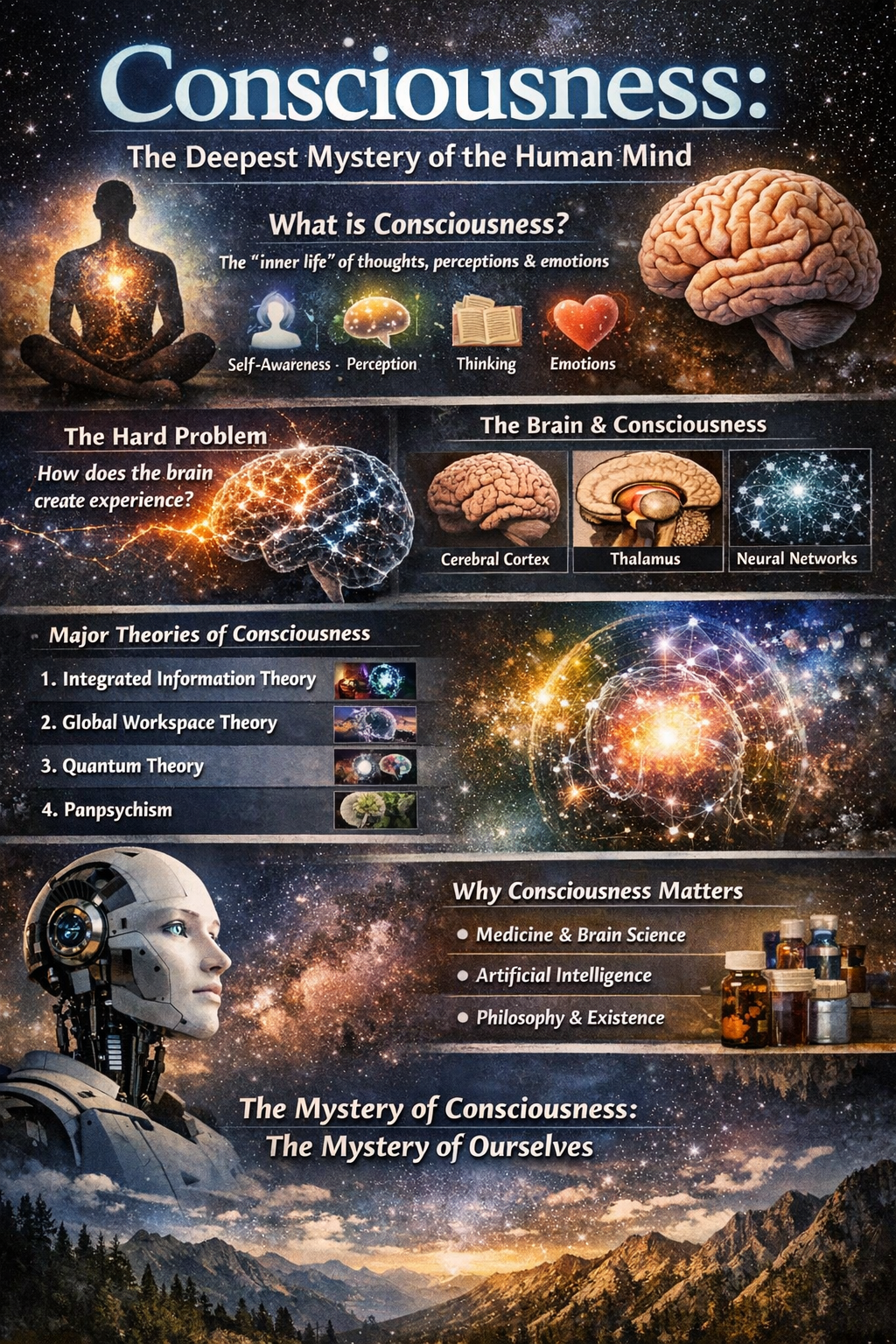
Introduction
What does it mean to be aware? To think, to feel, to experience the world from within? These questions lie at the heart of Consciousness—one of the most profound and elusive mysteries in science and philosophy.
Despite advances in neuroscience and psychology, we still do not fully understand how consciousness arises or why it exists at all.
What Is Consciousness?
Consciousness is often described as subjective experience—the “inner life” of thoughts, sensations, emotions, and awareness.
It includes:
-
Self-awareness
-
Perception of the external world
-
Thoughts and reasoning
-
Emotions and feelings
While the brain can be studied physically, consciousness itself is not something we can directly observe or measure.
The Hard Problem of Consciousness
One of the most famous challenges in understanding consciousness is the Hard Problem of Consciousness, a term introduced by philosopher David Chalmers.
The “hard problem” asks:
How do electrical signals in the brain create the experience of seeing color, feeling pain, or being aware?
Even if we map every neuron in the brain, the question remains: why does it feel like something to be alive?
The Brain and Consciousness
Modern neuroscience links consciousness to activity in the brain, particularly in regions such as:
-
The cerebral cortex
-
The thalamus
-
Neural networks that integrate information
Techniques like brain imaging have shown correlations between brain activity and conscious states—but correlation is not the same as explanation.
Major Theories of Consciousness
1. Integrated Information Theory (IIT)
Proposes that consciousness arises from the integration of information within a system. The more interconnected and complex the system, the higher its level of consciousness.
2. Global Workspace Theory (GWT)
Suggests that consciousness acts like a “global stage” where information is broadcast to different parts of the brain.
3. Quantum Theories
Some scientists speculate that quantum processes in the brain may play a role in consciousness, though this remains highly controversial.
4. Panpsychism
A philosophical idea that consciousness may be a fundamental property of the universe, present even in simple forms.
Can Machines Be Conscious?
With the rise of artificial intelligence, a new question has emerged:
Could machines ever become conscious?
While AI systems can simulate intelligence and behavior, there is no evidence that they possess subjective experience. This raises important ethical and philosophical questions about the nature of mind and awareness.
Why Consciousness Matters
Understanding consciousness could transform many fields:
-
Medicine: Better treatment for brain injuries and disorders
-
Artificial Intelligence: Defining limits and possibilities of machines
-
Philosophy: Understanding the nature of reality and existence
It also touches on deeply human questions:
What is the self? What is reality? What does it mean to exist?
Conclusion
Consciousness remains one of the greatest unsolved mysteries of our time. While science has uncovered many clues, the true nature of subjective experience continues to elude us.
Whether it emerges purely from the brain or reflects something more fundamental about the universe, one thing is certain:
The mystery of consciousness is, in many ways, the mystery of ourselves.
