
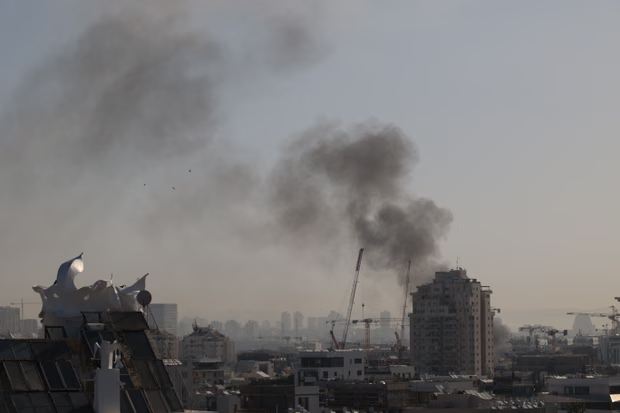
An Iranian missile has struck central Tel Aviv and the Israeli prime minister, Benjamin Netanyahu, has vowed to continue striking Tehran and Lebanon, dimming hopes of de-escalation after Donald Trump played up the chances of a deal to end the conflict.
“There’s more to come,” Netanyahu said in remarks that appeared to corroborate those of three Israeli officials who told Reuters they thought it was improbable that Iran would accept US demands in any new round of negotiations.
In a statement released on Tuesday, Iran’s Islamic Revolutionary Guard Corps said it would launch heavy missile and drone attacks at Israeli troops in northern Israel and the area near Gaza “without restraint” unless Israel ceased attacks in Lebanon and Palestine.
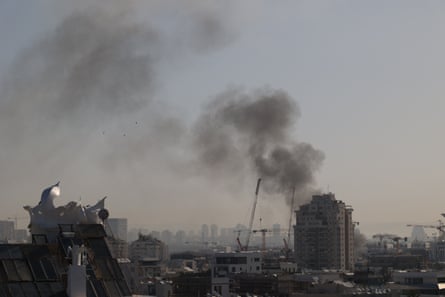
A thick plume of smoke rising over Tel Aviv’s skyline on Tuesday morning reinforced a sense that the end of the war remained distant.
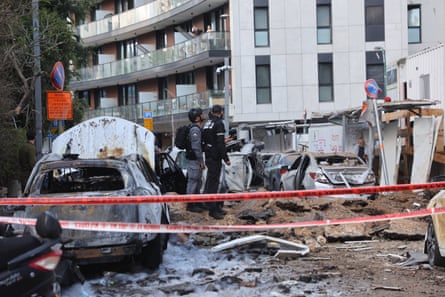
Police said an Iranian munition carrying a substantial explosive payload struck the central city, causing widespread damage to buildings and vehicles. At least six people were lightly injured. Several buildings were damaged across Tel Aviv, with emergency services reporting casualties at one of the impact sites. One building and the adjacent road were heavily affected, with cars set ablaze. Fragments from intercepted missiles also fell in Rosh Ha’ayin, causing minor damage but no reported injuries.
Israel’s health ministry says 4,829 injured people have been brought to hospitals since the onset of the war. Of those people, 111 remain in hospital and 12 are in a serious condition.
The strikes were the latest in a cycle of retaliation after Israeli operations announced on Monday. About 40 minutes after Trump said he would delay action against Iran’s power infrastructure, Israel said on X that it had “just begun another wave of strikes targeting infrastructure of the Iranian terror regime across Tehran”.
The Israel Defense Forces said energy facilities would be spared, suggesting that Israel may be aligning with Washington in suspending attacks on Iranian power plants and related sites.
The US-based Human Rights Activists’ News Agency said in the previous 24 hours it had recorded at least 206 attacks across 15 provinces in Iran, resulting in at least four casualties (killed and injured, both civilian and military). At least six people were killed in strikes on homes in the city of Tabriz, according to Iran’s Fars news agency.
Since US-Israeli bombs started falling on Iran, estimates of total deaths (military and civilian) in the country have exceeded 1,500, with some rights groups reporting figures as high as 3,230 as of 21 March.
In a statement on Telegram, the Israeli military said it had targeted a series of military bases and weapons sites across Iran, adding that further missile launchers had been destroyed, including ballistic missile storage facilities and various Iranian regime headquarters.
In recent weeks, Israel’s military claims to have eliminated more than 70% of Iran’s ballistic missile launchers, and says it has come close to establishing near-total control of Iranian airspace. Even so, Tehran has continued to penetrate Israel’s defences.
The escalation has also spilled beyond Israel. On Monday, Iranian strikes extended into Gulf states.
Bahrain’s interior ministry said its civil defence units had extinguished a fire at a company site after an Iranian attack, with no immediate reports of casualties. In Kuwait, power lines were damaged by air defence shrapnel, causing temporary electricity outages. Missile alert sirens sounded in Bahrain, while Saudi Arabia’s defence ministry said it had intercepted and destroyed 19 Iranian drones targeting its oil-rich eastern province.
