
How Ukraine killed Putin’s plan to make billions from Iran war
How Ukraine killed Putin’s plan to make billions from Iran war
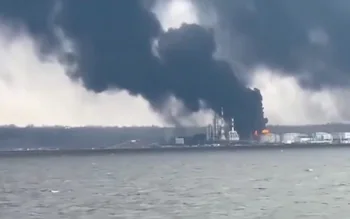
The wall of fire at Russia’s prized Ust-Luga oil port sent plumes of smoke into the air so high that they could be seen from Finland.
Ukraine’s biggest strike on Russia this year engulfed crude oil and petroleum storage tanks, as well as loading equipment, turning the skies above the Baltic Sea port orange on Wednesday.
Drones had slipped through successive layers of Russian air defences spanning Bryansk, Smolensk, Pskov and St Petersburg on their 620-mile voyage, before scoring what appeared to be direct hits.
The second strike on a key oil facility in days was not only an embarrassing defence failure for Russia.
As flames raged through the terminal, they also burned through the Kremlin’s coffers, with Ukraine draining a critical revenue source when Vladimir Putin needed it most.

Before the Iran war began on Feb 28, Russia’s oil and gas revenues were down 47 per cent on the previous year, barrels were selling at a third of market rate to India, and the national deficit had already reached 91 per cent of the 2026 target.
Analysts were asking how long Putin could maintain his costly war, with military spending slowing as finances were squeezed.
But since the US and Israel launched the Iran war, Moscow has been earning about $760m (£560m) per day in sales of oil and gas, totalling almost $24bn in March.
Blessed with soaring demand, eased sanctions and unaffected by the closure of the Strait of Hormuz, Russia has emerged as the Iran conflict’s unlikely winner, profiting from a frantic market stripped of roughly one fifth of its supply.
Moscow relies on oil and gas for more than 60 per cent of its exports and almost a third of its state revenues, and the remarkable turnaround has proved a boon for Russia’s economy and war ambitions.
It has also prompted the typically smug statements from the Kremlin, taunting Europe with offers to resume supplying oil to the Continent.
Ukraine feared that energy scarcity could force a rapprochement between the West and Moscow, and strengthen Putin’s hand on the battlefield and in the negotiation rooms.
The Belgian prime minister called for the “commonsense” normalisation of relations with Russia, in order to “regain access to cheap energy”, earlier this month.
But now, Ukraine has struck a hard blow against a reanimated Russia with its strikes on energy infrastructure.
With its furious campaign against the far-flung sites, Kyiv hopes to ensure extra billions will not reach the Kremlin.
As a result of Wednesday’s attack, as well as previous damage to pipelines and a series of recent tanker seizures, some 40 per cent of Russian oil export capacity was halted this week.
It was the worst disruption to oil supply in modern Russian history, according to a Reuters report.

Days earlier, Ust-Luga and the neighbouring export hub of Primorsk, which together handle 1.7 million barrels of oil per day, were forced to suspend operations by a drone barrage.
Export bottlenecks caused by drone strikes could put 400,000 barrels per day at risk in four Russian refineries – Kirishi, Yaroslavl, Moscow and Ryazan, Reuters reported on Thursday.
Russia tried to insist the damage was minor at the heavily guarded Primorsk, its biggest oil export hub on the Baltic Sea.
But satellite imagery suggested otherwise, showing at least four oil storage tanks flattened and spewing dense black smoke.
And Kyiv shows little sign of easing its efforts.
Early on Thursday, Ukraine’s unmanned systems forces confirmed that they had targeted an export-oriented oil refinery in Kirishi, just over 62 miles from St Petersburg.
The plant processes 6.6 per cent of Russia’s total oil refining volumes, some 350,000 barrels per day, according to Reuters.
Hours later, a marine drone descended on a sanctioned crude oil tanker near Istanbul’s Bosphorus Strait that had departed from the Russian port of Novorossiysk with one million barrels of crude oil, almost a full load.
Ukraine has been running a deep-strike campaign against Russia’s oil and gas industry for more than two years, aiming to drain the Kremlin’s war chest by cutting it off from the industry that enriches it.
But the assaults appear to be intensifying as Ukraine expands its weapons production.
More than 40 strikes were carried out inside Russia in the first two months of 2026, mostly on oil and gas infrastructure, double the rate of attacks in 2025.
Maksym Beznosiuk, a strategic policy expert focusing on Russia and Ukraine, said Kyiv increased its success by broadening its focus from refineries to the “oil system Russia uses to process, transport and export crude”.
“It is a serious development because higher global oil prices would otherwise give the Kremlin more room to absorb wartime costs,” he told The Telegraph.

“In practice, the broader effect appears to be that it makes it harder for the Kremlin to fully convert the current price rally into additional wartime costs.”
However, Mr Beznosiuk cautioned against viewing the campaign as a “knockout blow”. He said: “Russia still has eastern export routes to Asia, and the overall size of its oil sector means it cannot be seriously disrupted by several strikes alone.”
Ukraine has deployed a vast arsenal of munitions for the strikes, including Neptune and Flamingo missiles; FP-1 and Liutyi long-range attack drones; and Palianytsia, Ruta and Peklo drone missiles.
It is FP-1 drones, manufactured by Fire Point, the Ukrainian defence startup, that are believed to be responsible for some 60 per cent of deep strikes inside Russia.
At the end of February, The Telegraph visited one of Fire Point’s top-secret manufacturing facilities.
In a dozen crowded workshops blaring Pink Floyd, engineers assembled some of the hundreds of slender-fuselage, straight-wing strike drones the company produces per day.
Introduced in 2024, the one-way drones cost a little more than £40,000 apiece, making them several times cheaper than the menacing delta-winged black Shaheds that Russia has used to bombard Ukraine’s energy facilities.
Each FP-1 carries a modular warhead which weighs between 60kg and 120kg and can travel distances up to 995 miles. To enable quick, high-volume manufacturing, as well as to reduce detection by radar, the drone is constructed from epoxy resin and laser-cut plywood.
The start-up’s Silicon Valley-style open-plan office is adorned with Star Wars figurines and a huge, fluffy flamingo – a nod to Fire Point’s flagship heavy-payload long-range cruise missile unveiled last year.
Iryna Terekh, the chief executive and chief technologist, said the company’s drones and missiles were its way “to send a message” to Russia.
She said the company had overcome a “psychological threshold” to produce the homegrown weaponry Ukraine desperately needed at a low cost, so that the country would not be forced to rely on its allies indefinitely.
“We learned the hard way that our ability to defend our sovereignty should never rely on any political agenda other than Ukraine’s… This is the main driver of domestic production,” she said.
“Defence is not for fighting, but to very clearly communicate the cost of abuse to the abuser. We don’t have time to rest, we are fighting in a different league to our enemy. We have less land, less money, less people, less time.”
