Euclid Telescope Captures Terrifying New Cosmic Images — Scientists Stunned by What They’re Seeing
It began the way modern cosmic panic always does—not with a calm scientific briefing or a carefully worded statement from the European Space Agency, but with a single word screaming through headlines: terrifying. The Euclid Space Telescope had released new images, and within minutes the internet decided they were proof that reality was malfunctioning, the universe was cracking open, or scientists were quietly ignoring something deeply unsettling floating in front of a billion-euro camera.
For those only now discovering Euclid and feeling spiritually qualified to panic, the telescope was designed to study the “dark universe”—dark matter and dark energy—an assignment that already sounds suspiciously ominous. Its mission is to map billions of galaxies, trace invisible cosmic structures, and remind humanity that most of the universe is made of things we cannot see, cannot touch, and barely understand. Pairing that with the word terrifying was never going to end calmly.
The images arrived online with minimal context and maximum emotional damage. They showed warped galaxies, elongated arcs of light, clusters bent into unnatural shapes, and shadowy regions where light appeared to ignore the usual rules of physics. Almost immediately, captions claimed Euclid had “seen something it wasn’t supposed to,” that it had captured “structures beyond comprehension,” and that scientists were “struggling to explain” what they were seeing—which, strictly speaking, is just another way of describing astrophysics.
Social media responded exactly as expected. Loudly. Confidently. With arrows.
Images were reposted side by side with circles and captions like THIS IS NOT NORMAL, as if the universe has ever been obligated to behave. One viral post described “cosmic scars.” Another insisted the telescope had revealed “hidden frameworks of reality.” One especially ambitious account claimed Euclid had photographed “the skeleton of the universe,” a phrase that sounded impressive right up until no one could explain what bones look like in spacetime.
Fake experts arrived instantly. A self-described “quantum cosmology interpreter” announced the images showed “unnatural gravitational distortions,” a bold claim given that gravitational distortion is precisely what Euclid was built to observe. A “dark energy whistleblower” claimed the telescope had captured regions where physics breaks down, phrasing it as if the universe had violated its own terms of service.
Actual scientists reacted in the most suspicious way possible: they were calm, excited, and smiling.
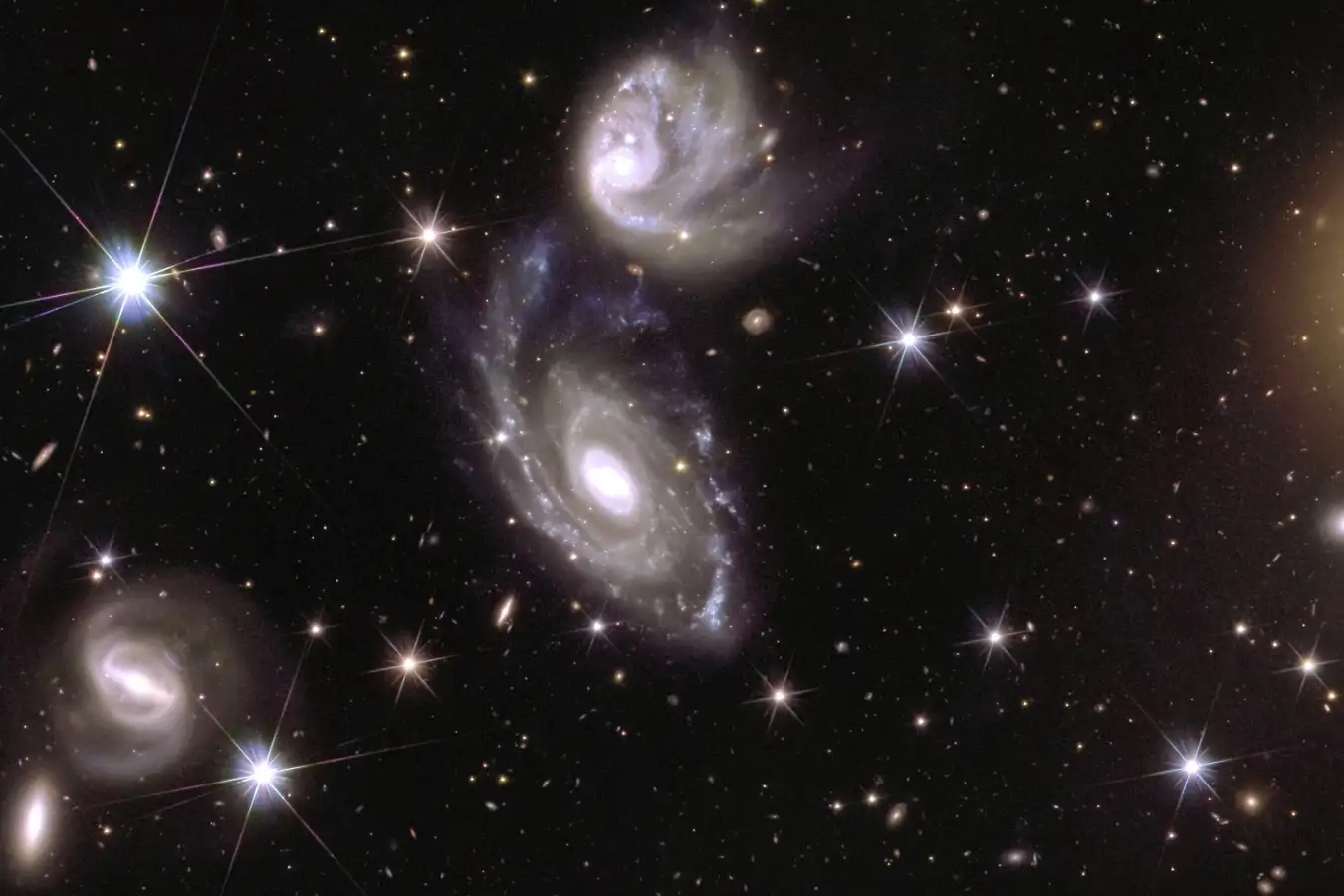
ESA explained that the images showcase large-scale gravitational lensing, where massive concentrations of dark matter bend the light from distant galaxies, creating warped arcs and stretched shapes that look unsettling precisely because they reveal structures normally invisible to us. This explanation was promptly ignored, as it lacked danger, secrecy, and an ominous countdown.
The phrase “scientists stunned” spread anyway, despite no visible stunning taking place beyond the usual academic expression of joy mixed with caffeine dependency. Headlines escalated accordingly: EUCLID SEES THE UNSEEN, NEW IMAGES DEFY REALITY, DARK UNIVERSE EXPOSED. Each one carefully engineered to suggest something terrible had been discovered and you were the last to know.
One outlet quoted an unnamed “ESA insider” saying the images were “more extreme than expected,” a statement true of nearly every major scientific discovery, but online it was translated as they didn’t think it would look like this, implying the universe was being intentionally rude.
Conspiracy theories followed instantly. Some claimed the images prove dark matter is “not natural.” Others argued Euclid had revealed “structures behind reality,” a phrase that sounds profound until you ask behind what and receive silence. A popular thread suggested the telescope had exposed the boundaries of a simulation, because no cosmic event is complete until someone blames a video game.
Naturally, NASA was dragged into the discussion. Commenters demanded to know why NASA hadn’t shown images like this before, overlooking the minor detail that Euclid is not a NASA mission and that different telescopes observe different things. Facts, however, were no match for suspicion.
Scientists tried again. They explained that Euclid’s unprecedented resolution and wide-field view allow it to map cosmic structures in ways never done before, revealing dark matter filaments and galaxy clusters with unsettling clarity. They emphasized that nothing dangerous had been discovered, nothing new was threatening Earth, and nothing had changed—except our ability to see what was always there.
This explanation did not calm anyone.
Because somehow, the idea that terrifying structures have always existed—quiet, invisible, and vast—is far more disturbing than the idea that something new has suddenly appeared.
