
The 1959 Intelligence Report: A “Possible Unidentified Flying Object” Over Ukraine During the Cold War
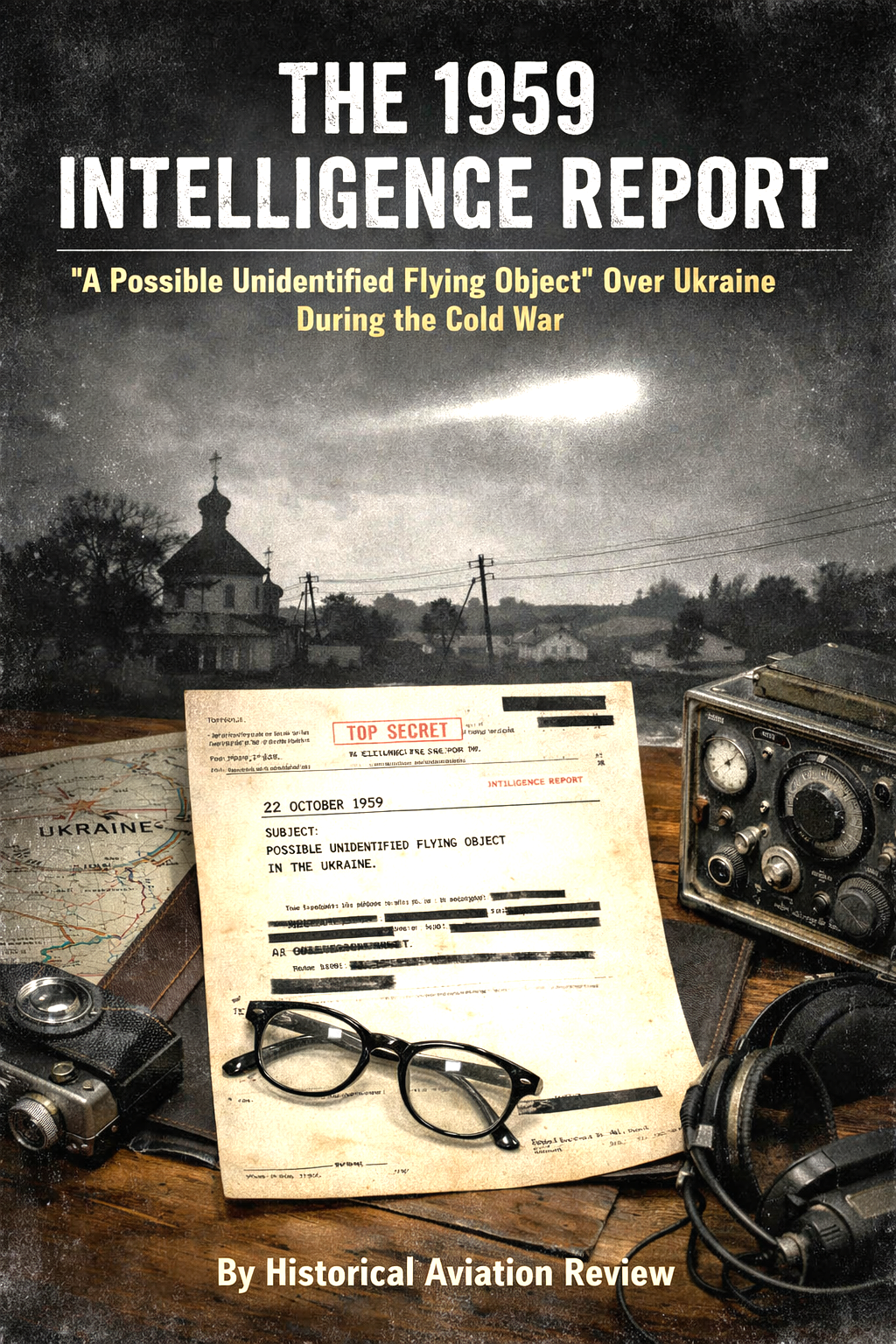
The 1959 Intelligence Report: A “Possible Unidentified Flying Object” Over Ukraine During the Cold War

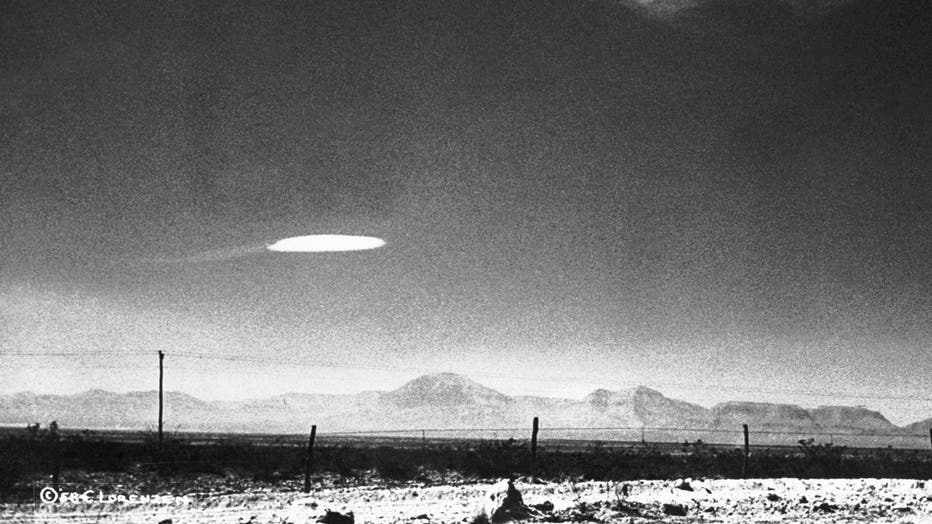

A Forgotten Report From October 22, 1959
On 22 October 1959, an intelligence information report circulated within Western intelligence channels describing a “Possible Unidentified Flying Object” observed in Ukraine, then part of the Soviet Union.
The document, later released among large collections of declassified Cold War files, represents one of many cases in which unidentified aerial sightings were monitored not only as scientific curiosities but also as potential national-security concerns.
Although brief and cautious in tone, the report reflected a period when unusual objects in the sky could trigger serious geopolitical attention.
What the Intelligence Report Described
According to the declassified record, the report summarized information obtained through intelligence sources regarding an aerial phenomenon witnessed over Ukrainian territory. The object was described as unusual enough to warrant classification as a possible unidentified flying object (UFO) rather than a known aircraft or atmospheric event.
Much of the original file was heavily redacted when first released, leaving only partial details visible. Later declassification efforts revealed more context, confirming that the document formed part of intelligence monitoring rather than a scientific conclusion.
Key characteristics mentioned in the report included:
-
observation of an unidentified aerial object
-
uncertainty regarding origin or technology
-
intelligence interest due to its location inside Soviet airspace
-
distribution through official reporting channels
The cautious wording shows analysts avoided extraordinary claims, instead documenting the event as an unresolved observation.
Why Ukraine Drew Intelligence Attention
In 1959, Ukraine was a strategically vital region within the Soviet Union. The area hosted:
-
military training zones
-
missile development activities
-
aviation facilities tied to Soviet aerospace programs
During the Cold War, any unidentified object detected over such territory could raise several possibilities:
-
Experimental Soviet aircraft
-
Foreign reconnaissance technology
-
Atmospheric or astronomical phenomena
-
Misidentified conventional aircraft
Because intelligence agencies lacked direct access to Soviet testing programs, unexplained sightings were carefully cataloged rather than dismissed.
UFO Reports as Intelligence Data
Contrary to popular belief, intelligence agencies did not treat UFO reports primarily as evidence of extraterrestrial activity. Instead, they viewed them as potential indicators of technological breakthroughs by rival nations.
Throughout the 1950s, both American and Soviet analysts collected unusual aerial reports for comparison with emerging aerospace developments. Even ambiguous sightings were preserved because they might reveal:
-
new propulsion experiments
-
high-altitude reconnaissance platforms
-
missile or radar technologies unknown to adversaries
The 1959 Ukraine report fits this pattern — a record of uncertainty rather than a declaration of mystery solved.
Declassification and Modern Interest
The report resurfaced decades later through archives of declassified intelligence material preserved by civilian researchers and document repositories such as The Black Vault, which specializes in Freedom of Information Act releases.
When released publicly, the document attracted renewed attention from historians and UFO researchers because it demonstrated that sightings inside Soviet territory were monitored just as closely as those reported in the West.
Importantly, the report does not confirm extraterrestrial origins. Instead, it illustrates how intelligence agencies documented anomalies during a period when technological surprise was a constant fear.
The Cold War Atmosphere of Uncertainty
The late 1950s were marked by rapid advances in rocketry and aviation. Only two years earlier, the Soviet launch of Sputnik had shocked the world and proven that revolutionary aerospace achievements could appear suddenly.
Against this backdrop, unidentified objects in the sky represented more than curiosity — they represented unknown capabilities.
A single unexplained observation could imply:
-
a new surveillance platform,
-
a weapons breakthrough,
-
or an intelligence gap.
Thus, even a short intelligence memo about a strange object over Ukraine became part of the broader strategic puzzle.
A Small Document, A Larger Story
Today, the 22 October 1959 intelligence report remains a modest but fascinating artifact of Cold War history. Its significance lies less in what was seen and more in how governments reacted to uncertainty.
The document reminds us that during an era defined by secrecy and rivalry, the unknown skies above Eastern Europe were watched carefully — and every unexplained object, no matter how ambiguous, was recorded for history.
Whether the object was experimental technology, natural phenomenon, or simple misidentification may never be known. What survives instead is evidence of a world on alert, scanning the heavens for clues about the future.
