
COSMIC COUNTDOWN: 3I/ATLAS, Time’s Edge, and the Formula That Silenced Scientists
🦊🌌 “THIS CHANGES EVERYTHING”—OR DOES IT? When a rare interstellar visitor like 3I/ATLAS sweeps through our solar system, it’s almost inevitable that the story grows larger than the object itself. Headlines flare, theories multiply, and suddenly names like Brian Cox and Michio Kaku are pulled into a narrative that hints at something far more dramatic—questions about time, reality, even the limits of physics. But beneath the noise, the truth is both quieter and far more fascinating.
3I/ATLAS is, at its core, a messenger from deep space. Unlike the asteroids and comets bound to our Sun, it comes from beyond—traveling on a hyperbolic path that ensures it will never stay. It has spent billions of years drifting through interstellar darkness, carrying with it the chemical fingerprints of a distant star system. In that sense, it is less an anomaly and more a rare opportunity—a fragment of another world passing briefly within reach of human observation.
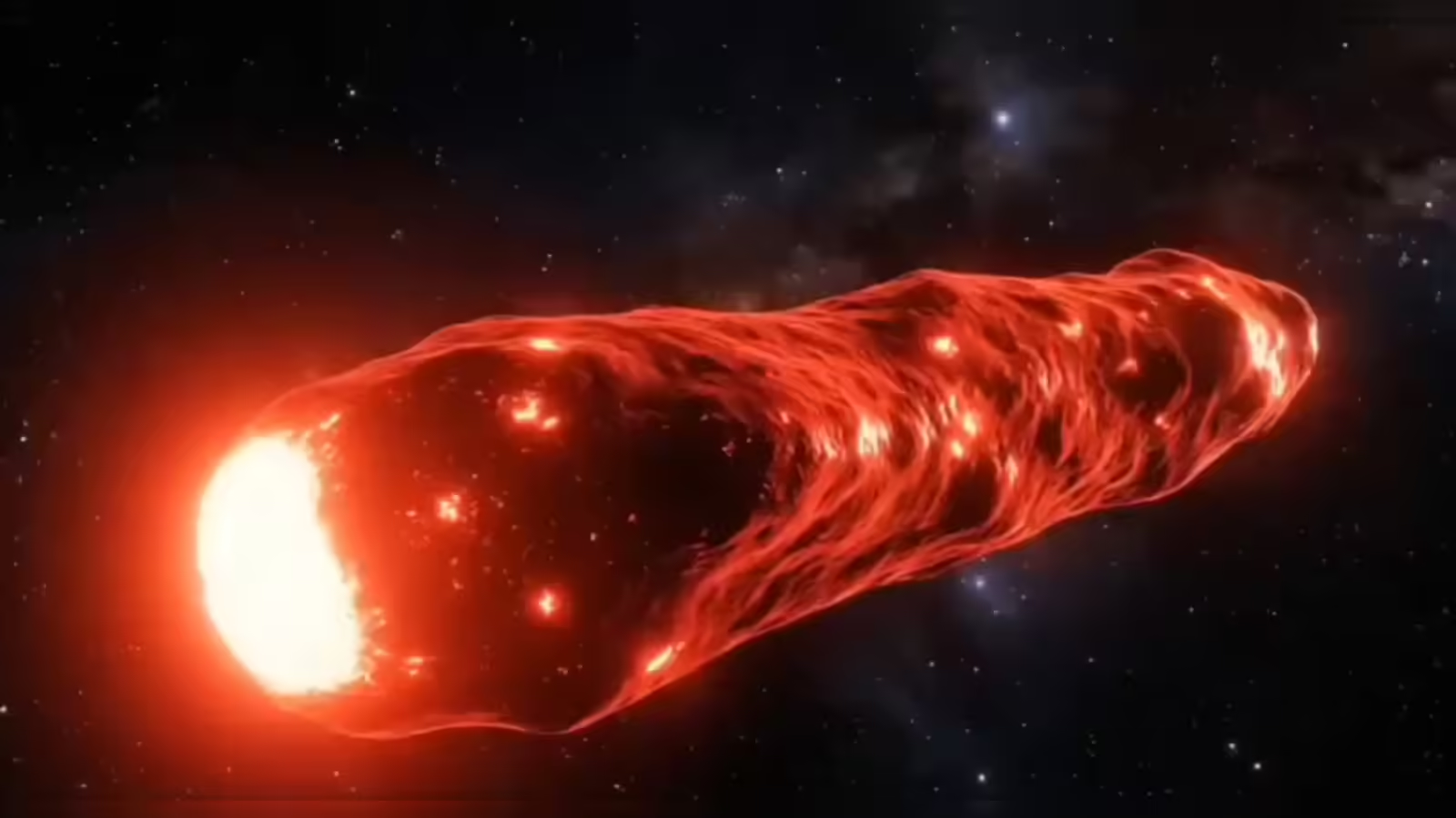
What makes it extraordinary is not that it breaks the rules, but that it helps us understand them better. Every measurement—its speed, its rotation, its composition—adds another piece to a much larger puzzle about how planetary systems form and evolve across the galaxy. Compared to earlier visitors like ʻOumuamua or 2I/Borisov, 3I/ATLAS offers richer, more detailed data, allowing scientists to refine models that were once based on only a handful of examples.
Figures like Brian Cox have emphasized this grounded perspective. Despite its exotic origin, the object behaves in ways consistent with natural physics. Its materials—ice, dust, rock—align with what we expect from small bodies formed around other stars. Its motion, while fast and unusual, follows predictable gravitational laws. There is no evidence of artificial design, no hidden mechanism rewriting the laws of nature.
Even Michio Kaku, known for exploring the frontiers of possibility, frames such discoveries not as proof of the extraordinary, but as invitations to deepen our understanding. Because the real significance of 3I/ATLAS is not that it challenges time itself—but that it connects us to it. This object is older than our solar system, a relic of processes that unfolded long before Earth existed. Studying it is, in a sense, studying the past on a cosmic scale.
Of course, in today’s media landscape, that nuance often gets lost. Claims spread quickly—suggesting anomalies, contradictions, even violations of physics. But so far, the evidence points in a different direction. Not toward something impossible, but toward something profoundly natural: a reminder that the universe is vast, varied, and still only partially understood.
And perhaps that’s the real shift in perspective. 3I/ATLAS doesn’t signal the end of what we know—it expands it. It shows that the laws of physics don’t collapse under scrutiny; they deepen. And as this distant traveler continues its journey back into interstellar space, it leaves behind more than data. It leaves a question—quiet, enduring, and far more powerful than any headline:
What else is out there, waiting to pass by… and what will we learn when it does?
