
Is 3I/ATLAS a Comet or a Cosmic Deception? The Data Silence Sparks Intense Speculation
3I/Atlas is no ordinary interstellar passerby. It is only the third object ever confirmed to have entered our solar system from beyond its boundaries. Hurtling through space at nearly 68 kilometers per second, it is currently racing inside the orbit of Mars and accelerating as it draws closer to the Sun. Its hyperbolic trajectory clearly distinguishes it from typical comets or asteroids, placing it on a path that will bring it to its closest solar approach on October 29, at a distance of about 1.36 astronomical units—between the orbits of Earth and Mars.
In response, NASA and international space agencies have coordinated an unprecedented observational campaign using multiple orbiters around Mars to monitor 3I/Atlas as it brightens in ways that defy conventional comet models. While Earth-based telescopes will soon be overwhelmed by the Sun’s glare, spacecraft orbiting Mars retain an unobstructed view, offering a rare opportunity to study the object’s behavior in real time.
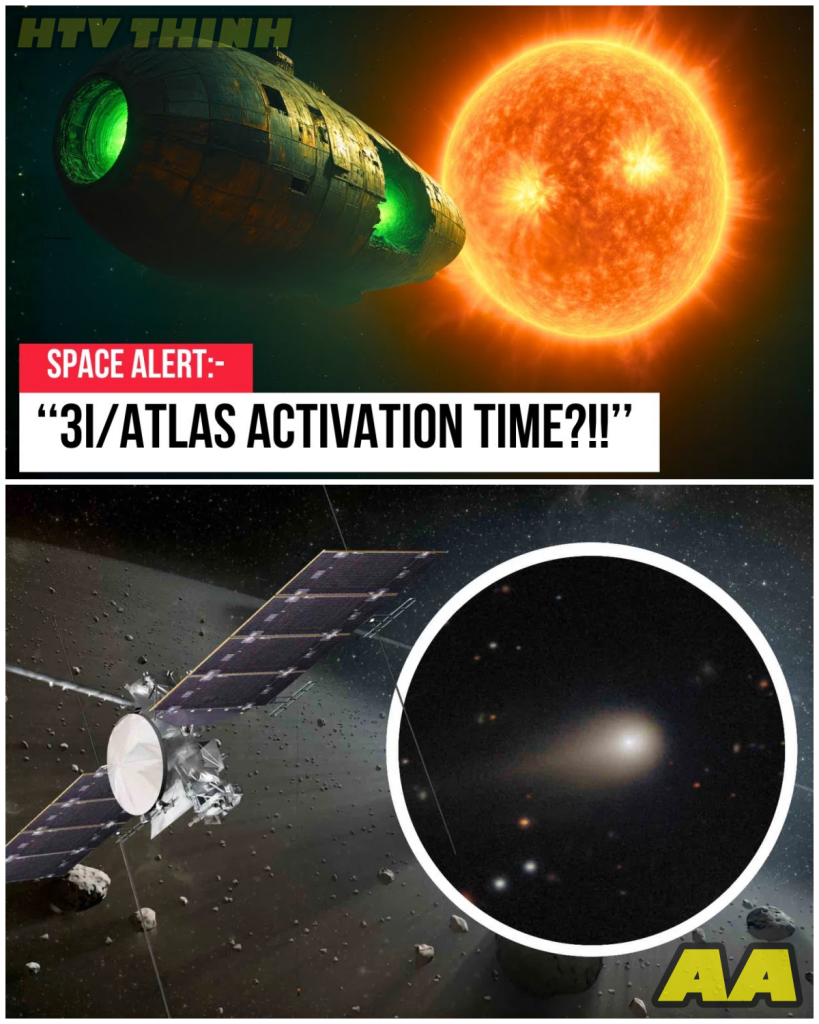
The central question driving this effort is whether 3I/Atlas is “activating”—that is, whether it is beginning to erupt, releasing gas and dust and exhibiting the defining features of a comet. Such activation would indicate that solar heating is driving volatile materials off its surface, forming a coma and tail that evolve as it approaches the Sun. If confirmed, this behavior would challenge existing theories of comet activity and provide unprecedented insight into the chemistry of interstellar material.
On October 3, 3I/Atlas made a close pass within 0.20 astronomical units of Mars, enabling six orbiters to observe it simultaneously. These included spacecraft from the United States, Europe, China, and the United Arab Emirates. However, none of these missions were designed to track faint, fast-moving targets like 3I/Atlas, which shines at magnitude 12—tens of thousands of times dimmer than Mars itself.
Despite these limitations, mission teams pushed their instruments to the edge of their capabilities. Long-exposure imaging and sensitive spectroscopic techniques were employed to search for even the faintest traces of gas or dust. Each successful detection represented a significant technical achievement, made possible through intense coordination and precision.
A particularly striking moment occurred on October 2, when a Mars-based rover captured a faint diagonal streak in nighttime images. The streak aligned with predicted models of 3I/Atlas’s trajectory, suggesting the rover had inadvertently photographed the object as it crossed the Martian sky. An amateur astronomer reviewing publicly released data was the first to notice the anomaly, igniting widespread excitement and debate.
Scientists quickly moved to verify the finding, weighing alternative explanations such as cosmic rays or imaging artifacts. This process highlighted the value of open data and citizen science, as researchers and enthusiasts worldwide collaborated to determine the truth. It also underscored the delicate balance between rapid discovery and careful verification.
Complicating matters further, on October 21, 3I/Atlas will pass behind the Sun from Earth’s perspective, entering a blackout period known as superior conjunction. During this time, ground-based observations will be impossible, leaving Mars orbiters as the sole source of data. This creates a bottleneck, intensifying debates over how quickly observations should be released to the public.
Some researchers argue for immediate open access to encourage global collaboration, while others warn that releasing raw, unprocessed data could lead to misinformation or premature conclusions. As a result, data embargoes ranging from hours to days have frustrated both professional scientists and citizen observers eager for updates.
This blackout period has become fertile ground for speculation. Rumors of sudden outbursts, unusual activity, or even artificial origins have flourished, often fueled by delays and incomplete information. Official statements, however, continue to urge patience and restraint, emphasizing that extraordinary claims require robust evidence.
At the core of the investigation is a detailed chemical analysis. One major focus is the ratio of carbon dioxide to water vapor in the object’s surrounding coma. Observations indicate an unusually high ratio of roughly 8:1—far above what is typically seen in solar system comets. This points to a fundamentally different composition and outgassing mechanism.
Another mystery lies in the detection of strong atomic nickel signatures without corresponding iron lines. Scientists suspect this may be caused by a volatile compound known as nickel tetracarbonyl, which can release nickel atoms when exposed to sunlight in cold, carbon-rich environments. Monitoring how these spectral features evolve as 3I/Atlas nears perihelion could reveal whether new material is being exposed or fragmented.
Notably absent is the familiar green glow produced by C2 molecules, commonly seen in active comets. Instead, the faint greenish hue observed so far is likely due to fine dust scattering light and possibly nickel fluorescence. If a surge in C2 production occurs near perihelion, it would signal classic cometary activation. If not, the object’s behavior may be governed by dust-driven processes and unusual chemistry.
Researchers are watching closely for sudden changes in brightness, tail morphology, or coma expansion—potential indicators of fragmentation or explosive outbursts. Each of these signals would offer critical insight into the physical and chemical processes shaping 3I/Atlas.
For now, the question of whether 3I/Atlas truly “activates” remains unanswered. A definitive conclusion will require sustained, multi-wavelength observations over time, particularly as the object passes perihelion. This slow, methodical approach reflects the inherent challenges of studying interstellar visitors that do not conform to established models.
Beyond its scientific significance, the effort underscores the importance of international cooperation and transparency in space exploration. The combined contributions of space agencies, research teams, and amateur astronomers alike are proving essential in unraveling the mysteries of this extraordinary object.
As scientists await the full release of data and prepare to observe 3I/Atlas again when it reemerges in December, one conclusion is already evident: this interstellar visitor is reshaping our understanding of cosmic chemistry and redefining what it means to encounter material from beyond our solar system.
