The Barra da Tijuca UFO Photos (1952): Brazil’s Famous Flying Saucer Images
The Barra da Tijuca UFO Photos (1952): Brazil’s Famous Flying Saucer Images


Introduction
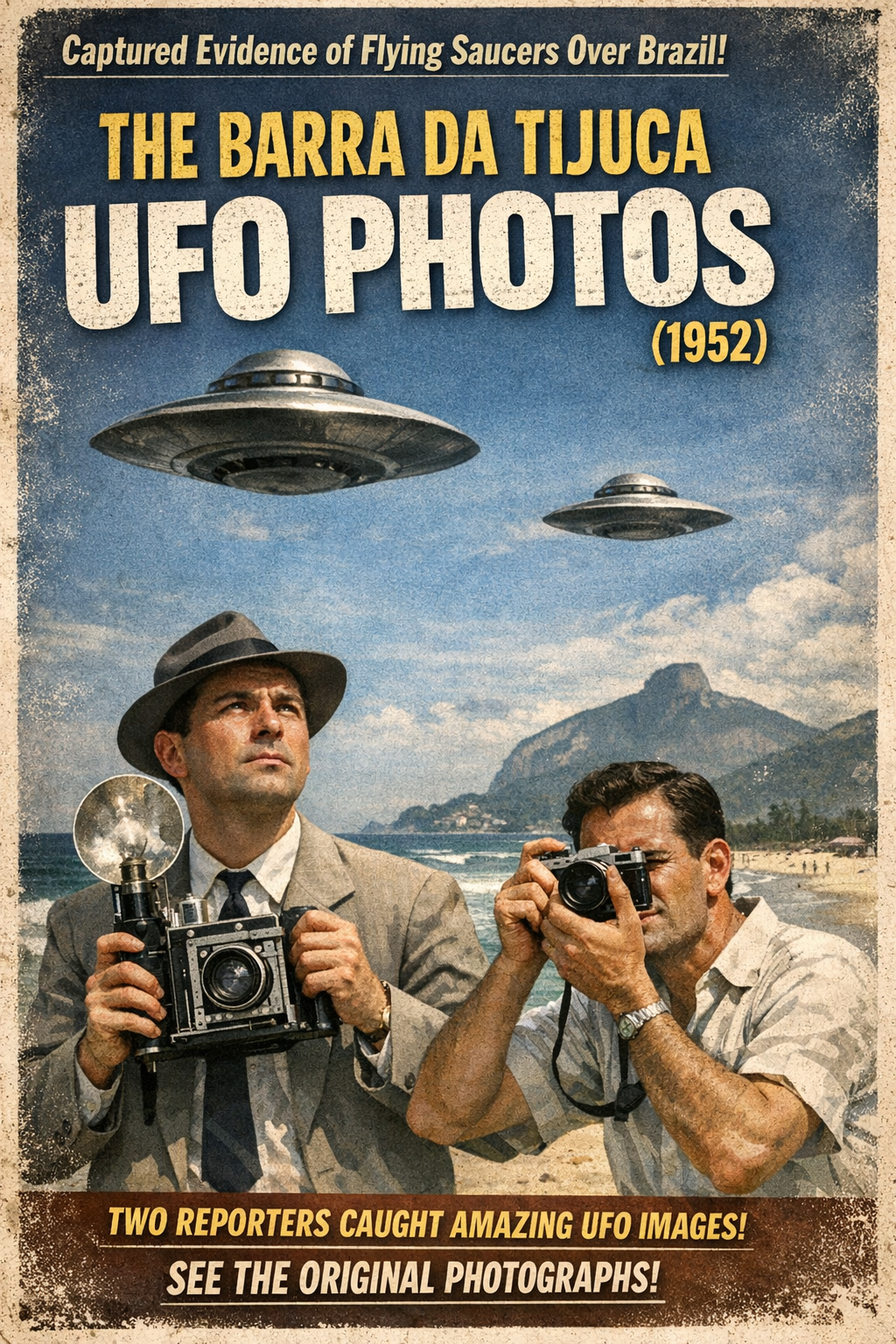
On May 7, 1952, one of the most famous UFO photographic cases in South America occurred over the beach area of Barra da Tijuca, near Rio de Janeiro, Brazil. Two journalists working for the magazine O Cruzeiro claimed they witnessed and photographed a mysterious flying object moving across the sky.
The resulting images—five photographs taken within about a minute—became some of the most widely discussed UFO photos of the 1950s, sparking debate among scientists, ufologists, and skeptics that continues today.
The Witnesses
The incident involved two media professionals:
-
Ed Keffel – a press photographer
-
João Martins – a reporter and engineer
Both worked for O Cruzeiro, one of Brazil’s largest weekly magazines at the time. On the afternoon of May 7, 1952, they were visiting Barra da Tijuca for a routine assignment when the strange event occurred.
The Moment of the Sighting
According to their testimony, the incident happened around 4:30 PM while they were near the beach. Martins noticed an object approaching rapidly from the direction of the ocean.
At first he thought it might be an airplane, but something looked unusual—the object appeared to be flying sideways and silently. Realizing it was something strange, Martins shouted to Keffel to start taking photographs.
Keffel quickly raised his Rolleiflex camera and captured five consecutive photos in about 60 seconds as the object moved across the sky.
The images showed a disc-shaped object that appeared metallic and slightly tilted, resembling what many people in the 1950s called a “flying saucer.”
Publication and Worldwide Attention
The photographs were soon published in the May 24, 1952 issue of O Cruzeiro, accompanied by a detailed article describing the encounter.
The story spread rapidly across Brazil and internationally. For many readers, the photos appeared to be some of the clearest UFO images ever captured at the time.
Some reports suggested that other witnesses in the area also saw the object, although the journalists’ photographs remained the main evidence.
Government and Scientific Interest
The case attracted the attention of the Brazilian Air Force, which conducted an investigation into the photographs. Some early analyses suggested the negatives showed no obvious signs of manipulation, leading certain investigators to consider the photos authentic.
Because of their clarity and sequence, the images were often cited in early UFO research as one of the strongest photographic cases from the 1950s.
Skeptical Analysis and Debate
Despite the excitement surrounding the photos, many scientists later questioned their authenticity.
Prominent skeptics such as Donald H. Menzel and planetary scientist William K. Hartmann argued that the lighting and shadows on the object appeared inconsistent with the shadows on the landscape below.
This suggested the possibility that the UFO image might have been added artificially or created using a small model.
Because the original negatives were never widely available for modern forensic analysis, the debate about the photographs remains unresolved.
Legacy of the Barra da Tijuca Case
More than seventy years later, the Barra da Tijuca photos remain one of the most famous UFO photographic cases in Latin America.
The incident is frequently referenced in UFO research alongside other classic sightings of the 1950s. Whether the photos captured a genuine unidentified aerial phenomenon or an elaborate journalistic hoax, they played an important role in shaping public fascination with flying saucers during the early Cold War era.
✅ Key Facts
-
Date: May 7, 1952
-
Location: Barra da Tijuca, Rio de Janeiro, Brazil
-
Witnesses: Ed Keffel and João Martins
-
Evidence: Five sequential photographs of a disc-shaped object
-
Status: Authenticity still debated
