
The Advanced Aerospace Threat Identification Program (AATIP)
The Advanced Aerospace Threat Identification Program (AATIP)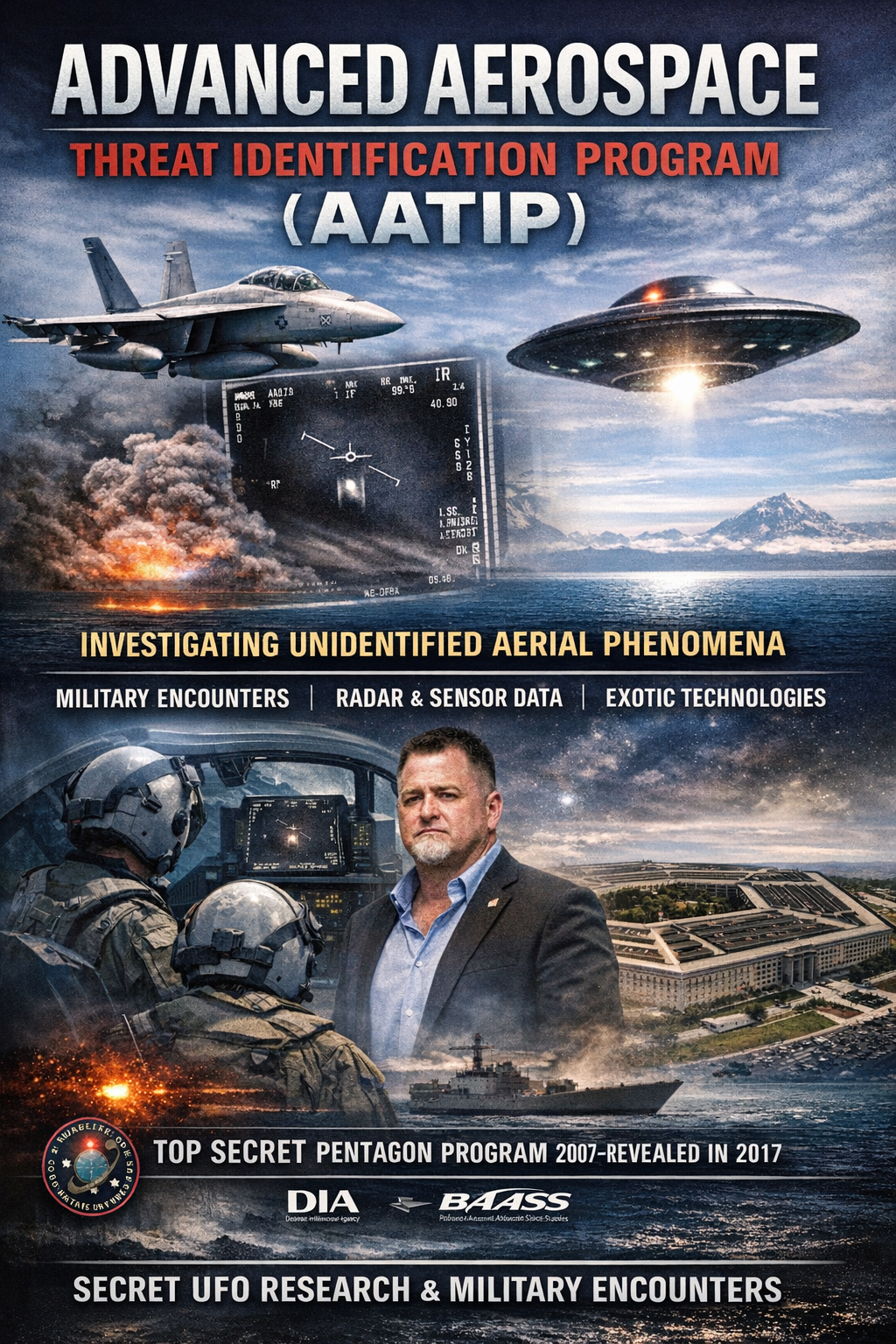
Introduction
The Advanced Aerospace Threat Identification Program (AATIP) was a secret U.S. government initiative created to investigate unidentified flying objects (UFOs)—now often referred to as Unidentified Aerial Phenomena (UAP). The program was funded by the United States Department of Defense and operated primarily between 2007 and 2012, although its existence remained unknown to the public until 2017.
AATIP attracted worldwide attention because it represented one of the most serious modern attempts by a government to scientifically analyze unexplained aerial encounters reported by military pilots and radar systems.
Origins of the Program
The program began in 2007 within the U.S. Defense Intelligence Agency (DIA) after funding was secured by former U.S. Senator Harry Reid of Nevada. He was supported by Senators Ted Stevens and Daniel Inouye, who shared concerns about unexplained aerial encounters reported by military personnel.
The project initially received $22 million in funding over five years. Its early phase was connected to a related research initiative called the Advanced Aerospace Weapon System Applications Program (AAWSAP), which studied advanced aerospace technologies and anomalous aerial events.
Much of the research work was contracted to Bigelow Aerospace Advanced Space Studies (BAASS), a private research company owned by aerospace entrepreneur Robert Bigelow.
Goals and Research Focus
The primary mission of AATIP was to analyze unidentified aerial phenomena and determine whether these objects posed a potential threat to national security.
Researchers examined reports of aerial objects displaying unusual characteristics, such as:
-
Extremely high speeds
-
Instant acceleration and sudden stops
-
Lack of visible propulsion systems
-
Ability to maneuver in ways beyond known aircraft capabilities
The program also funded 38 scientific studies exploring advanced theoretical technologies, including topics like hypersonic travel, warp drives, dark energy, and exotic propulsion systems.
These studies aimed to determine whether observed phenomena could be linked to unknown aerospace technologies developed by foreign powers or entirely new physical concepts.
Military Encounters and Data Collection
AATIP examined several high-profile encounters involving U.S. Navy pilots. One of the most famous cases involved mysterious objects tracked by radar and visually observed by pilots during training missions off the U.S. East Coast and Pacific Ocean.
Pilots reported seeing objects that:
-
Hovered without visible wings or engines
-
Accelerated faster than conventional aircraft
-
Disappeared suddenly from radar
These incidents were later discussed publicly when several U.S. Navy videos of unidentified aerial objects were released and analyzed by researchers and the media.
Public Revelation in 2017
For years, AATIP remained largely unknown outside classified government circles. Its existence became public on December 16, 2017, when investigative journalists revealed the Pentagon’s secret UFO research program.
The report revealed that the program had already ended official funding in 2012, though some officials claimed investigations continued informally afterward.
Former Pentagon intelligence officer Luis Elizondo, who was associated with the program, later resigned from the Department of Defense and publicly advocated for greater transparency about unexplained aerial phenomena.
Legacy and Successor Programs
Although the Pentagon stated that AATIP officially ended in 2012, government interest in unidentified aerial phenomena continued.
In 2020, the U.S. government confirmed the existence of a successor initiative known as the Unidentified Aerial Phenomena Task Force (UAPTF), which continued investigating military sightings of unexplained objects.
This marked a shift in how governments approach UFO research—moving from secrecy toward more open scientific and national security discussions.
Conclusion
The Advanced Aerospace Threat Identification Program (AATIP) represents a significant chapter in modern UFO research. Although its findings remain largely classified, the program demonstrated that governments take unexplained aerial encounters seriously—particularly when they involve military aircraft and advanced technology.
Today, AATIP is often cited as the foundation for the modern study of Unidentified Aerial Phenomena (UAP). Its legacy continues to influence ongoing investigations and the growing public interest in the mysteries of our skies.
