
The Condon Committee: A Scientific Investigation into UFO Phenomena

The Condon Committee: A Scientific Investigation into UFO Phenomena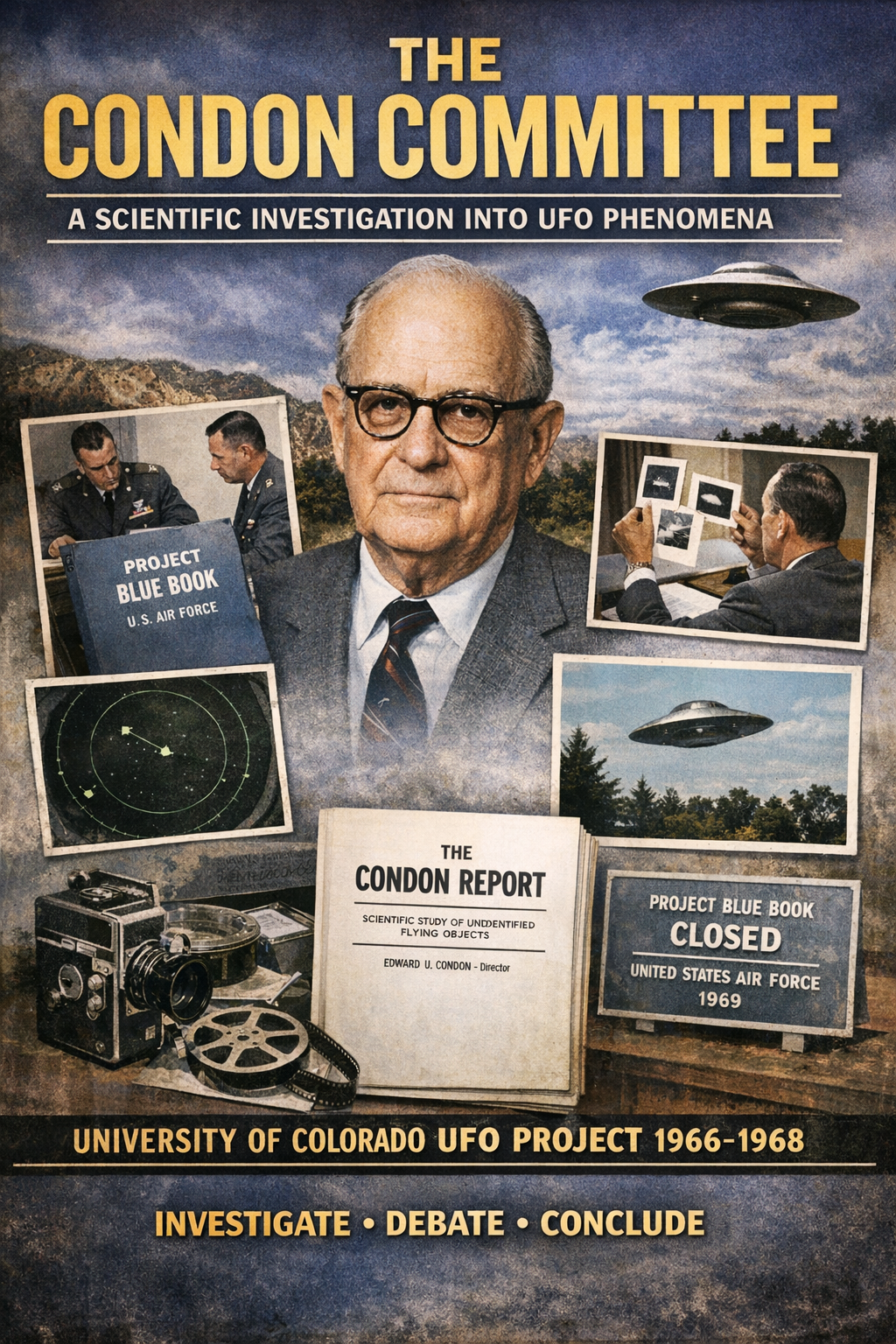
Introduction
The Condon Committee was a scientific research project established in 1966 to study reports of unidentified flying objects (UFOs). Officially known as the University of Colorado UFO Project, the program was conducted by scientists at the University of Colorado Boulder and funded by the United States Air Force.
The committee was led by renowned physicist Edward Uhler Condon, whose name later became associated with the project. Its purpose was to provide an independent scientific evaluation of UFO sightings and determine whether further official investigation of UFOs was scientifically justified.
Background
By the 1960s, thousands of UFO sightings had been reported across the United States and around the world. The U.S. Air Force had already been investigating these reports through Project Blue Book, which began in 1952.
However, the growing number of reports and public curiosity led the Air Force to seek a more formal scientific assessment. The Condon Committee was created to determine whether UFOs represented a serious scientific mystery or could largely be explained through conventional phenomena.
Research and Investigations
Between 1966 and 1968, the committee conducted detailed investigations of 59 UFO cases selected from hundreds of reports. These cases involved sightings reported by civilians, pilots, police officers, and military personnel.
Researchers examined evidence such as:
-
Eyewitness testimonies
-
Radar data
-
Photographs and films
-
Physical traces allegedly left by UFOs
Many sightings were eventually explained as misidentified aircraft, planets, weather balloons, or atmospheric phenomena. However, a small number of cases remained unexplained due to insufficient data.
The committee emphasized applying scientific methods and maintaining a skeptical approach when evaluating extraordinary claims.
The Condon Report
In 1969, the project published its final document, commonly known as the Condon Report. The report concluded that:
“Further extensive study of UFOs probably cannot be justified in the expectation that science will be advanced thereby.”
The committee stated that most UFO sightings did not represent new scientific phenomena and that continued government investigation was unlikely to produce significant discoveries.
This conclusion had major consequences for official UFO research in the United States.
Impact on Project Blue Book
Soon after the report’s release, the United States Air Force announced the closure of Project Blue Book in 1969.
The Air Force declared that UFO sightings:
-
Did not pose a threat to national security
-
Did not represent advanced technology from foreign nations
-
Did not provide evidence of extraterrestrial spacecraft
For many years afterward, the Condon Report became the primary scientific reference used by the U.S. government when discussing UFO phenomena.
Criticism and Debate
Despite its influence, the Condon Committee’s work has been debated by UFO researchers and scientists. Some critics argued that the committee was biased toward dismissing UFO reports, while others believed the study did not analyze enough cases.
Supporters of the report, however, maintain that it represented the most comprehensive scientific examination of UFO sightings conducted at the time.
Legacy
The Condon Committee remains one of the most important scientific investigations of UFO phenomena in the 20th century. Its conclusions shaped official government policy for decades and effectively ended large-scale public UFO research programs in the United States until renewed interest emerged in the 21st century.
Today, historians and researchers still examine the Condon Report as a key moment in the history of UFO investigations, representing the intersection of science, government policy, and public fascination with unexplained objects in the sky. 🛸
