
April 1, 2026 Artemis II Mission Launch
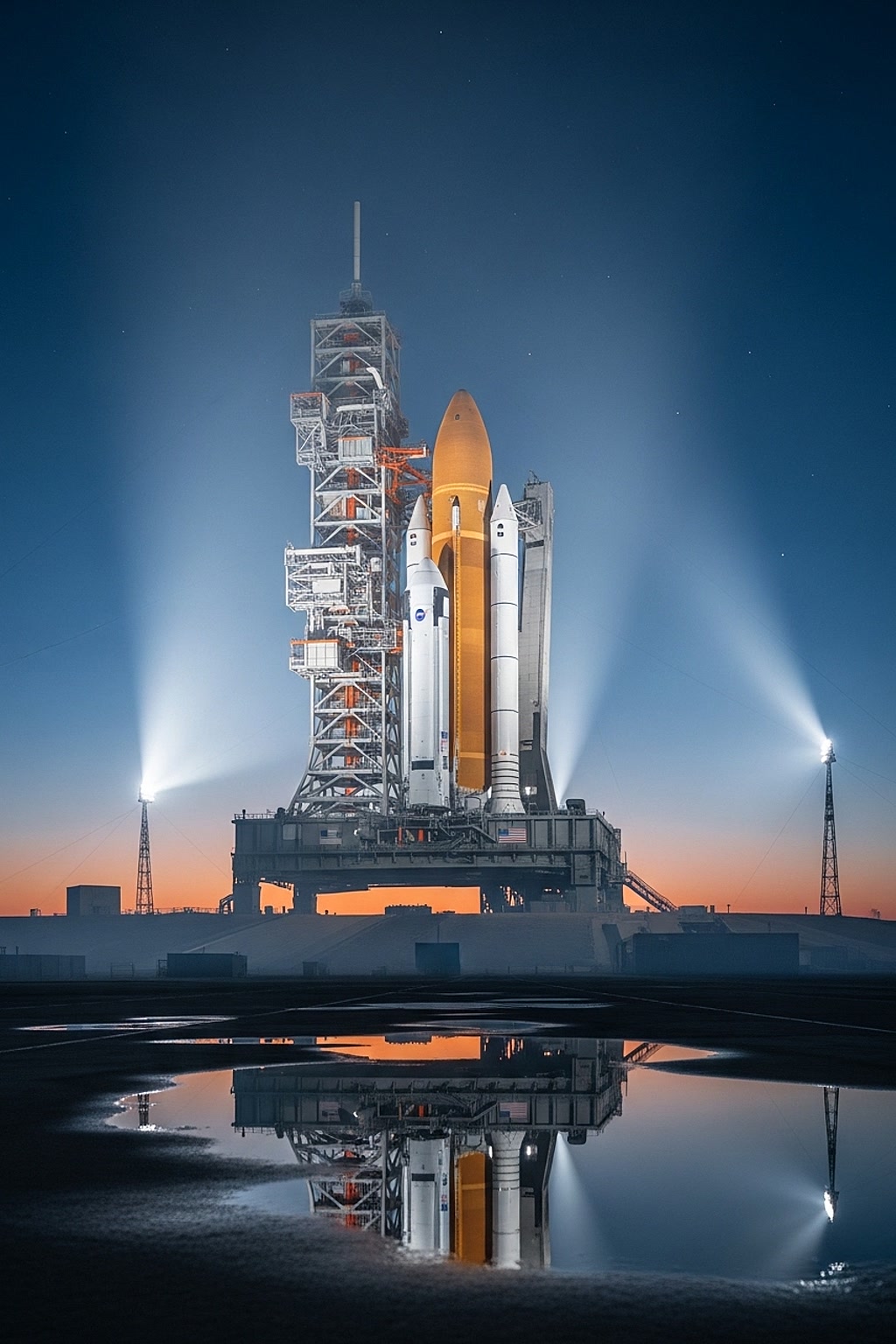
April 1, 2026 Artemis II Mission Launch
THE LUNAR FRONTIER REAWAKENS! (April 1, 2026)
After more than half a century of remaining confined within the protective cocoon of Low Earth Orbit (LEO), humanity is poised to shatter the celestial ceiling and reclaim its status as a deep-space species. The Artemis II mission represents a monumental leap in astronautics, marking the first time since the conclusion of the Apollo program in 1972 that biological entities will cross the high-energy Van Allen radiation belts to enter cislunar space. This is not merely a demonstration of ballistic prowess; it is the culmination of decades of cryogenic engineering, advanced thermal protection research, and complex orbital mechanics designed to extend the reach of our species into the profound gravitational well of our silver neighbor.
☿ Mercury: While the innermost planet remains tucked near the solar glare, the radiation-hardening technologies tested on the Orion spacecraft are the direct precursors to the future shielding required for inner-solar system exploration.
Venus: Our sister planet’s brilliance in the twilight serves as a stark atmospheric contrast to the airless, vacuum-exposed lunar environment that our four-person crew will navigate with precision.
♃ Jupiter: The king of planets reminds us of the massive gravitational forces at play in our solar system; Artemis II utilizes a “Hybrid Free Return Trajectory” to ensure the Moon’s own gravity acts as a safety tether to pull our explorers back toward Earth.
♄ Saturn: As the ringed giant orbits in the distance, the star-tracking navigation systems of the Orion capsule will use distant stellar markers to maintain an accuracy of mere meters across hundreds of thousands of miles of void.
The Orion MPCV: This Multi-Purpose Crew Vehicle is equipped with an Avcoat-coated heat shield designed to withstand 5,000°F during a high-velocity skip-reentry, dissipating energy at Mach 32.
The Atlantic Recovery Zone: A meticulously calculated splashdown coordinates where the U.S. Navy and NASA’s Exploration Ground Systems will execute a high-stakes recovery of the crew and their data-rich capsule.
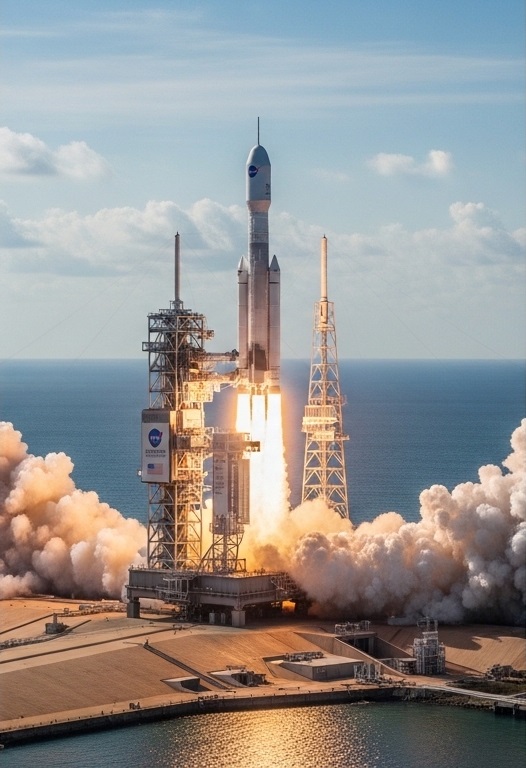
The Space Launch System (SLS) utilized for this mission is a marvel of modern thermodynamic efficiency and structural integrity. Standing 322 feet tall, the Block 1 configuration utilizes two five-segment Solid Rocket Boosters (SRBs) which, when combined with four liquid-hydrogen/liquid-oxygen-fueled RS-25 engines, generate a staggering 8.8 million pounds of liftoff thrust—15% more power than the legendary Saturn V. This massive energy output is required to accelerate the 5.75-million-pound vehicle to an escape velocity of approximately 24,500 mph. The mission’s journey involves a “trans-lunar injection” burn that will propel the crew 4,600 miles past the far side of the Moon, further than any human has ever traveled into the cosmic dark.
What to Watch For:
The Rollout (March 19, 2026): Observe the Crawler-Transporter 2, a 6.6-million-pound behemoth, as it painstakingly moves the SLS from the Vehicle Assembly Building to Pad 39B at a maximum speed of 1 mph.
The Primary Launch Window: Set your chronometers for April 1, 2026, at 6:24 PM EST. This 120-minute window is determined by the precise alignment of the Earth’s rotation and the Moon’s orbital position.
The Backup Opportunity: Should meteorological conditions or liquid hydrogen “scrubs” occur, a secondary window is calculated for April 2, 2026, at 7:22 PM EST.
Max-Q: Approximately 70 to 90 seconds after ignition, the vehicle will encounter the moment of Maximum Aerodynamic Pressure, the point where the structural stress from the atmosphere is at its absolute peak.
SRB Separation: At roughly 2 minutes and 12 seconds, watch for the blinding white plumes to vanish as the twin boosters drop away, having exhausted their solid propellant.
Pro-Tips for the Best View:
• Synchronize with Telemetry: Follow the official NASA live stream to track real-time velocity (km/s) and altitude data, which provides context for the sheer speed of the ascent.
• Atmospheric Clarity: For those in the Southeastern United States, ensure you have an unobstructed view of the Eastern horizon. The “twilight phenomenon” may create a glowing “jellyfish” effect in the upper atmosphere as the exhaust gases expand in the low-pressure environment.
• Acoustic Experience: If you are within 20 miles of Cape Canaveral, be prepared for the sound delay. Sound travels at roughly 1,125 feet per second; you will see the flame long before the low-frequency rumble vibrates your chest.
• Optical Assistance: Use high-powered binoculars or a telescope with a wide-field eyepiece to track the stage separation events, which will be visible as distinct rhythmic flashes in the night sky.
We are witnessing the dawn of the “Artemis Generation,” a pivotal era where the legacy of our ancestors meets the cutting-edge innovation of the 21st century. As the SLS clears the lightning towers, it carries with it the collective curiosity of eight billion people. This mission is the bridge to the surface of Mars and the foundational step toward a permanent presence on the lunar south pole. Take a moment to scan the heavens and appreciate the sheer magnitude of this orbital ballet.
The universe is putting on a show just for you.
