
The Loch Ness Monster: Scotland’s Most Famous Unsolved Mystery
The Loch Ness Monster: Scotland’s Most Famous Unsolved Mystery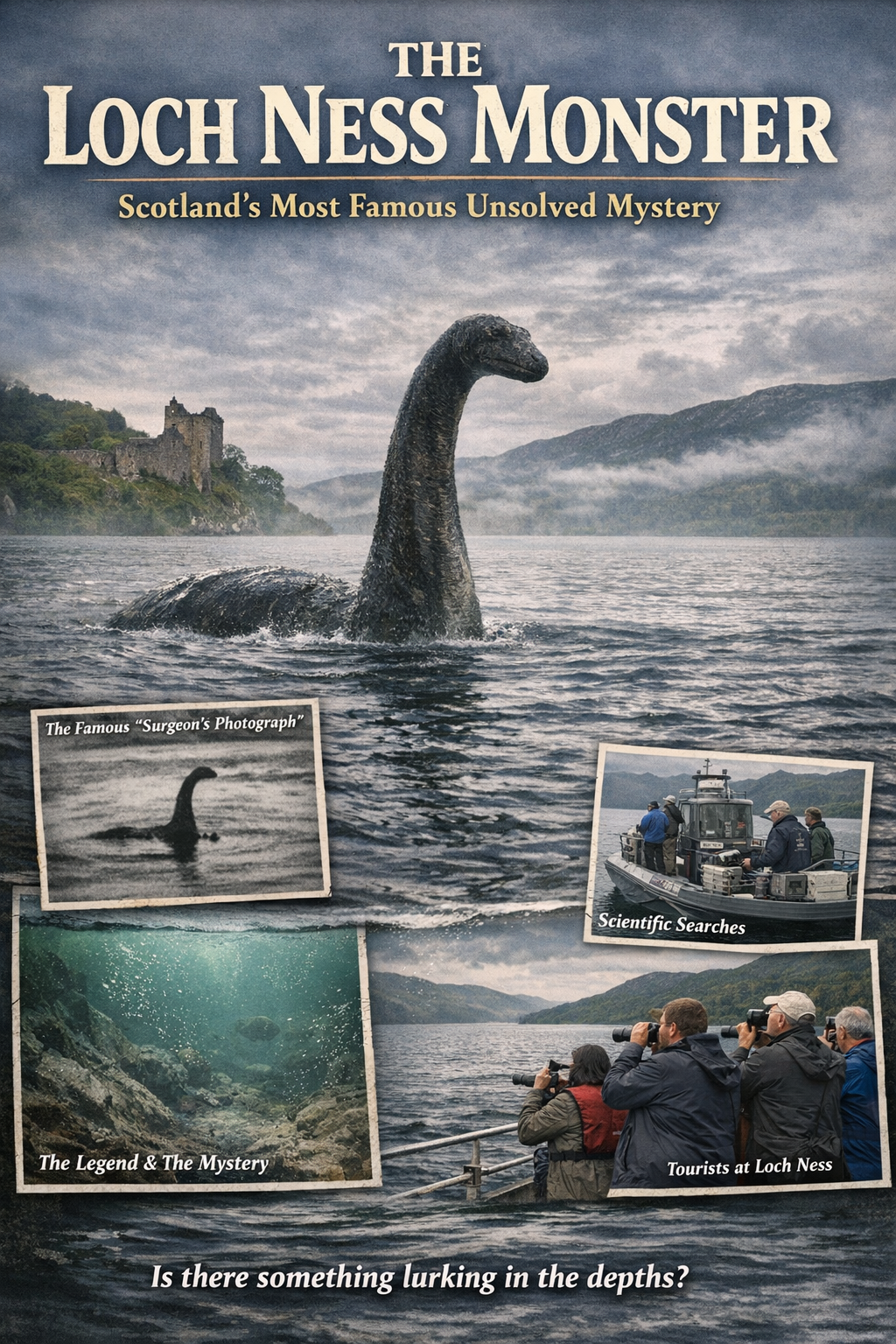
Introduction
For nearly a century, stories of a mysterious creature lurking beneath the dark waters of Loch Ness have fascinated the world. Known as the Loch Ness Monster, or simply “Nessie,” the creature has become one of the most famous legendary monsters in modern folklore.
Despite decades of scientific studies, underwater searches, and thousands of eyewitness accounts, no definitive proof has ever confirmed the creature’s existence. Yet the mystery continues to capture imaginations around the globe.
The Legend Begins
Stories about strange creatures in the waters of Loch Ness date back more than a thousand years.
One of the earliest references appears in the writings of Saint Columba in the year 565 AD. According to the account, the Irish monk reportedly encountered a “water beast” in the River Ness and frightened it away with the sign of the cross.
Although historians debate the accuracy of the story, it became the earliest legend associated with the mysterious creature.
The Modern Sightings
The modern legend of the Loch Ness Monster truly began in 1933, when a local couple claimed to see a massive animal crossing the road before sliding into the lake.
Soon afterward, newspapers began publishing reports of similar sightings. Witnesses described:
-
A long neck rising from the water
-
A large, dark body
-
Humps moving across the lake’s surface
These reports turned the quiet Scottish lake into a global sensation.
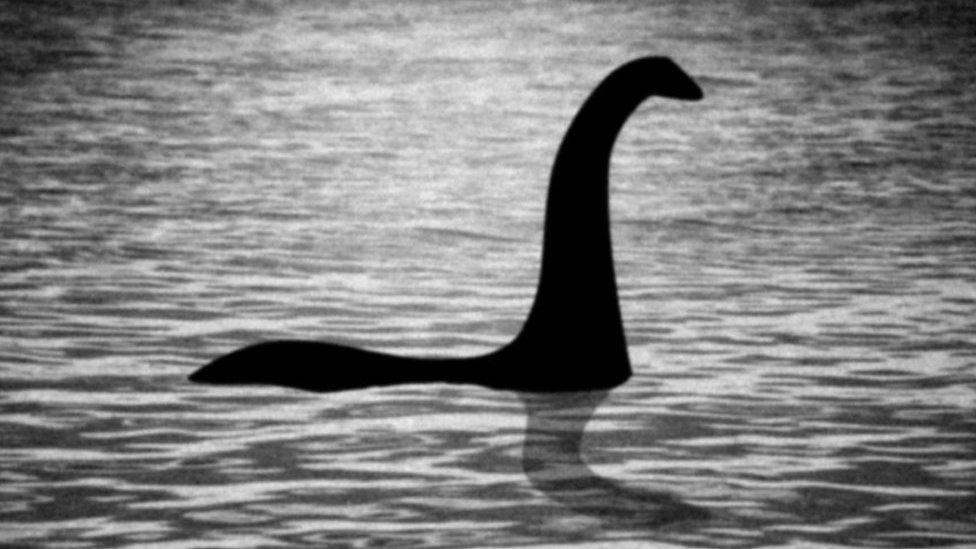
The Famous “Surgeon’s Photograph”
In 1934, one of the most famous images in cryptozoology was published in a British newspaper.
The photograph—taken by Robert Kenneth Wilson—appeared to show a long-necked creature emerging from the water.
For decades, the image was considered the strongest evidence of Nessie’s existence. However, in 1994, it was revealed to be a hoax involving a small model attached to a toy submarine.
Even so, the photograph remains one of the most iconic images connected to the legend.
Scientific Searches
Scientists and researchers have spent decades attempting to solve the mystery.
Major investigations have included:
-
Sonar scans of the lake
-
Submarine explorations
-
Underwater photography
-
Environmental DNA (eDNA) studies
In 2018, an international research team analyzed DNA samples from the lake’s water. The results found no evidence of large unknown reptiles but suggested that many sightings might actually be giant eels.
Still, the research did not completely rule out unknown species in the deep waters.
Why the Mystery Persists
There are several reasons why the Loch Ness Monster legend continues today.
1. The Depth of the Lake
Loch Ness is extremely deep—reaching over 230 meters (755 feet)—and its dark, murky water limits visibility.
2. Optical Illusions
Waves, floating logs, and unusual light reflections can easily create shapes that resemble a large animal.
3. Human Imagination
The mystery itself fuels tourism, stories, and ongoing speculation.
A Global Cultural Icon
Today, the legend of Nessie is deeply tied to the identity of the Scottish Highlands. The mystery attracts hundreds of thousands of tourists each year, eager to glimpse something unusual in the dark waters of the lake.
Museums, boat tours, and observation points around Loch Ness keep the legend alive.
Whether Nessie is a surviving prehistoric creature, a giant eel, or simply a myth created by imagination, the mystery continues to endure.
Conclusion
Nearly a century after the first modern sightings, the Loch Ness Monster remains one of the most famous unsolved mysteries in the world.
No conclusive evidence has proven the creature’s existence—but no explanation has completely ended the legend either.
And somewhere beneath the dark waters of Loch Ness, many still wonder if something unknown might still be hiding.
