
A Fully Habitable World — And Why Officials Are Being Extremely Careful With Their Words
Recent viral headlines claiming that the James Webb Space Telescope has discovered a “fully habitable planet” have captured widespread attention, but they significantly overstate what scientists have actually confirmed. While such a finding would mark one of the most profound breakthroughs in human history, there has been no official confirmation from NASA or the international teams operating the telescope that a truly Earth-like, fully habitable world has been identified. The excitement instead reflects both the extraordinary capabilities of JWST and humanity’s deep curiosity about life beyond Earth, rather than a definitive discovery.
Launched in 2021, the James Webb Space Telescope is the most powerful observatory ever built, designed to study the universe primarily in infrared light. This allows it to peer through cosmic dust, observe distant galaxies, and—perhaps most importantly—analyze the atmospheres of exoplanets with unprecedented detail. These planets, which orbit stars beyond our solar system, are key targets in the search for potentially habitable environments.
One of the primary criteria scientists use is whether a planet lies within the “habitable zone,” the region around a star where temperatures could allow liquid water to exist. However, this alone does not guarantee habitability. A planet must also have the right atmospheric composition, pressure, magnetic protection, geological stability, and a relatively calm host star. Habitability is therefore not a simple yes-or-no condition, but a complex spectrum of possibilities.
JWST has made remarkable progress using a technique called transit spectroscopy, which analyzes how starlight filters through a planet’s atmosphere during a transit. This method has already detected molecules such as water vapor, carbon dioxide, and methane on distant worlds. For example, observations of K2-18b revealed carbon-based molecules and even tentative hints of dimethyl sulfide—a compound associated with life on Earth. However, these findings remain preliminary, and K2-18b itself is a sub-Neptune, meaning its conditions are likely very different from Earth’s and possibly inhospitable to life as we know it.
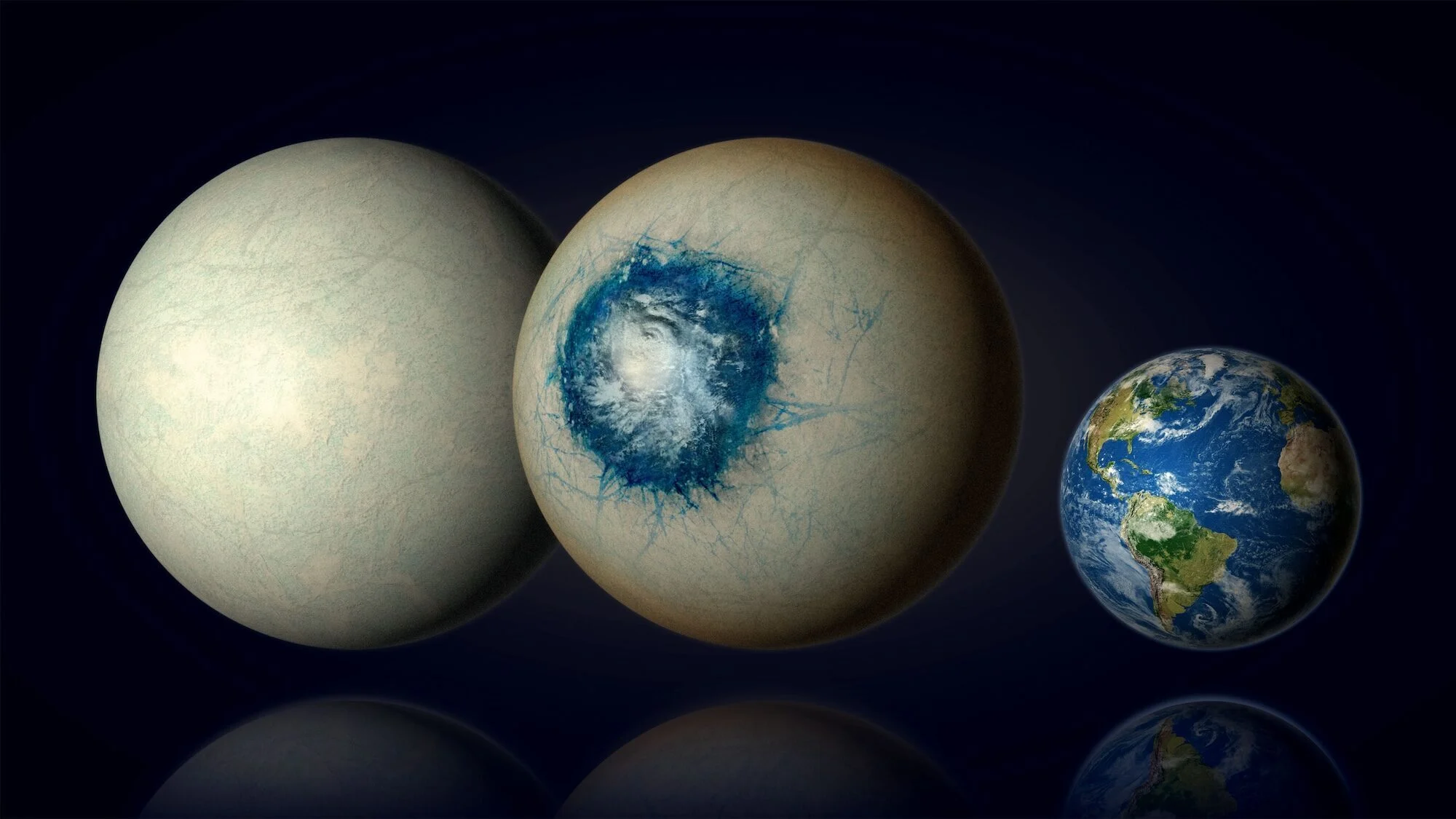
Another important system under study is TRAPPIST-1, which contains several Earth-sized planets within its habitable zone. Early JWST data suggests that some of these planets may lack thick atmospheres, reducing their chances of being truly habitable. These mixed results highlight how challenging it is to assess distant worlds with limited data.
A key concept in this search is the detection of biosignatures—chemical indicators that could suggest the presence of life. While combinations like oxygen and methane are considered promising, scientists must carefully rule out non-biological processes that could produce similar signals. False positives remain a major concern, and no confirmed biosignature has yet been detected on any exoplanet.
It is also important to recognize the limitations of current technology. JWST cannot directly image the surfaces of Earth-like planets around Sun-like stars; instead, it relies on indirect measurements that, while powerful, provide only partial information. Interpreting these signals requires careful statistical analysis, and findings are typically presented with caution, including uncertainty ranges and the need for further verification.
The public enthusiasm surrounding these discoveries reflects a deeper question that has fascinated humanity for centuries: are we alone? While JWST has not yet found a fully habitable planet, it has dramatically expanded our understanding of planetary diversity—from lava worlds to ocean candidates to gas giants—suggesting that the universe may host a wide range of potentially life-supporting environments.
Future missions, such as the Nancy Grace Roman Space Telescope, aim to build on this progress by identifying more candidate planets and, eventually, enabling direct imaging of Earth-like worlds. These advancements may bring us closer to confirming true habitability or even detecting signs of life.
For now, however, claims of a confirmed “fully habitable planet” remain premature. The James Webb Space Telescope is providing unprecedented insights and identifying promising candidates, but definitive proof of an Earth-like world has not yet been achieved. Scientific progress in this field is gradual and evidence-driven, requiring patience, verification, and careful interpretation. Even so, each new observation brings us closer to answering one of humanity’s most enduring questions, reshaping our understanding of the universe along the way.
