
James Webb Space Telescope Has Just Discovered a Supernova That Should Not Exist
When astronomers first examined the data from the James Webb Space Telescope, the reaction was not panic—but profound curiosity. The instruments had performed exactly as designed, peering deeper into cosmic history than ever before. And within that ancient light, researchers identified something remarkable: the signature of a powerful stellar explosion dating back to the universe’s earliest epochs.
This was not “impossible,” but it was unexpected.
The event appears to be a supernova originating during what scientists call the Cosmic Dawn—a period when the first stars and galaxies were just beginning to form after the Big Bang. According to long-standing models, this era was dominated by simple stars composed almost entirely of hydrogen and helium, with heavier elements emerging later through successive generations of stellar evolution.
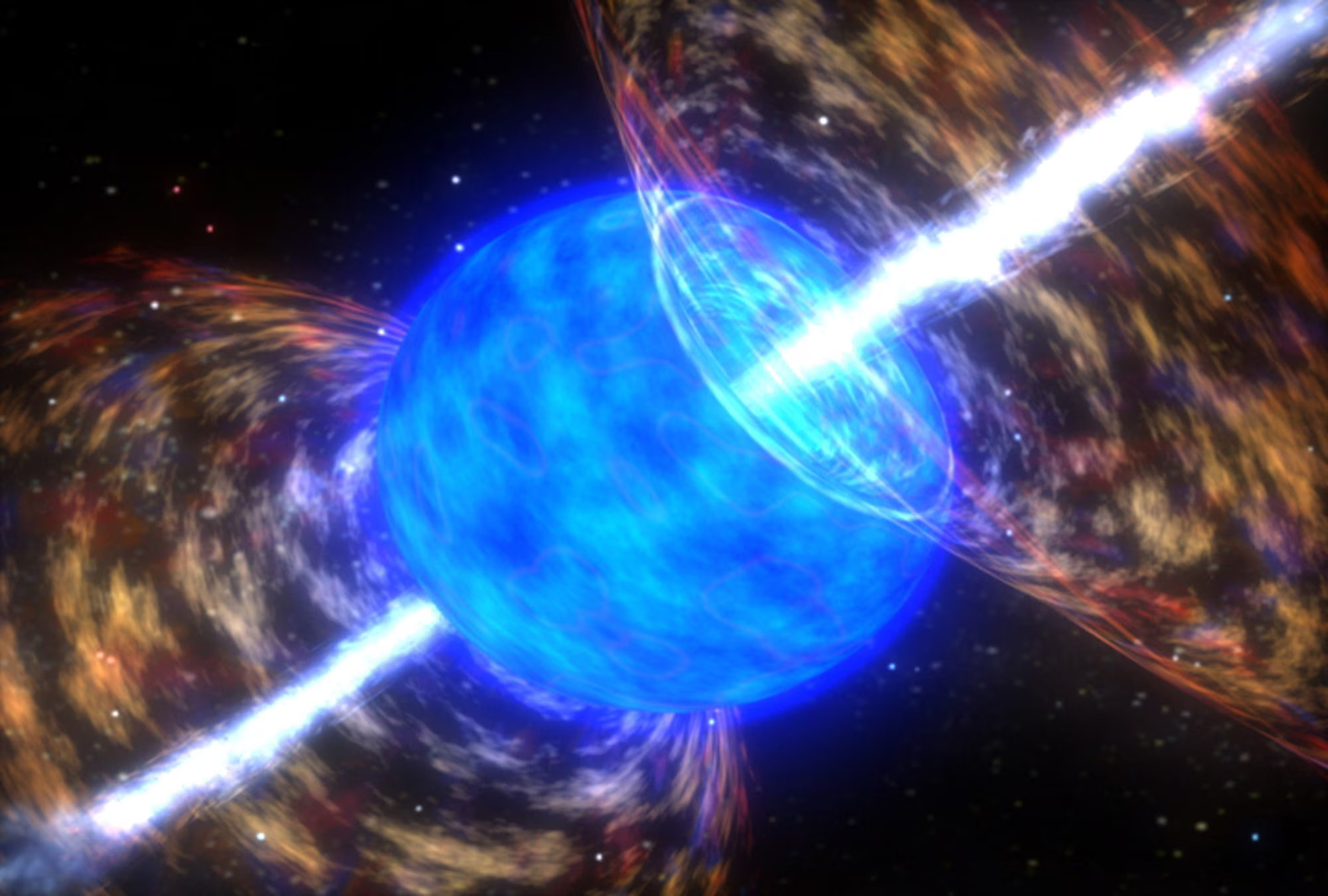
What makes this observation intriguing is that the explosion seems more energetic and chemically complex than expected for such an early time. Its spectral features suggest the presence of heavier elements, implying that earlier generations of stars may have already lived and died before this event occurred. In other words, the cycle of stellar birth and death—and the enrichment of the universe with heavier elements—may have begun sooner than previously thought.
This does not overturn cosmology, but it does refine it.
Scientists have long theorized the existence of Population III stars—massive, short-lived stars that formed from pristine primordial gas. These stars have never been directly observed, but their explosive deaths would have seeded the universe with the first heavy elements. Observations like this may represent indirect evidence of such early stellar populations or reveal that star formation in the young universe was more rapid and efficient than models predicted.
There are also alternative explanations under active investigation. Effects such as gravitational lensing—where massive foreground objects magnify distant light—or overlapping signals from multiple sources can sometimes make distant events appear brighter or more evolved than they truly are. Careful follow-up observations and analysis are essential before drawing firm conclusions.
What is clear is that discoveries like this highlight how dynamic and self-correcting science truly is. When new data challenges existing models, those models are updated—not discarded. The core principles of astrophysics remain intact, but the timeline and details of early cosmic evolution may need adjustment.
Rather than signaling a crisis, this is a moment of progress.
If stars were forming, evolving, and exploding earlier than expected, it suggests the young universe was more active and complex than once believed. That has important implications: galaxies may have assembled faster, and the elements necessary for planets—and potentially life—could have been distributed earlier in cosmic history.
Perhaps most striking is the perspective this provides. The light from this explosion traveled for over 13 billion years before reaching Webb. Long before the Milky Way took its current form, long before the Sun or Earth existed, this star lived and died—contributing to the cosmic processes that eventually made life possible.
The universe has not rewritten its history overnight. But with each new observation, especially from Webb, that history becomes richer, more detailed, and occasionally more surprising than we imagined.
And that is exactly how discovery is supposed to feel.
