
Something Is Trailing 3I/ATLAS… NASA’s Response Is Terrifying
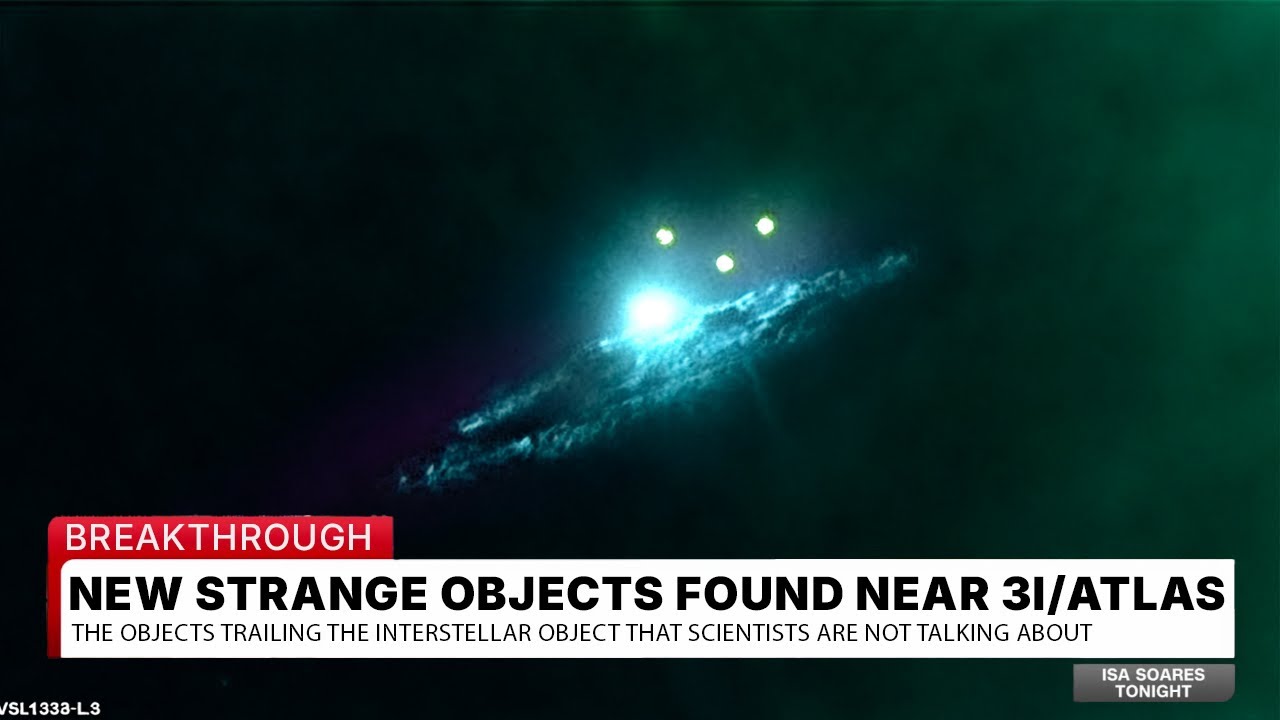
On October 2, 2025, an image allegedly showing the interstellar object 3I/ATLAS began circulating online, drawing attention for a peculiar feature: a thin, elongated structure appearing to trail alongside the object’s coma.
At first glance, the anomaly seemed unusual. It did not resemble the broad, diffuse tail typically associated with comets. Instead, it appeared narrow, sharply defined, and offset—prompting speculation about its origin.
But before jumping to conclusions, it’s important to examine the context more carefully.
The Instrument and the Limits of Imaging
The image has been attributed to the Mars Reconnaissance Orbiter, specifically its HiRISE camera—an instrument designed primarily for detailed imaging of the Martian surface, not fast-moving, distant comets.
When a camera like HiRISE captures an object tens of millions of kilometers away, several limitations come into play:
Motion blur from tracking a fast-moving target
Line-of-sight compression, which can distort spatial relationships
Image processing artifacts, especially when enhancing faint signals
Cosmic ray strikes, which can create streaks or linear features
A narrow “structure” in such conditions is far more likely to be an imaging artifact or projection effect than a solid object.
Known Comet Phenomena That Can Look “Wrong”
Comets are far more complex than they appear in textbook diagrams. Features that seem unnatural often have well-understood explanations:
Dust jets can form narrow, collimated streams that appear rigid in images
Perspective effects can make tails look offset or even detached
Ion tails and dust tails can separate and align differently depending on solar wind conditions
Rare geometric effects can even create the illusion of an “anti-tail”—a feature that appears to point toward the Sun due to viewing angle, not actual motion
These phenomena have been observed in multiple comets long before any claims about interstellar anomalies.
The “Silence” Question
The idea that NASA “said nothing” is often interpreted as suspicious—but in reality, it’s routine.
Organizations like NASA release enormous amounts of raw and minimally processed data. Not every image receives a detailed public explanation, especially when:
The feature is not scientifically significant
The anomaly is likely instrumental or observational
Further analysis is still ongoing
The object itself has not been officially confirmed or prioritized
Silence, in this context, usually reflects normal scientific filtering, not secrecy.
The Bigger Issue: Verification
As of now, there is no widely accepted, peer-reviewed confirmation of an object designated “3I/ATLAS” behaving in the ways described.
By contrast, confirmed interstellar objects like ʻOumuamua and 2I/Borisov were tracked extensively by multiple observatories, with openly published data and analysis.
Extraordinary claims—especially those involving artificial structures or unknown physics—require the same level of verification.
So What Did the Image Actually Show?
Most likely, the “elongated structure” falls into one of three categories:
A dust jet or tail filament shaped by solar radiation
A projection effect caused by viewing geometry
An imaging artifact from the sensor or processing pipeline
All three are common in deep-space imaging and can look surprisingly structured under certain conditions.
Why It Still Feels Mysterious
Human perception is wired to detect patterns and assign meaning—especially when something looks clean, linear, or “engineered.”
Combine that with:
limited context
high-contrast image processing
and no immediate explanation
…and it’s easy for a natural phenomenon to feel artificial.
Conclusion: Mystery vs. Evidence
The image is intriguing—but not evidence of anything artificial, hidden, or extraterrestrial.
What it does highlight is something more grounded:
We are observing distant objects at the edge of our technological limits. At those limits, physics, perspective, and instrumentation can produce visuals that challenge intuition.
And sometimes, the biggest mystery isn’t what we’re seeing—
It’s how easily we can misinterpret it.
