
The Quantum Measurement Problem: When Reality Refuses to Choose
📰 The Quantum Measurement Problem: When Reality Refuses to Choose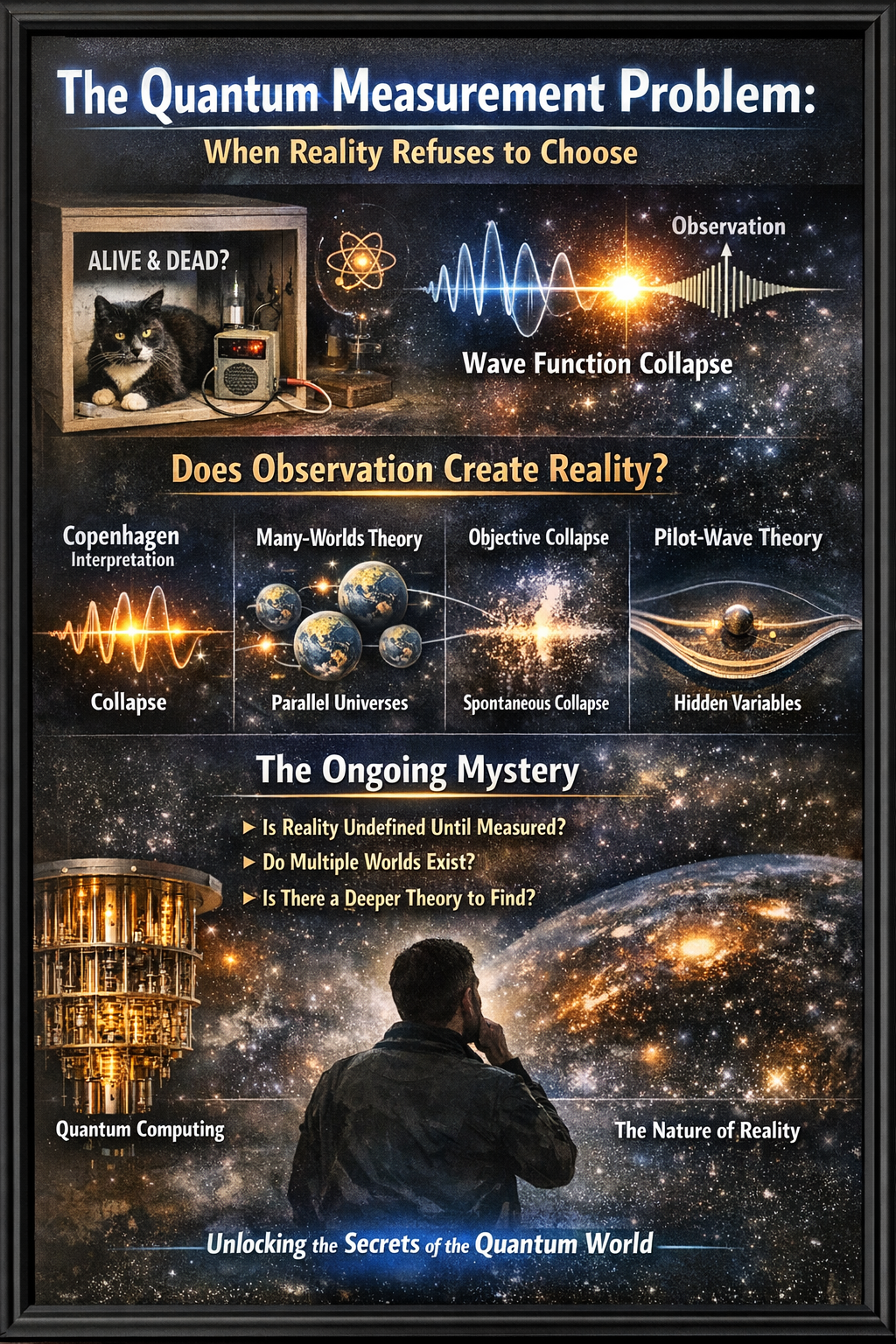
Introduction
At the smallest scales of nature, reality behaves in ways that defy common sense. Particles can exist in multiple states at once—until they are observed. This strange phenomenon lies at the heart of the Quantum Mechanics Measurement Problem, one of the deepest mysteries in modern physics.
Why does observation seem to “choose” a single outcome? And what does that mean about reality itself?
The Strange World of Quantum Physics
In quantum mechanics, particles such as electrons or photons are described by a wave function—a mathematical object that encodes all possible states of a system.
Before measurement, a particle exists in a superposition, meaning it can be in multiple states simultaneously. But when we measure it, we always observe a single, definite outcome.
This transition—from possibility to reality—is what makes the measurement problem so puzzling.
Schrödinger’s Cat: A Thought Experiment
To illustrate the paradox, physicist Erwin Schrödinger proposed the famous thought experiment known as Schrödinger’s Cat.
A cat is placed in a sealed box with a mechanism that may or may not release poison based on a quantum event.
According to quantum theory:
-
Before observation, the cat is both alive and dead
-
Only when the box is opened does the system “collapse” into one outcome
This absurd scenario highlights the difficulty of applying quantum rules to everyday objects.
The Role of Observation
One of the biggest questions is:
What counts as a “measurement”?
Does it require:
-
A human observer?
-
A measuring device?
-
Any interaction with the environment?
Physicists still debate whether consciousness plays any role—or if the process is entirely physical.
Major Interpretations
1. Copenhagen Interpretation
Traditionally associated with Niels Bohr, this view states that the wave function collapses upon measurement, producing a definite outcome.
2. Many-Worlds Interpretation
Proposed by Hugh Everett III, this theory suggests that all possible outcomes occur—but in separate, branching universes.
3. Objective Collapse Theories
These propose that wave function collapse happens spontaneously, without observation, due to physical processes.
4. Pilot-Wave Theory
Also known as Bohmian mechanics, this interpretation suggests particles always have definite positions guided by hidden variables.
Why It Matters
The measurement problem is not just philosophical—it has real implications for:
-
Quantum computing
-
Fundamental physics
-
The nature of reality itself
Understanding it could reshape our view of the universe at its most basic level.
The Ongoing Mystery
Despite nearly a century of research, there is still no consensus on how or why measurement works in quantum mechanics.
Some physicists believe the answer will come from new physics beyond quantum theory. Others think the mystery reflects a limitation of human understanding.
Conclusion
The quantum measurement problem challenges our most basic assumptions about reality.
Is the world fundamentally uncertain until observed?
Do multiple realities exist simultaneously?
Or is there a deeper theory yet to be discovered?
Until these questions are answered, the measurement problem remains one of the most fascinating and unsettling mysteries in science—where reality itself seems to hesitate before making a choice.
