
Time Dilation and Time’s Arrow: The Mystery of Time Itself
📰 Time Dilation and Time’s Arrow: The Mystery of Time Itself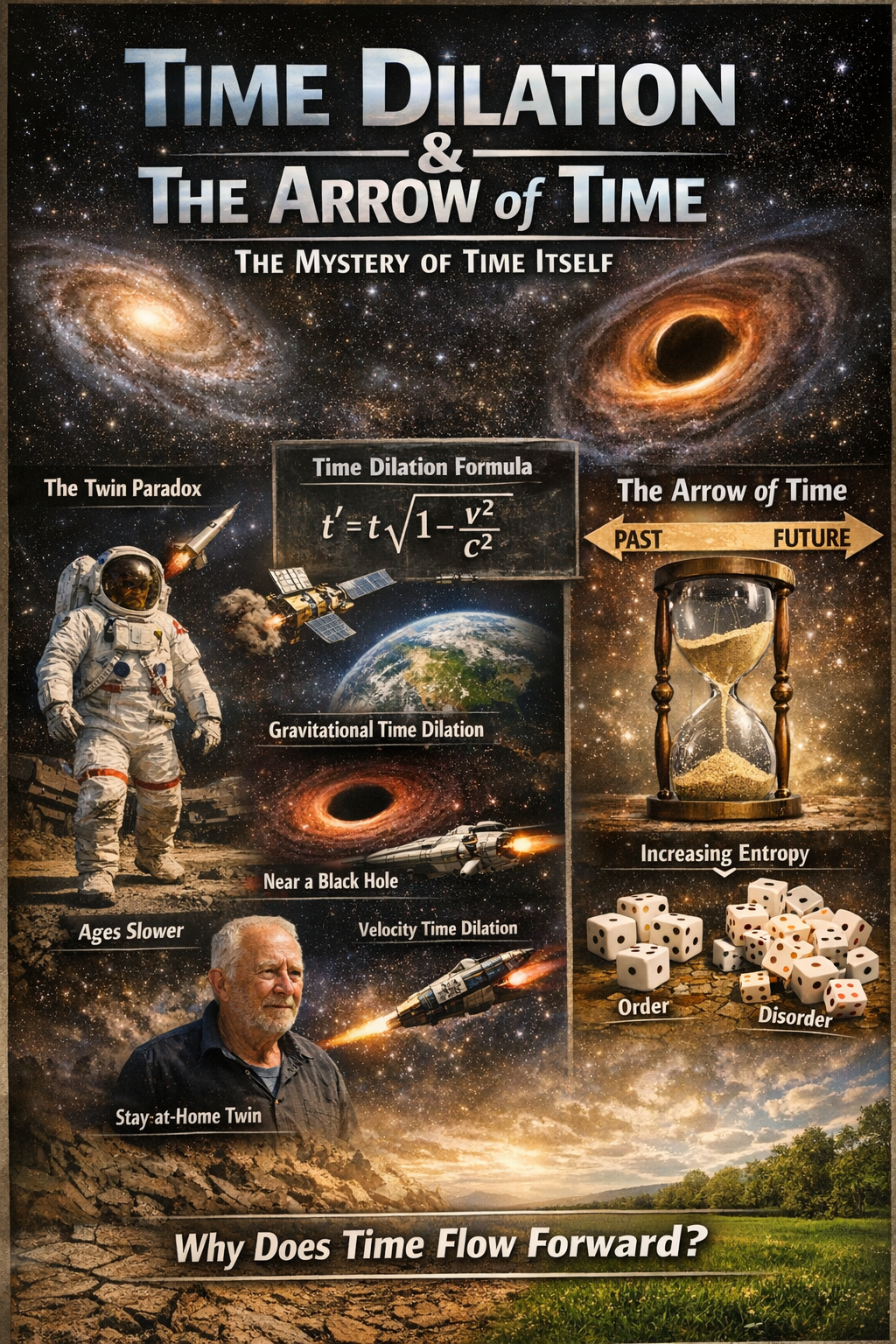
Introduction
Time is one of the most familiar aspects of our lives—yet it is also one of the most mysterious. Why does time seem to flow in one direction? And how can it slow down under certain conditions?
These questions lie at the intersection of two profound ideas: Time Dilation and Arrow of Time. Together, they reveal that time is far stranger than it appears.
Time Is Not Absolute
For centuries, time was thought to be constant and universal. That changed with the work of Albert Einstein, whose theories of relativity revolutionized our understanding of time.
According to relativity:
-
Time can pass at different rates for different observers
-
Motion and gravity can affect how fast time flows
This means that time is not fixed—it is flexible.
What Is Time Dilation?
Time dilation occurs when time passes at different speeds depending on conditions such as velocity or gravity.
There are two main types:
1. Velocity-Based Time Dilation
The faster an object moves, the slower time passes for it relative to a stationary observer.
This effect becomes noticeable at speeds close to the speed of light.
2. Gravitational Time Dilation
Strong gravitational fields—such as those near massive objects—slow down time.
For example, near a black hole, time can pass dramatically slower compared to distant observers.
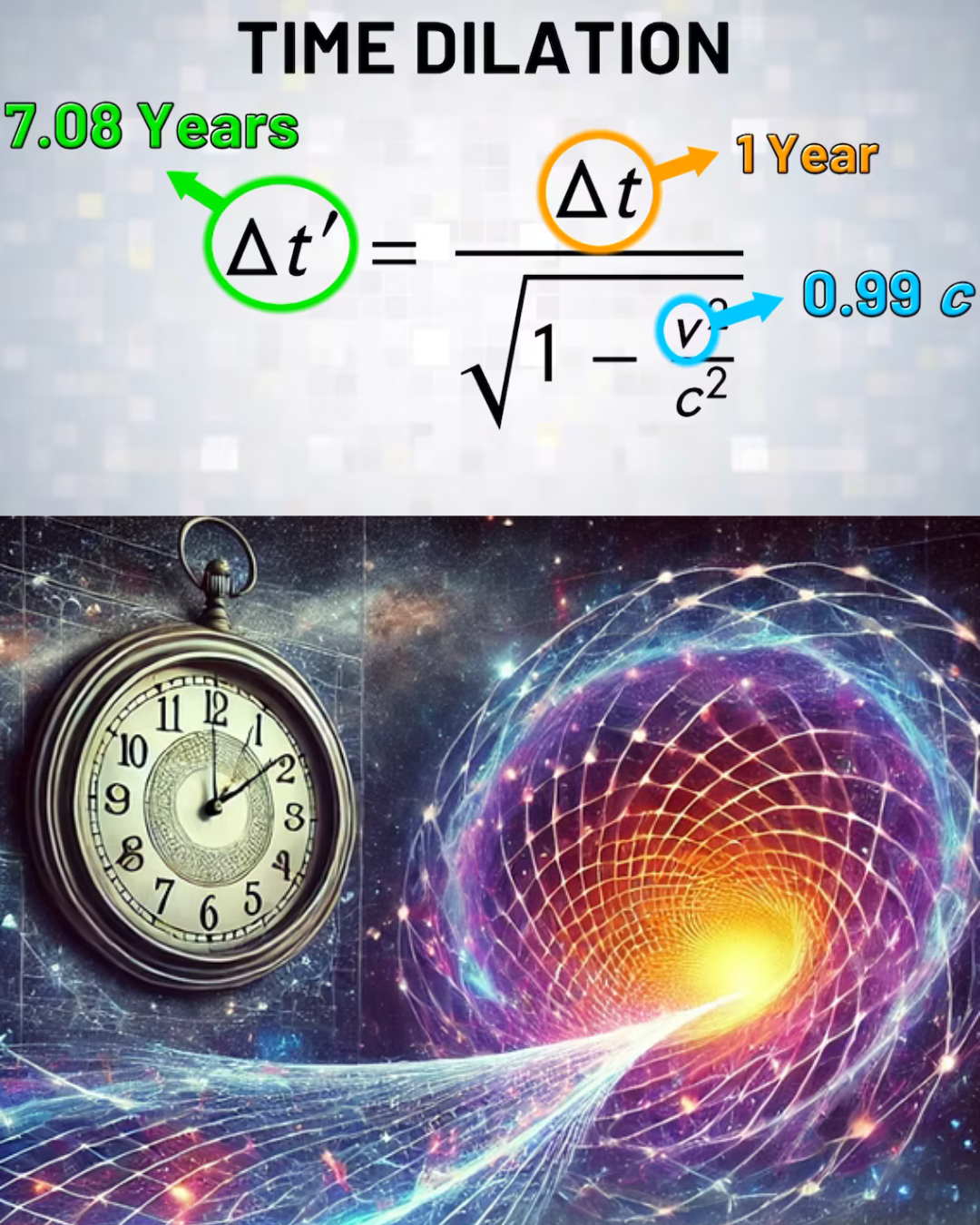
Time Dilation Formula
The relationship between motion and time is described by a key equation from relativity:
t′=t1−v2c2t’ = \frac{t}{\sqrt{1 – \frac{v^2}{c^2}}}
This equation shows how time (t′t’) for a moving observer depends on velocity (vv) relative to the speed of light (cc).
The Arrow of Time
While physics equations often work the same forward and backward, our experience of time is one-directional—we remember the past, not the future.
This direction is called the arrow of time, and it is closely linked to the concept of entropy from thermodynamics:
-
Systems naturally move from order to disorder
-
Entropy (disorder) increases over time
This gives time its apparent direction—from past to future.
Why Does Time Move Forward?
One of the biggest mysteries is why time has a direction at all.
Some explanations include:
-
The universe began in a highly ordered state (low entropy)
-
The expansion of the universe may define a time direction
-
Human perception may play a role in how we experience time
However, none of these fully explain why time cannot be reversed.
The Twin Paradox
A famous example of time dilation is the Twin Paradox:
-
One twin travels through space at near-light speed
-
The other remains on Earth
-
When the traveling twin returns, they are younger
This thought experiment demonstrates that time is not the same for everyone.
Why It Matters
Understanding time dilation and the arrow of time has real-world implications:
-
GPS satellites must account for time dilation to remain accurate
-
Astrophysics relies on these concepts to study black holes and cosmic evolution
-
Philosophy explores what time means for reality and existence
Conclusion
Time is not just a simple, steady flow—it is dynamic, flexible, and deeply mysterious.
Time dilation shows that time can stretch and slow, while the arrow of time suggests a direction that shapes our entire experience of reality.
Together, they reveal a universe where time is not absolute—but a complex and still-unsolved puzzle.
What is time, really—and why does it move the way it does?
