
Ultra-High Energy Cosmic Rays: The Most Powerful Particles in the Universe
📰 Ultra-High Energy Cosmic Rays: The Most Powerful Particles in the Universe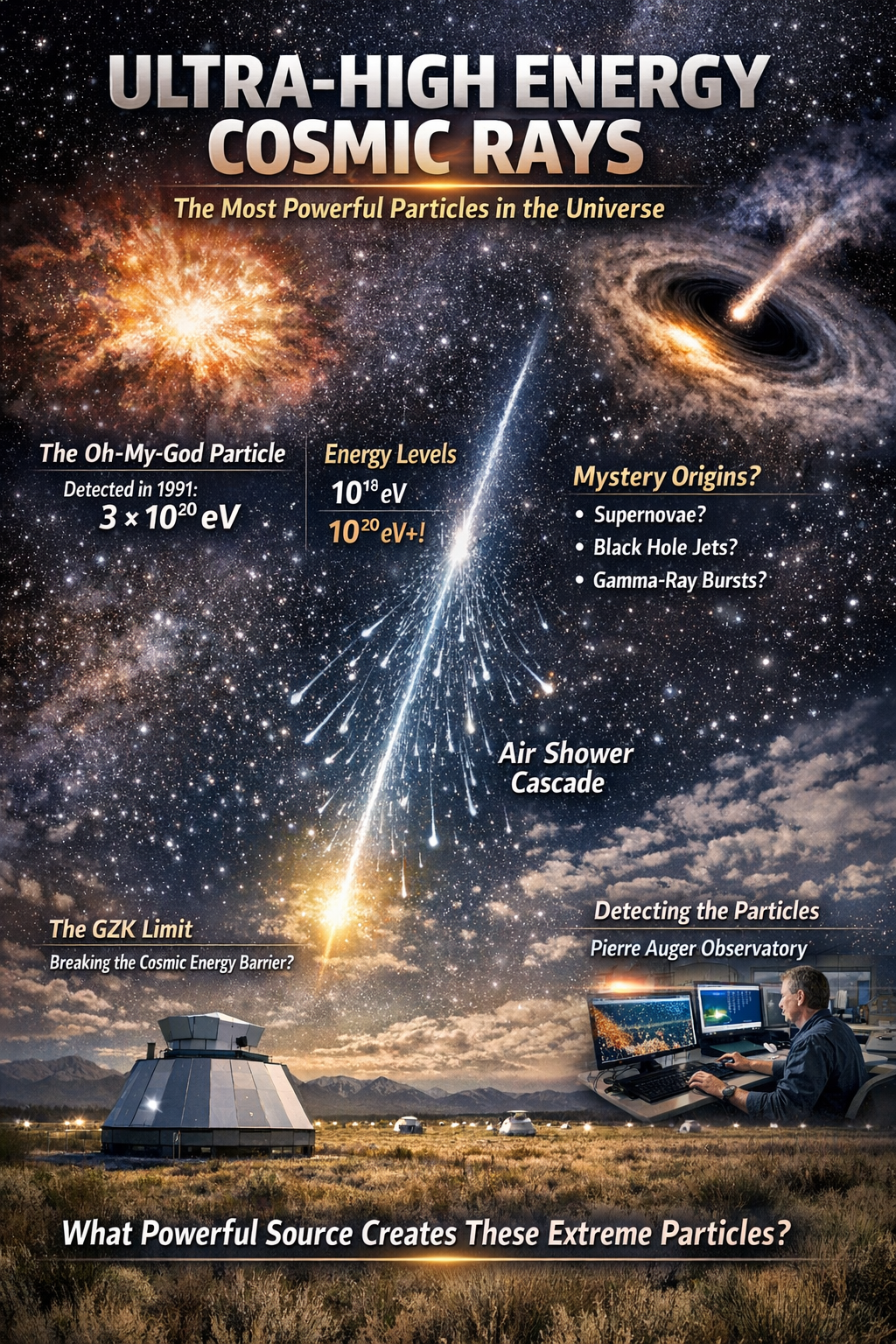
Introduction
From the depths of space, invisible particles constantly bombard Earth at nearly the speed of light. Among them are the most energetic particles ever observed—Ultra-High Energy Cosmic Rays.
These particles carry more energy than anything produced by human technology, yet their origin remains one of the greatest mysteries in astrophysics.
What Are Cosmic Rays?
Cosmic rays are high-energy particles—mostly protons or atomic nuclei—that travel through space at incredible speeds.
Most cosmic rays have relatively low energy, but a rare few reach astonishing levels known as ultra-high energy cosmic rays (UHECRs). These can exceed:
-
101810^{18} electronvolts (eV)
-
Some even reaching beyond 102010^{20} eV
To put this in perspective, a single UHECR can carry as much energy as a well-hit baseball—compressed into a single subatomic particle.
The Oh-My-God Particle
In 1991, scientists detected one of the most famous cosmic rays ever recorded, nicknamed the “Oh-My-God Particle.”
It had an energy of about 3×10203 \times 10^{20} eV, far beyond what scientists expected. This discovery shocked the scientific community and highlighted just how extreme these particles can be.
Where Do They Come From?
The origin of ultra-high energy cosmic rays is still unknown. Possible sources include:
-
Exploding stars (supernovae)
-
Black Hole jets
-
Active galactic nuclei (supermassive black holes at galaxy centers)
-
Gamma-ray bursts
However, none of these sources fully explain the highest-energy particles observed.
The GZK Limit
According to theory, there is an upper limit to how energetic cosmic rays can be when reaching Earth, known as the Greisen–Zatsepin–Kuzmin Limit (GZK limit).
This limit suggests that ultra-high energy cosmic rays should lose energy as they travel through space due to interactions with background radiation.
Yet, some observed particles appear to exceed or challenge this limit, deepening the mystery.
How Do We Detect Them?
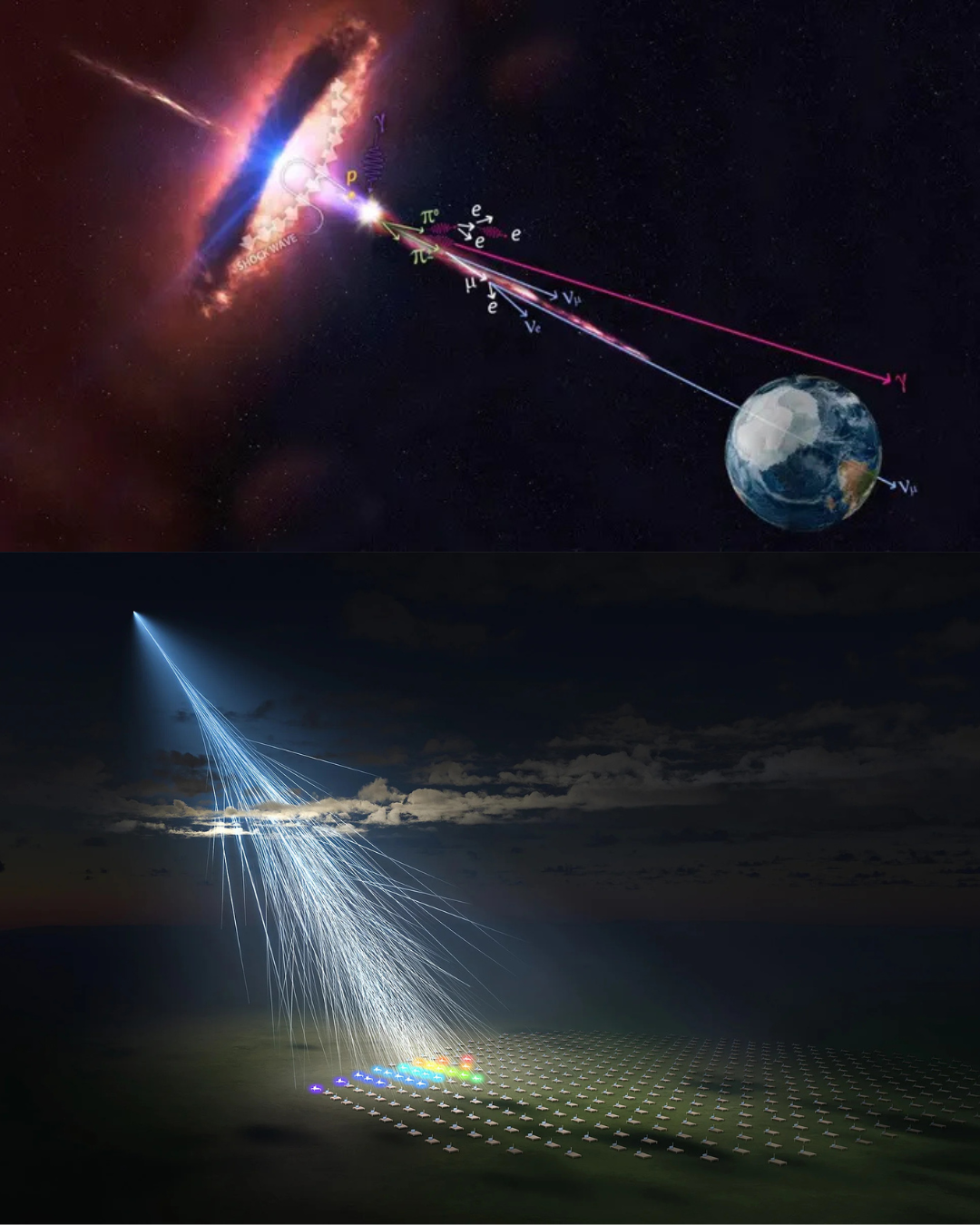
Because these particles are so rare, scientists use massive detectors on Earth, such as the Pierre Auger Observatory, to study them.
When a UHECR strikes Earth’s atmosphere, it creates a cascade of secondary particles called an air shower, which can be detected across large areas.
Why the Mystery Matters
Understanding ultra-high energy cosmic rays could help scientists:
-
Identify the most powerful particle accelerators in the universe
-
Understand extreme astrophysical environments
-
Test the limits of known physics
These particles may even hint at new physics beyond current theories.
Conclusion
Ultra-high energy cosmic rays are among the most powerful and mysterious phenomena in the universe.
They travel unimaginable distances, carry enormous energy, and arrive at Earth without revealing their origins.
As scientists continue to study them, one question remains:
What cosmic engine is powerful enough to create such extraordinary particles?
