
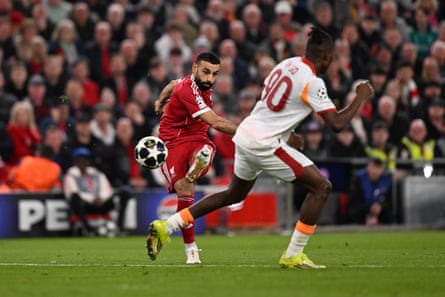
It was perhaps as well that Mohamed Salah’s last game before the announcement of his departure from Liverpool was the home game against Galatasaray. After all the frustrations and disappointments of this season, all the games of drifting forlorn and disconnected on the right, after the missed penalty in the first half, here at last was a reminder of the player he had been.
It wasn’t just his goal, a characteristic left-footed whip into the top corner after cutting in from the right after a one‑two with Florian Wirtz, or even the low cross for Hugo Ekitiké’s goal or the fearsome shot that led to Ryan Gravenberch’s; it was the sense of menace, of gleeful mischief, of the way the crowd was gripped by anticipation when the ball came to him. Even if he is not granted another spell like that this season, at least he and Anfield had that chance to remember old times.
But this has been a troubled season, the loss of form, focus and confidence startlingly sharp. The death of Diogo Jota has, almost certainly, played a part. The season began with Salah standing alone before the Kop after scoring in the 4‑2 win against Bournemouth, as they sang their tribute to Jota and he wiped away the tears with his cuff. But there is rarely only one factor at play.
Salah is 33 and time is sapping at his legs. Liverpool are moving on: if the summer spree was undertaken with any single plan in mind, it was presumably to play with two central forwards and Wirtz in behind, which is not a system in which Salah naturally fits. There was a sense at times that this was a post-Salah side that somehow still featured Salah.
His departure has felt inevitable from the moment he stopped in the mixed zone after Liverpool’s 3‑3 draw at Leeds in December and, clearly smarting at repeatedly being left out, spoke of how he had “no relationship” with Arne Slot. Which, if nothing else, was a reminder of how vital relationships are in football, not only with managers but with other players.
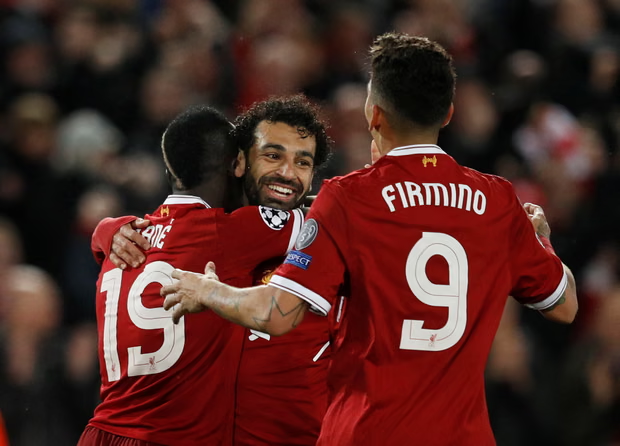
Salah was fortunate during his Liverpool peak to be part of two great trios at once. There was the forward line, with Sadio Mané and Robert Firmino, but there was also the right side, with Jordan Henderson and Trent Alexander‑Arnold. Among his many gifts as a manager, perhaps Jürgen Klopp’s greatest strength was his capacity to find internal balance and harmony.
Mané and Salah were clearly never great friends – as was made clear by Mané’s gently provocative words after Senegal had beaten Egypt in the Africa Cup of Nations semi-finals – but they played supremely well together, both cutting in from their respective flanks into the space left by Firmino. But just as important was that link-up on the right, three players of various degrees of unorthodoxy who gelled perfectly.
Alexander-Arnold could overlap, creating a passing option outside or drawing a defender to create space for Salah to exploit. But he was also valuable in releasing Salah with quick and accurate early passes, or stepping infield into a defensive midfield position from where he could still pick out Salah on the wing. Henderson, a relentless worker and more tactically astute than he is often given credit for, could then fill the space, not quite doing the running for the entire flank, but certainly allowing Salah and Alexander-Arnold to exploit their abilities to the full.
Salah took full advantage. His 255 goals for the club place him third in the all-time list, behind only Ian Rush and Roger Hunt. Scoring in 10 games in a row is a club record. Nobody else has scored 20 or more in a campaign for Liverpool eight seasons in a row. But the stats are only corroboration. What will live on are individual memories. His most important goal was probably the penalty that set Liverpool on their way to victory in the 2019 Champions League final, but his greatest goal, amid a lot of competition, was probably his solo run in the 2-2 draw at home against Manchester City in October 2021.
He played a huge part too in Liverpool’s two Premier League title successes: 19 goals in 2019‑20 and 29 last season, when Slot gave him the freedom to operate high on the right and, with Alexander‑Arnold behind him and Dominik Szoboszlai plus Gravenberch compensation for his lack of tracking. But as the system has changed, so has the environment and Salah’s effectiveness. Perhaps it would have been better had he left at the end of last season, but it would have taken real ruthlessness and clear-sightedness, from both sides, to move on after such a high.
There can be debate about exactly where in the pantheon of great Liverpool forwards Salah stands, but that he is in the pantheon, and pretty near the top, is beyond dispute. Soon, the anticlimactic final season will be forgotten, and he will be remembered as the club legend he is, wriggling in from the right, setting the ball on to his left and arcing it at pace into the corner – just as he did last Wednesday.
