
From Earth to the Moon: How Speed Changes the Meaning of Distance
From Earth to the Moon: How Speed Changes the Meaning of Distance
The Moon often appears so close that it feels almost within reach, a bright companion in the night sky that has inspired wonder for generations. Yet the reality of traveling to our nearest cosmic neighbor depends entirely on one simple factor: speed. The distance between Earth and the Moon averages about 384,400 kilometers, a vast stretch of space that transforms dramatically depending on how it is crossed.
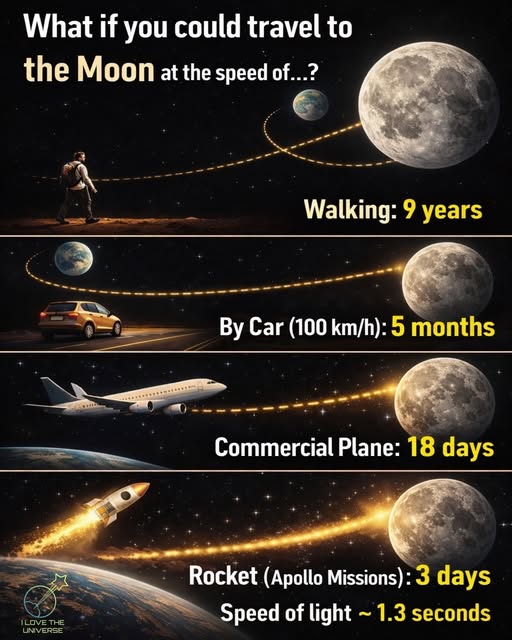
At a walking pace of roughly five kilometers per hour, the journey would take close to nine years of continuous movement, turning a celestial trip into a lifetime endurance test. A car traveling at one hundred kilometers per hour could shorten that journey to around five months, still a daunting and impractical endeavor. A commercial airplane, cruising at approximately nine hundred kilometers per hour, would make the trip in about eighteen days, revealing how modern technology can compress enormous distances into achievable timeframes.
Only with rockets, such as those used during the Apollo missions, does lunar travel become truly realistic, reducing the voyage to roughly three days. At the ultimate limit, the speed of light would make the journey in just over a second, illustrating the profound difference between human engineering and the fundamental laws of physics.
The Moon may seem close when we gaze upward, but this comparison reminds us that space is both intimate and immense. It is a reminder of humanity’s curiosity, innovation, and the extraordinary scale of the universe we continue to explore.
