
““Her Eyes Were Huge, Her Skull Was Misshapen”: Mom Shares Story of Baby Born With Pfeiffer Syndrome
““Her Eyes Were Huge, Her Skull Was Misshapen”: Mom Shares Story of Baby Born With Pfeiffer Syndrome
“Emmy is a very wanted baby.
We tried for months to get pregnant. We visited doctors and went through testing. We were already discussing medications and possible procedures when we finally saw that beautiful positive pregnancy test.
During the pregnancy, I tried to do everything right. I ate healthy foods—along with the occasional Taco Bell—exercised regularly, and took all my vitamins. I was determined to have a smoother pregnancy this time and hoped to avoid gestational diabetes.
At 10 weeks, our doctor recommended genetic testing. I was almost 40, so the risks were a bit higher. We waited anxiously for the results and decided not to tell our 5-year-old son about the pregnancy until we knew everything was okay.
When the results came back completely normal, we both felt enormous relief. That same test also revealed that we were expecting a girl. Her big brother, Baron, was thrilled.
For the next 10 weeks, we lived in pure happiness. We talked about baby names and began planning her nursery.
At 20 weeks, we went in for the routine anatomy scan without any concerns. We held hands and laughed as we watched her on the screen. We couldn’t wait to take the pictures home and show her grandparents.
But then something changed.
The technician kept scanning her head over and over again in complete silence. The room was so quiet it felt like she wasn’t even breathing. Eventually she left the room, saying she needed to speak with the radiologist.
The moment she walked out, I started crying. I told my husband, Robert, that something was wrong and that they just weren’t telling us yet.
When the technician finally returned, all she said was that the doctor wanted to see us upstairs.
I could barely stand.
Upstairs, the doctors told us there was an ‘anomaly’ with our baby’s skull. They wanted us to see a maternal-fetal medicine specialist the next day for a more detailed scan using better equipment. We did exactly that.
The doctor we met there told us our baby most likely had a type of dwarfism that would not be compatible with life. She then explained our options for terminating the pregnancy and warned that we would have to decide quickly because the legal window for abortion was closing.
My head was spinning. I told her I wanted another opinion before making any decisions.
Because our baby’s skull appeared to be fusing too early, she suggested we visit the craniofacial department at Seattle Children’s Hospital. We scheduled an appointment for the following week.
During that same week, we had already planned a trip to Disneyland with our son to celebrate him becoming a big brother. It ended up being the most heartbreaking week of my life.
We sent all our medical records to the craniofacial team and met with one of their specialists. He studied the scans and told us the first diagnosis was completely wrong. He was 98 percent certain our baby had Pfeiffer Syndrome.
He explained both the challenges and the possibilities. Our daughter would need surgeries—likely many of them—but she could live and have a good life. She could grow up to be a happy child.
We immediately stopped seeing the first doctor.
Pfeiffer Syndrome is a rare genetic condition that can occur in any pregnancy. Nothing we did—or didn’t do—caused it.
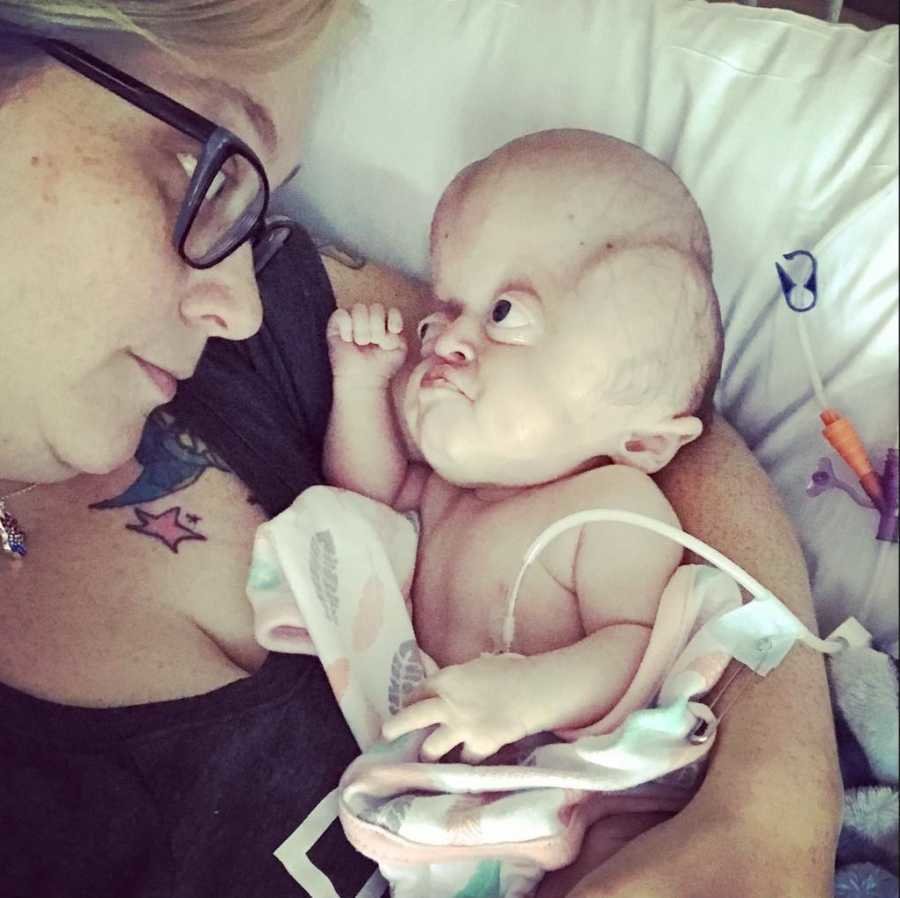
The condition mainly affects the skull. The bones fuse together too early, preventing normal growth. In Emmy’s case, most of the skull sutures had already closed. This also caused shallow eye sockets, which made her eyes appear to bulge outward. Her midface was compressed, narrowing her airway.
For the next 18 weeks, our lives were filled with ultrasounds and doctor appointments. We assembled a team of specialists who would be ready the moment she was born to help manage her breathing.
When the day finally arrived, we were both excited and terrified.
Even though we had prepared ourselves as best as we could, it was still shocking to see Emmy in person.
Her eyes were huge. Her skull was misshapen. The doctors intubated her immediately before I even had time to really look at her.
And yet she had the most beautiful blue eyes and dark hair.
There was a large swelling on the side of her head where cerebrospinal fluid had built up because it wasn’t draining properly. Her hydrocephalus had become severe. My first thought was that it wasn’t supposed to be this bad.
The room was eerily quiet. The nurses barely spoke. Emmy didn’t cry. They rushed her straight to the operating room next door.
Most families only discover Pfeiffer Syndrome at birth, but because we already knew, everyone focused on getting both of us safely through the delivery.
The first four months of Emmy’s life were spent in the hospital.
Those days were long, stressful, and often terrifying. Every day we had to make difficult decisions about her care. We had conversations about quality of life and even discussed DNR paperwork.
There were moments of celebration and moments of heartbreak. We cried, we argued, we prayed, and we fought for her.
Today, Emmy is 18 months old.
She has already undergone around 20 medical procedures and surgeries. Doctors corrected an intestinal malrotation, placed a feeding tube, performed a tracheostomy, and completed three skull surgeries to allow her brain to grow properly.
She still has more surgeries ahead, including a major facial operation to expand her midface.
Despite everything she has endured, Emmy is doing remarkably well—better than many people ever expected.
There have been hospital stays, emergencies, PICC lines, and many sleepless nights filled with worry. But through it all, she continues to smile.
She is growing and developing, even if it’s at her own pace. Her determination is incredible.
She has parents who love her deeply, a brother who absolutely adores her, grandparents who encourage her, and a dedicated team of doctors, nurses, and therapists who give her every opportunity to thrive.
We know Emmy will always look different, and we know that someday she may face people who stare or judge.
Our goal is to make sure she always knows how deeply she is loved and to give her the confidence to become anything she dreams of being.
By sharing her story, we hope that in the future she receives fewer stares—and more invitations that simply say, ‘Let’s play.’””
