
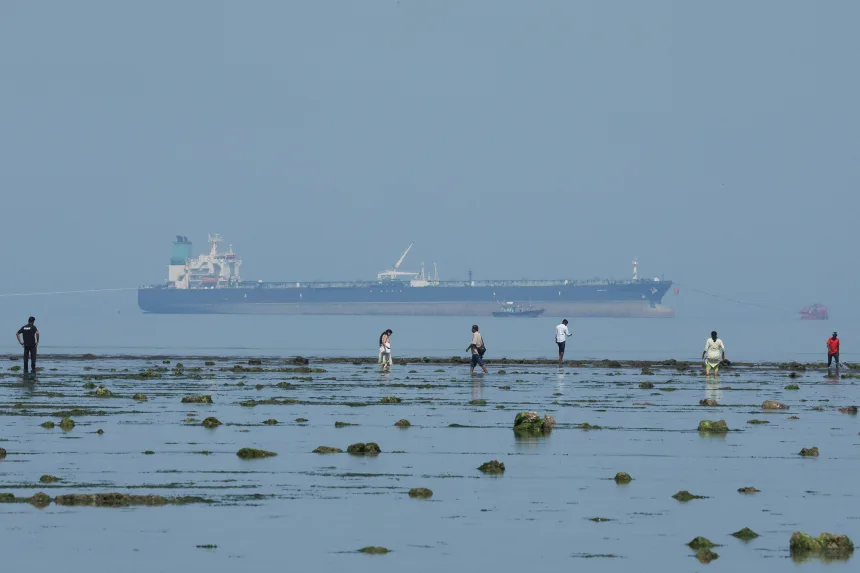

High oil prices are boosting the Kremlin’s coffers, helping plug a hole in its federal budget and sustain the war effort in Ukraine. But beyond oil, a global scramble for natural gas and fertilizer supplies — also choked off by the Iran conflict — could further boost Russia’s financial gains.
“The biggest winner of the (Iran) conflict is Russia,” said Ben Cahill, a senior associate at the Center for Strategic and International Studies (CSIS), a think tank in Washington, DC. The Kremlin can now sell previously discounted Russian crude “at full market prices,” marking “a pretty big turnaround” for the economy, he added.
The windfall for Russia’s public finances comes at a crucial moment. Before the Iran war, “Russia was heading toward a genuine budget crisis,” said Alexandra Prokopenko, a fellow at the Carnegie Russia Eurasia Center, a Russia-focused research institute in Berlin. Although the latest Middle East conflict has not fundamentally changed the outlook for an economy structurally damaged by a drawn-out war, it has “bought time,” she told CNN.
Quite how much time depends on how long the Iran war lasts, but higher oil prices have already brought some relief. Russia’s finance ministry signaled that spending cuts previously expected for this year will now be pushed out to 2027, Prokopenko added.
By mid-March, the price of Russian Urals crude stood at $90 a barrel, twice as high as in February, according to Sergey Vakulenko, a senior fellow at the Carnegie Russia Eurasia Center. Even a smaller increase, of $30 a barrel, seen earlier in March, meant $8.5 billion of additional revenue per month, “$5 billion of which goes into state coffers and the rest – to oil companies,” he wrote in a note this week.
Oil and natural gas revenues account for roughly a quarter of Russia’s federal budget, and they are key to funding its “war machine in Ukraine,” said Simone Tagliapietra, a senior fellow at Brussels-based think tank Bruegel. “This spells bad news for Ukraine.”
A dramatic turnaround
Before the Iran war, the pool of buyers for Russian oil was shrinking and customers were demanding steep discounts, thanks to stricter sanctions from the European Union and Washington. The White House also penalized India, one of the biggest buyers of Russian crude in recent years.
That pressure was working. Exports of Russian crude and oil products plunged to 6.6 million barrels a day in February, their lowest level since the start of the 2022 invasion of Ukraine, according to the International Energy Agency. Export revenues plunged by about 30% that month compared with a year earlier.
The Iran war has since brought about drastic change, thanks in part to a stark reversal of the Trump administration’s previous position on Russian oil. Earlier this month, the United States temporarily eased sanctions on seaborne Russian crude to “enable oil to keep flowing into the global market.”

Russian shipments to India are on course to nearly double in March, compared with February, as Indian refiners ramp up purchases to offset a fall in oil supply from the Middle East, according to Kpler, a real-time data and analytics provider.
Natural gas and fertilizers
The Middle East conflict could also deliver other financial and strategic gains to the Kremlin.
The Strait of Hormuz is a critical transit route not just for oil, but also liquefied natural gas, fertilizers, helium and aluminum – all of which Russia produces in vast quantities.
As the world’s second-largest fertilizer exporter, Russia is already getting “more and more” orders, with importers in Nigeria and Ghana pre-purchasing shipments for the third quarter of this year, according to Prokopenko.
“Once established, these connections will solidify into a dependency that could outlast any ceasefire,” she noted this week.
Russia is also the world’s second-largest producer of natural gas, behind only the United States. Already, there is some speculation that the European Union could delay the timeline for phasing out Russian natural gas. Some imports are due to be prohibited as early as next month, with November 2027 currently set as the deadline to stop all Russian imports.

This points to another potential strategic win for Russia, said Tatiana Mitrova, a fellow at the Center on Global Energy Policy at Columbia University. Here, too, lifting US sanctions on some Russian oil is symbolic, opening the door for the Kremlin to renegotiate with the United States for longer-term concessions, she told CNN.
India, China rethink Gulf imports
If India and China reduce their dependence on fossil fuels from the Middle East, they may increasingly turn to Russian imports instead, according to Vakulenko of the Carnegie Russia Eurasia Center. And that could strengthen the case for some large-scale infrastructure projects, which would deliver another boost to the Russian economy.
For example, China was previously reluctant to commit to Russia’s proposed Power of Siberia 2 natural gas pipeline project. Now, Beijing might be more willing, Vakulenko wrote in his note this week.
“A safe overland route for gas, impervious to (Strait of Hormuz) closures and naval blockades, is starting to look more attractive than it did even six months ago,” he wrote.
A major expansion of the Eastern Siberia-Pacific Ocean pipeline, currently capable of transporting 1.6 million barrels of oil per day from Russia to Asia, suddenly also “starts to make a lot of sense” for both Russia and China.
However, Asia’s renewed appetite for Russian fossil fuels may not last. The energy shock from the Iran war will push China and India to double down on home-grown renewables and even coal, argued Mitrova of Columbia University. The world’s two most populous economies “will do everything to reduce their import dependency,” she said.
Russia is also not immune to a broader rise in shipping costs and prices of traded goods as a result of the Iran war. The Organisation for Economic Co-operation and Development on Thursday increased its forecast for headline inflation in Russia, which includes food and energy prices, this year by a percentage point to 6%.
The OECD expects Russia’s economy to grow by 0.6% this year, compared with 1% in 2025. The forecast decline highlights that windfall revenues in the short term are not a durable solution for Russia’s economy. The Kremlin’s economic woes are multiplying with its years-long war, which has added to government debt and dampened business investment.
