
Scientists Scramble as the James Webb Space Telescope Detects Something So Strange It Could Rewrite the Universe
The internet thrives on dramatic headlines, but every so often a telescope truly does reveal something that feels almost unimaginable.
That is precisely what has happened since the launch of the James Webb Space Telescope.
When the telescope first began sending back images from deep space, scientists expected remarkable discoveries. What they did not anticipate was how quickly the data would begin to challenge long-standing ideas about the early universe. Within just months of operation, Webb started detecting galaxies that appeared far older, far brighter, and far more massive than many theories predicted. That revelation alone sent shockwaves through the astronomy community.
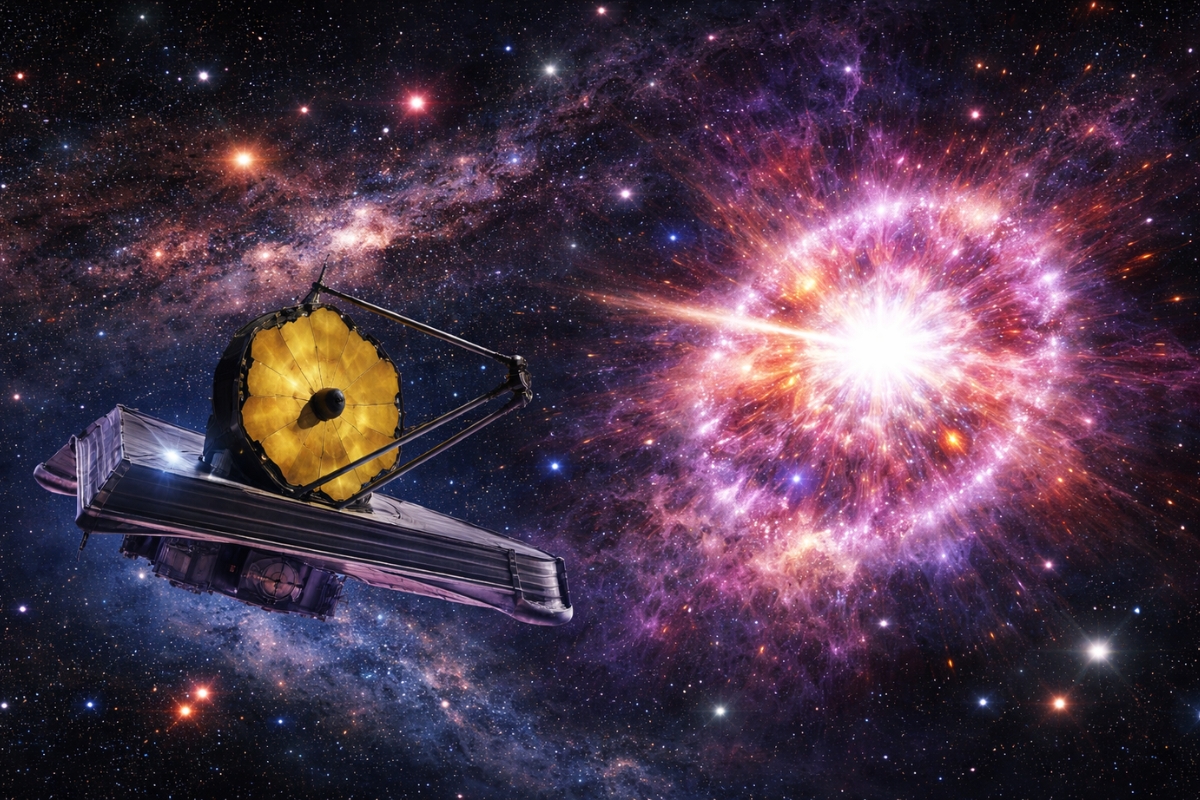
For decades, astronomers believed that the earliest galaxies formed slowly after the Big Bang. The prevailing view held that small clouds of gas collapsed first, gradually merging into larger galaxies over hundreds of millions of years. But Webb’s observations told a different story.
Massive galaxies were already shining in the darkness of the young universe far earlier than expected. Some appeared only a few hundred million years after the Big Bang—practically an instant in cosmic time.
One of the most startling findings involved surprisingly mature galaxies detected at extreme distances. These systems looked fully developed long before many models suggested they should exist. Astronomers were stunned. One researcher described it as “finding a fully grown city where we expected only small villages.”
Webb’s power lies in its infrared instruments, which allow it to peer through cosmic dust and observe extraordinarily distant objects. Because light takes time to travel, looking far into space also means looking back in time. In effect, Webb functions as a time machine aimed at the universe’s earliest moments.
When astronomers examined galaxies forming shortly after the Big Bang, they expected faint, chaotic structures. Instead, they found galaxies that appeared surprisingly organized. This does not mean the laws of physics are broken—but it does suggest that scientists may need to revise models describing how quickly galaxies can grow.
Some researchers now think stars may have formed far more rapidly in the early universe than previously believed. Others suspect that early galaxies merged together at a much faster pace. There is also growing interest in the role of dark matter, whose invisible gravitational pull helps draw normal matter into galaxies. If dark matter behaved differently in the universe’s earliest epochs, it could help explain why these massive structures formed so quickly.
Another intriguing area of discovery involves the universe’s first generations of stars. Astronomers have long searched for evidence of so-called Population III stars—the very first stars formed after the Big Bang. These stars would have been enormous, intensely hot, and composed almost entirely of hydrogen and helium. While direct evidence remains elusive, Webb has detected chemical signatures suggesting that early star formation was already enriching galaxies with heavier elements much sooner than expected. That implies the cosmic processes that eventually make planets—and life—may have begun earlier than once thought.
Then there are the images themselves.
Webb has produced some of the most detailed views of the universe ever captured: vast galaxy clusters, glowing stellar nurseries, and distant structures never before observed. Each image contains thousands—sometimes tens of thousands—of galaxies, each home to billions of stars. The sheer scale is enough to make anyone pause and reconsider their place in the cosmos.
One particularly famous image, often called a “deep field,” shows a tiny patch of sky crowded with ancient galaxies, many of which existed when the universe was less than a billion years old. Telescopes like the Hubble Space Telescope had glimpsed some of these distant objects before, but Webb’s infrared vision reveals them with unprecedented clarity. As the universe expands, light from distant galaxies stretches into longer wavelengths, shifting into the infrared—exactly where Webb excels.
And the discoveries are far from over.
Scientists are also using Webb to study the atmospheres of distant exoplanets, detecting molecules such as water vapor, methane, and carbon dioxide. These observations could one day help identify worlds capable of supporting life.
For now, however, the greatest surprise remains how quickly the early universe appears to have built complex structures. Some scientists argue that existing theories are not broken, but incomplete. Others acknowledge that certain assumptions about galaxy formation may need to be rethought.
This is how science advances.
Whenever new technology allows humanity to see farther than ever before, surprises are inevitable. The James Webb Space Telescope has opened an entirely new window onto the universe—and with every new observation, the cosmos reveals something unexpected.
So did Webb confirm something truly “unimaginable”?
Not in the sensational way viral headlines suggest. But it did reveal that the universe may have grown up much faster than we once believed.
And in cosmology, that realization is nothing short of extraordinary.
Because the deeper we look into space, the clearer it becomes how much we still have to learn about the origins of everything.
