
The Signal 3I/ATLAS Sent as It Passed Jupiter
A Science-Fiction Examination of an Unacknowledged Anomaly**
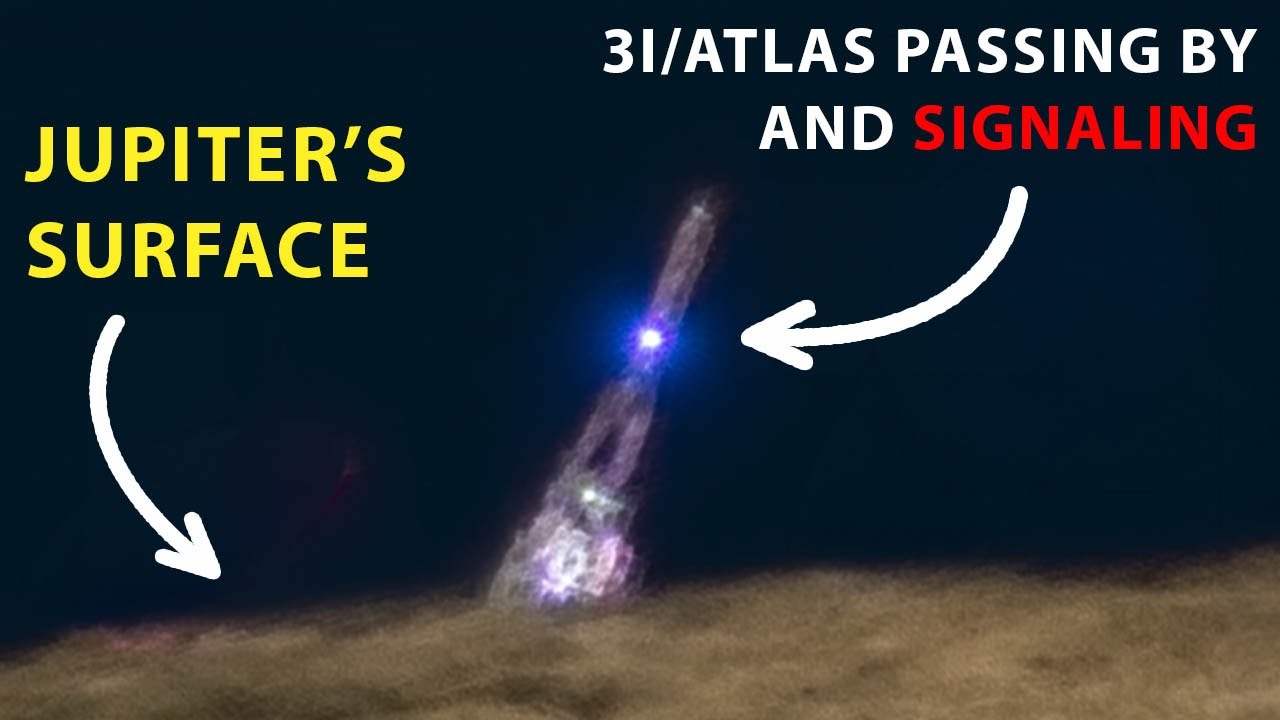
On October 2, 2025, as the interstellar object known as 3I/ATLAS passed through the outer regions of the Solar System near Jupiter, a series of events unfolded that—within speculative analysis—raised questions about transparency, data gaps, and the limits of current planetary science. Official records confirm that imagery was captured. What followed, however, was an unusual absence of public acknowledgment.
This absence coincided with a U.S. government shutdown, interruptions to routine communications, and growing discrepancies between publicly released summaries and claims circulating among independent analysts. The result was not proof of concealment, but a fractured information timeline—one in which interpretation rushed to fill the vacuum left by silence.
This investigation begins at that fracture point.
The Discovery of 3I/ATLAS
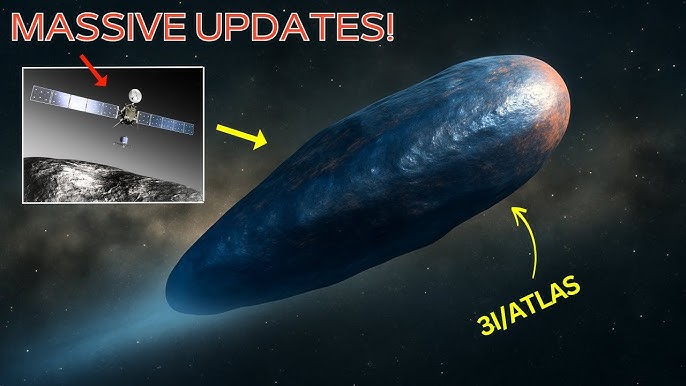
On July 1, 2025, an automated telescope associated with the ATLAS Survey operating in Chile detected a fast-moving object that did not conform to bound Solar System trajectories. Within hours, the Minor Planet Center logged over one hundred observations.
The object—initially cataloged as C/2025 N1 and later designated 3I/ATLAS—was confirmed to be the third known interstellar object detected passing through the Solar System. Its hyperbolic trajectory indicated that it was not gravitationally bound to the Sun and would not return.
At this stage, the discovery followed standard procedure: detection, confirmation, designation, and public logging.
Nothing appeared unusual.
The Imaging Attempt and the Communication Gap
As 3I/ATLAS approached a favorable observational geometry in early October, attention turned to direct imaging. According to mission planning records, the Mars Reconnaissance Orbiter was temporarily tasked with attempting a long-range observation—an uncommon but not unprecedented maneuver.
At distances exceeding tens of millions of kilometers, even large objects reduce to faint, fast-moving points of light. A short exposure was used to avoid motion blur. The resulting image, as expected, was limited in resolution.
Shortly afterward, routine public updates from NASA slowed dramatically due to the federal shutdown. Outreach, social media, and press briefings were suspended. No follow-up imagery was discussed.
The silence created space for speculation.
The Official Explanation: Data Quality Limitations
When processed imagery was eventually released, NASA described the data as inconclusive, citing noise, jitter, and signal degradation. The object appeared as a diffuse streak—consistent with expectations for a distant, fast-moving interstellar body observed outside the instrument’s primary design parameters.
To mission engineers, this explanation was unremarkable.
To the public, it felt unsatisfying.
Where Speculation Entered
Independent analysts reviewing orbital solutions noted minor non-gravitational accelerations—effects already observed in earlier interstellar objects and typically attributed to asymmetric outgassing or radiation pressure.
Within speculative frameworks, however, these deviations were interpreted differently: not as physical irregularities, but as intentional trajectory adjustments. Such interpretations went well beyond available evidence, but gained traction in the absence of continuous official commentary.
A member of Congress reportedly requested access to raw observational data—an action that, while not unusual in oversight contexts, was interpreted online as confirmation that something was being withheld.
No documentation publicly confirms that the request revealed suppressed findings.
The Jupiter Passage and the “Signal” Hypothesis
As 3I/ATLAS passed near Jupiter’s orbital region, some researchers monitoring radio and magnetic data proposed the possibility of transient electromagnetic anomalies. Within speculative science fiction analysis, these were reframed as a signal—a brief interaction between the object and the Jovian magnetosphere.
In reality, Jupiter’s immense magnetic field produces constant, complex emissions that frequently complicate deep-space measurements. Correlation does not imply causation.
Still, in narrative extrapolation, the idea took hold: that the object may have used Jupiter’s environment as a natural amplifier or reference point—less a transmission, more a calibration event.
Silence as a Catalyst, Not Proof
The most powerful element of the 3I/ATLAS story is not any single dataset, but the psychological effect of interrupted communication. When institutions pause—even for mundane reasons—interpretation accelerates.
NASA’s lack of acknowledgment does not confirm censorship. It confirms only that the object behaved interestingly enough to hold attention during a moment when official voices were quiet.
A Broken Timeline, Not a Broken Science
Within disciplined speculative analysis, the story of 3I/ATLAS is not evidence of extraterrestrial technology—but a case study in how interstellar objects challenge expectations. Their unfamiliar chemistry, velocity, and origin naturally strain models designed around Solar System norms.
Science did not fail here.
Narrative filled the gaps where data ended.
What Remains True
3I/ATLAS was a confirmed interstellar object
Imaging attempts were technically difficult and yielded limited results
Public communication slowed due to external political factors
The object exhibited minor non-gravitational behavior consistent with known physics
Everything beyond that resides in interpretation.
Why the Story Persists
3I/ATLAS matters not because it was proven artificial—but because it arrived at a moment when humanity is newly aware of how common planets, organic chemistry, and stellar migration truly are.
Interstellar visitors are no longer unthinkable.
They are expected.
And when expectation meets uncertainty, imagination rushes in.
Conclusion
Within science-fiction logic, the silence surrounding 3I/ATLAS becomes symbolic: not of concealment, but of transition. Humanity is entering an era where objects from other star systems are no longer rare—and where the boundary between natural and artificial may not always be immediately clear.
The unanswered question is not what NASA is hiding.
It is whether we are ready for a universe that no longer behaves according to familiar patterns.
And 3I/ATLAS, signal or not, passed through that realization like a quiet messenger—leaving behind more questions than answers.
